

By 2027, we plan to expand our research team with three additional analysts.
The objective is not simply to publish more editions. We want to improve the quality and depth of our research, follow existing investment theses more closely, and begin covering markets that we have not yet explored in sufficient detail.
One of those markets is China’s AI infrastructure industry.
AI infrastructure in the United States and Europe has already been extensively documented, both by Macro Notes and by many other independent researchers on Substack.
Over the past year, we have covered several parts of this investment opportunity.
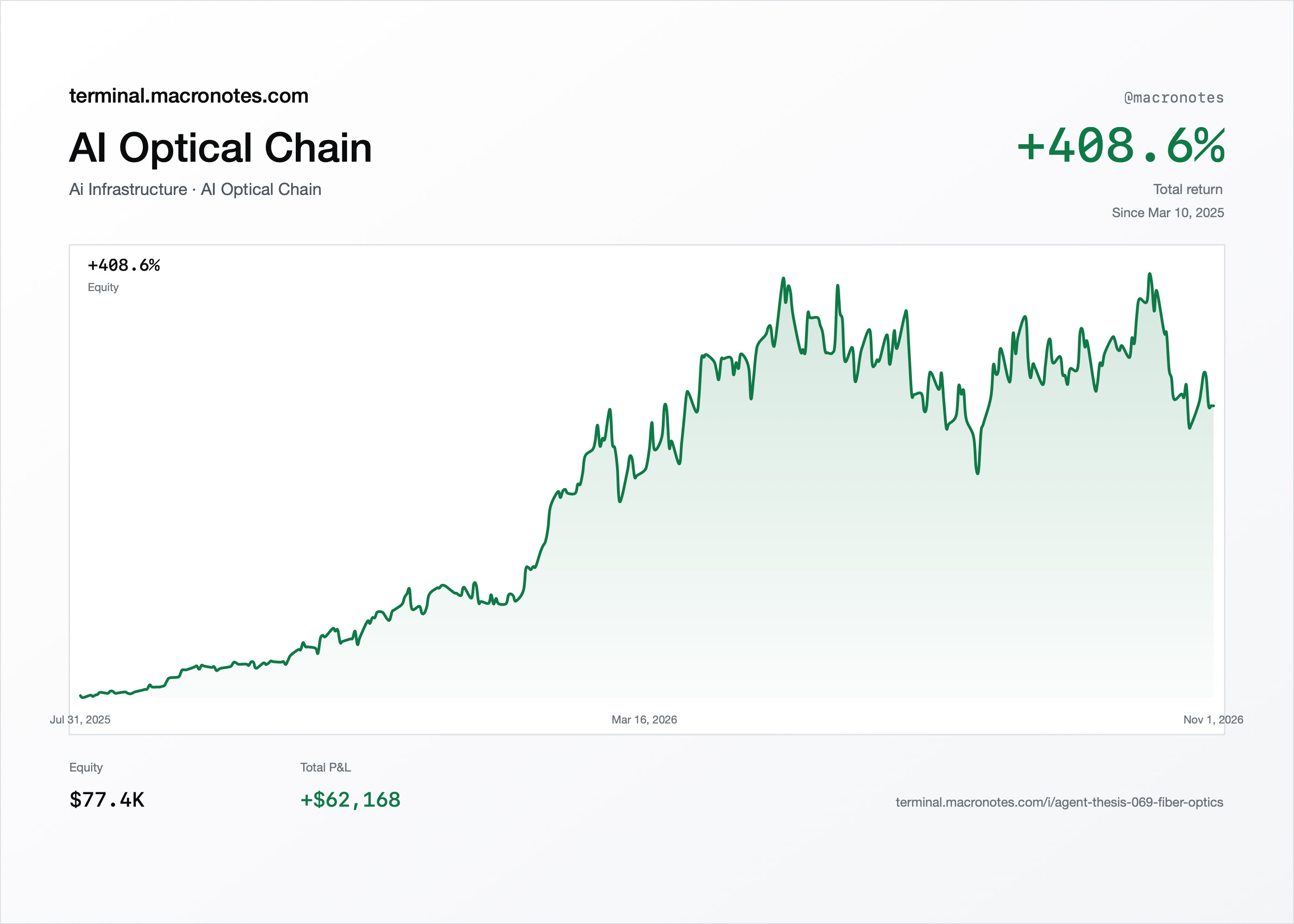
In July, we published The $73 Billion Fiber Optics Thesis, exploring how the growing computing requirements of AI data centers were creating demand for optical networking infrastructure.
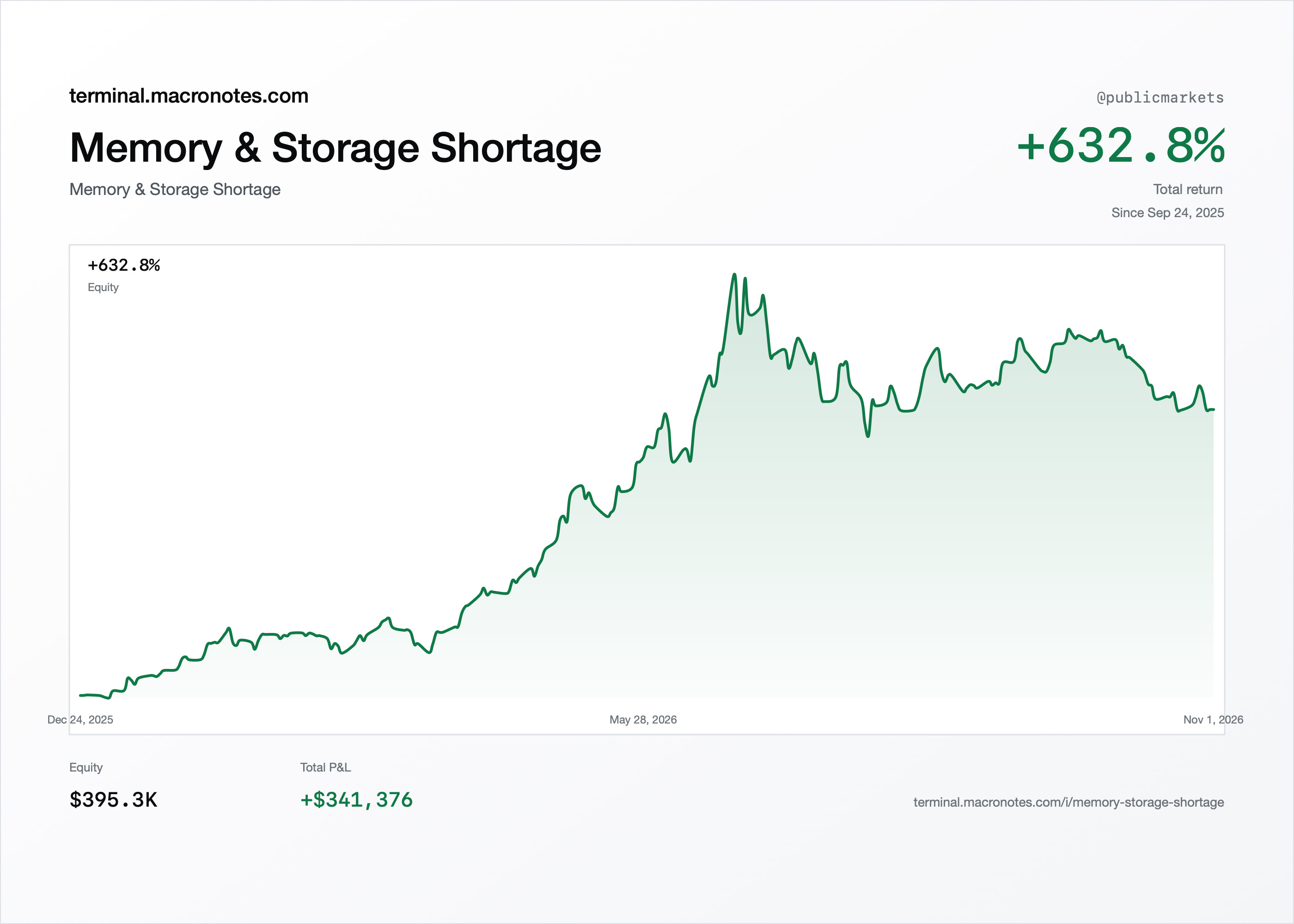
On our secondary newsletter, Public Markets, we also documented the emerging shortage of memory and storage capacity.
On August 2, we published The Overlooked AI Shortage Behind a +516.8% Portfolio, explaining the economic mechanisms behind the shortage and the companies positioned to benefit.
Just over two weeks later, on August 18, we returned to the thesis after the portfolio had appreciated significantly, publishing Our Memory Shortage Portfolio Is Now Up 829% — What Happens Next?.
We have also been following another aspect of AI infrastructure that I believe deserves considerably more attention: AI sovereignty.
Rather than focusing exclusively on the infrastructure needs of private companies, hyperscalers, and AI laboratories, we started examining the requirements of governments seeking to develop or secure their own computing capacity.
We explored this development in The $600 Billion Sovereign AI Race, and more recently in The $600 Billion AI Sovereignty Paradox.
The distinction is important because AI infrastructure spending is no longer driven exclusively by the commercial ambitions of technology companies. National security, industrial policy, data sovereignty, and strategic independence are increasingly influencing where computing infrastructure is built and who supplies it.
For Macro Notes, AI infrastructure has also been one of our most successful areas of investment research.
Several of our strongest-performing indexes on Macro Notes Terminal have been built around opportunities emerging from the expansion of AI infrastructure.
And from what we have observed, this is also one of the main reasons many readers decide to subscribe to Macro Notes Premium.
AI Optical Chain
Memory & Storage Shortage
Sovereign AI Compute
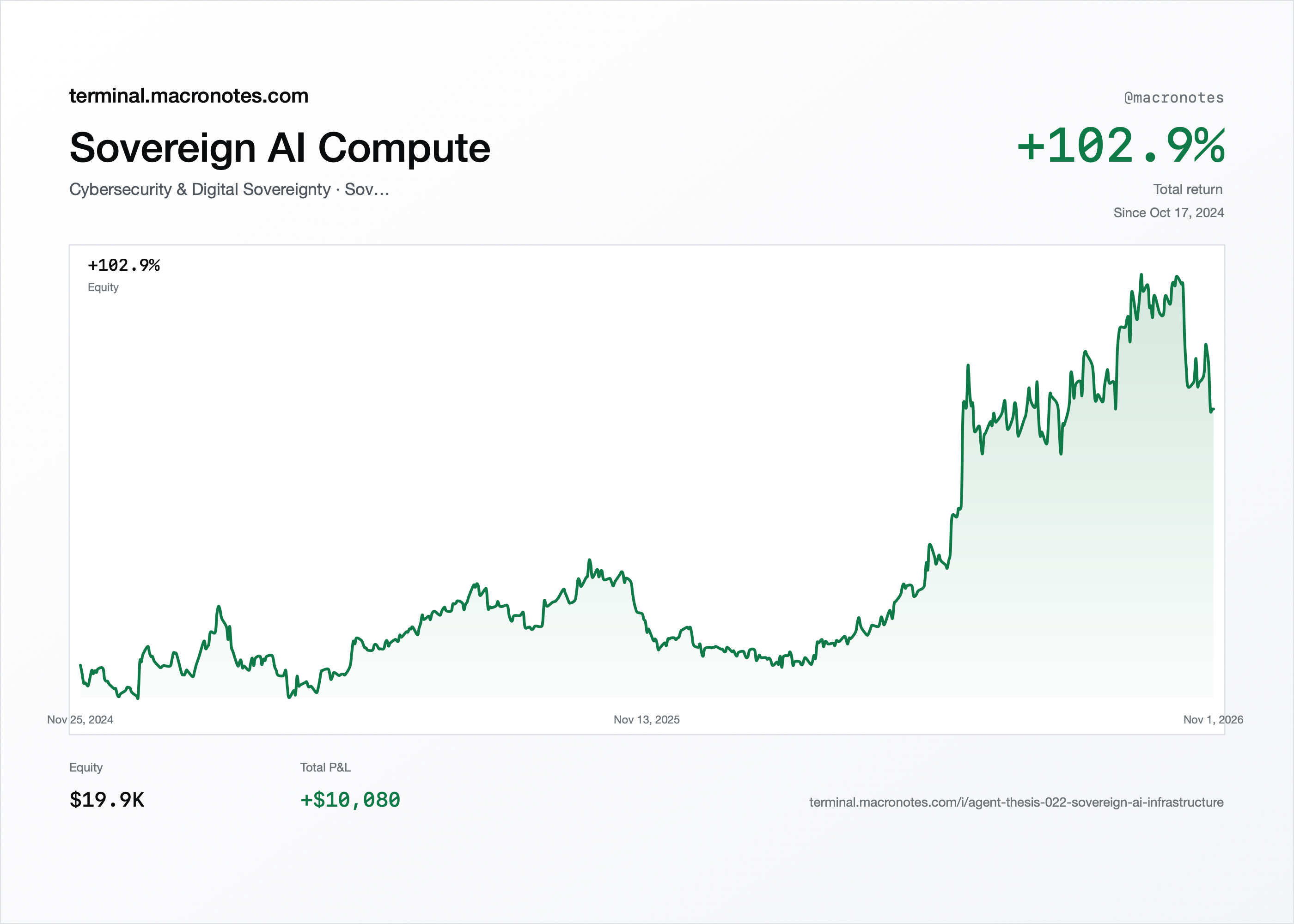
What interests me most is not simply how much these indexes have appreciated. It is that each began with an identifiable economic change, followed a particular part of the value chain, and continued evolving as new information became available.
However, I also want to clarify our current position on AI infrastructure.
Over the past month, we have been reducing exposure across most of the AI infrastructure-related indexes we track on Macro Notes Terminal, as we believe the risk of a significant market correction has increased.
This does not mean we have become bearish on the long-term fundamentals of AI infrastructure. Quite the opposite. We continue to believe that structural demand for computing capacity, memory, networking equipment, and supporting infrastructure remains strong.
Our concern is primarily about valuations. Following the extraordinary appreciation of many AI-related stocks, we believe parts of the market are now pricing in expectations that may be difficult to justify, even if the underlying businesses continue performing well.
We are not predicting the collapse of an AI bubble or the end of the AI investment cycle. We simply believe that a substantial valuation correction is increasingly likely after such an exceptional period of market performance.
There is an important difference between believing in the long-term growth of an industry and believing that its companies remain attractive investments at any price.
For us, following an investment thesis also means knowing when to reduce exposure, even when the underlying economic opportunity remains intact.
This is precisely the type of research and ongoing investment analysis we want to continue developing.
Why we want to expand our coverage to China
There is, however, an important part of the global AI infrastructure market that we have not documented nearly as extensively: China.
Until now, most of our work has focused on the infrastructure investment cycle in the United States and Europe, where we could follow the spending of major hyperscalers, examine suppliers through their financial disclosures, and build investment theses around identifiable industrial constraints.
China requires a different research approach.
Its AI infrastructure industry is developing under different economic, technological, and political conditions. Government procurement, domestic semiconductor development, export restrictions, state-owned infrastructure operators, and national industrial policy all influence how investment flows through the value chain.
That makes the market more difficult to analyze using the same framework we apply to American technology companies.
But it also makes it particularly interesting.
According to figures published by Chinese authorities, the country’s intelligent computing capacity increased by approximately 177% year over year as of June 2026.
At the same time, restrictions on access to advanced foreign semiconductors have accelerated the development of domestic alternatives. Chinese companies are attempting to build an increasingly independent ecosystem of accelerators, memory, networking equipment, software, and computing infrastructure.
The investment implications could be considerable.
If China continues expanding its domestic AI infrastructure, the beneficiaries may be very different from those we have identified in the American market.
A company that benefits from Nvidia’s dominance in the United States might have little exposure to the Chinese market. Conversely, domestic manufacturers could gain access to demand that would otherwise have gone to foreign suppliers.
The constraints may also be different.
In the United States, we have spent considerable time studying electricity availability, cooling requirements, optical networking, and the supply of advanced semiconductors.
In China, some of these constraints remain relevant, but domestic manufacturing capabilities, policy-driven procurement, technology substitution, and the economics of locally produced AI accelerators create additional questions.
Which parts of China’s infrastructure supply chain are becoming strategically important? Where could domestic suppliers gain pricing power? Which listed companies have meaningful exposure to this investment cycle? And how much of the announced investment will ultimately translate into profitable business?
We also have to examine the risks. Government support does not automatically produce attractive shareholder returns, and differences in disclosure, capital allocation, competitive intensity, and investor access can materially change the investment case.
These are questions worth investigating independently rather than simply applying our existing American AI investment theses to a different market.
Our objective is to understand China’s AI infrastructure economy on its own terms, identify the companies positioned to benefit, and determine whether the opportunities are financially attractive at current valuations.
Expanding the team will allow us to dedicate more resources to this work without reducing the attention we give to our existing research.
Introducing Macro Notes Research & Models
Alongside this expansion, we are also introducing a new research format.
You can now explore it on our website:
Macro Notes Research & Models — Explore our research agenda
Over the past year, I have been thinking about how we could make our most extensive research available to individual investors without compromising the work we already publish through Macro Notes Premium.
The newsletter is an effective format for introducing an investment thesis, explaining the economic mechanisms behind it, identifying potential beneficiaries, and publishing updates as the situation evolves.
Macro Notes Terminal complements that work by allowing subscribers to follow the indexes and portfolios associated with each thesis.
But some subjects deserve a substantially deeper investigation.
Understanding an entire industry often requires more than a written analysis or a portfolio of publicly traded companies. It requires mapping supply chains, collecting financial and operational data, estimating the size of individual markets, comparing business models, and testing how different scenarios could affect the companies involved.
That is what we want to introduce with Macro Notes Research & Models.
Each month, we will select an investment thesis that we consider particularly promising and develop a comprehensive research project around it.
Each project will combine a detailed report with original datasets and editable analytical models, giving investors access to the underlying research rather than simply presenting our conclusions.
The research will be distributed to Macro Notes Founding members, with the supporting data and models updated as important new information becomes available.
The idea is to create resources that investors can return to as an industry evolves, rather than publications they read once.
Our first Research Model: The Space Economy
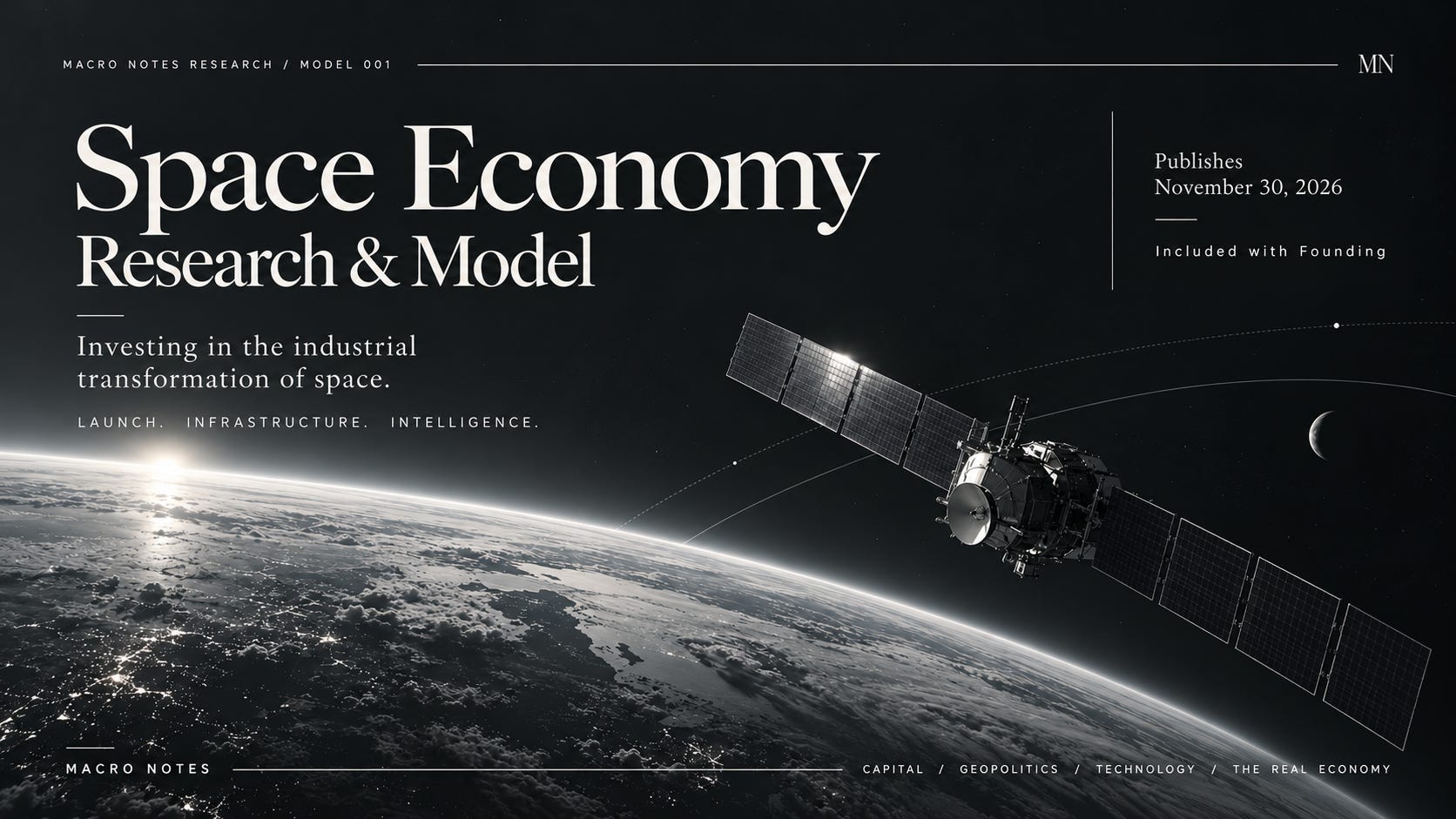
Another area that has attracted considerable interest from our Premium readers is the space economy, alongside European defense.
We have published several editions exploring SpaceX, the development of its surrounding industrial ecosystem, and the ways investors could gain exposure to its growth before its IPO.
The subject extends far beyond SpaceX itself.
Lower launch costs, reusable rockets, satellite communications, Earth observation, defense infrastructure, and the convergence of artificial intelligence with space technologies are gradually changing the economics of an entire industry.
But understanding that transformation does not necessarily tell us which companies will generate the greatest financial value.
That requires a deeper investigation into how the industry operates, where its revenues and profits are likely to concentrate, and which businesses are positioned to capture them.
We have therefore started building our first comprehensive research project dedicated to the space economy.
Space Economy Research & Model is scheduled for publication on November 30, 2026, and will be included exclusively with Macro Notes Founding.
Explore the Space Economy Research & Model
The project will examine seven interconnected markets within the space economy and build a research universe of more than 30 publicly traded companies.
We are developing several analytical resources, including a map of SpaceX’s supplier ecosystem, a database of publicly traded space companies, a model examining the economics of SpaceX and Starlink, and scenario models for the industry’s emerging markets.
We will evaluate which companies have meaningful exposure to these developments, how that exposure could translate into revenue and profitability, and whether their current valuations provide attractive investment opportunities.
The objective is to move beyond the idea that the space economy could become a trillion-dollar industry and investigate where that economic value could actually be captured, by whom, and under what conditions.
Bringing institutional-style research to Founding members
With this new format, we are introducing a level of research much closer to the work we normally produce for institutional clients.
Our commissioned research projects generally start at $5,000, with the final price depending on the scope of the investigation, the required datasets, and the analytical models involved.
These projects are developed around a specific question selected by the client.
For Macro Notes Founding members, we are taking a different approach.
For $1,500 per year, Founding members will receive twelve Research & Models publications, alongside their existing membership benefits.
Unlike an institutional client commissioning a dedicated investigation, Founding members will not choose the subjects individually. We will select the opportunities ourselves, concentrating on the investment themes that already attract our readers to Macro Notes.
By developing each research project for our entire Founding community, rather than for a single client, we can distribute the research costs across the membership and make this level of analysis considerably more accessible.
This is not intended to replace Macro Notes Premium, which will continue publishing our regular investment research and providing access to Terminal.
The Founding program is designed for readers who want to go beyond identifying promising investment theses and examine their underlying economics in much greater detail.
What Founding members will receive
To illustrate what this means in practice, imagine we are examining the growth of a particular segment of the nuclear industry.
A conventional research article might explain why demand is increasing, which companies could benefit, and what factors investors should monitor.
Our Research Model would go further.
We could build a database of existing production capacity, planned projects, capital requirements, supply contracts, and the companies exposed to different parts of the industry.
From that information, we could develop an analytical model estimating how changes in demand, prices, production capacity, or government spending might affect the revenues and profitability of those businesses.
Rather than simply presenting our conclusions, readers would be able to change the assumptions themselves and examine how the results evolve.
For example, what happens to the economics of a uranium producer if prices increase but production costs rise at the same time? How much additional revenue could a supplier generate if several planned nuclear projects move forward? And what level of future growth is already reflected in a company’s current valuation?
These are the types of questions we want our models to help answer.
This is where I believe the greatest value lies.
An investment thesis can sound convincing without being financially attractive. An industry can grow considerably while the companies operating within it struggle to generate acceptable returns on invested capital.
Similarly, a company can benefit from an important structural trend while its valuation already reflects expectations that are extremely difficult to achieve.
By connecting industry data to financial models and company valuations, we want to make these distinctions easier to investigate.
We will also document the principal risks, catalysts, and developments that could invalidate the original thesis, so readers can understand not only what might go right but also what would need to change for the investment case to become less attractive.
The objective is not simply to provide a list of companies to buy.
It is to give investors the research, data, and analytical tools needed to develop, challenge, and refine their own investment conclusions.
The investment opportunities we want to investigate next
The space economy will be our first Research Model, but it represents only the beginning of the program.
Over the coming months, we also plan to investigate several other industries in greater depth.
Nuclear energy will remain an important area of interest, particularly the industrial constraints surrounding fuel production, enrichment, new reactor technologies, and the infrastructure needed to expand nuclear capacity.
We will also continue studying autonomy and robotics, sometimes described as physical AI, where advances in artificial intelligence could progressively transform manufacturing, logistics, transportation, and other labor-intensive activities.
Neurotechnology is another industry we want to investigate more closely, particularly the development of brain-computer interfaces, neuromodulation, and the possible economic consequences of new human-machine interfaces.
And, of course, AI infrastructure will remain one of our central research areas, with a broader geographical perspective that increasingly includes China.
These subjects have something in common.
They are not simply industries benefiting from a temporary increase in investor attention. They are areas where technological progress, capital investment, demographic changes, or geopolitical priorities could produce important structural transformations over the coming decade.
That does not mean every industry will develop as expected, or that every company exposed to these trends will become a successful investment.
Some markets will take longer to develop than investors expect. Others may grow rapidly without generating attractive profits for shareholders. And in some cases, the companies that initially appear best positioned may eventually lose their advantage.
This is precisely why we want to invest more resources in the research.
We are not trying to cover every industry or publish an opinion on every market development.
We want to concentrate our work on the investment opportunities that could matter most over the next decade, particularly those where changes in the global economy may create substantial new markets, reshape established industries, or generate opportunities that are not yet fully understood by investors.
Expanding our research team, improving Macro Notes Terminal, and introducing monthly Research & Models are all part of the same objective.
To move beyond identifying promising investment themes and develop the research necessary to understand how those themes could translate into financial opportunities.
That is the direction we want to take Macro Notes in 2027.
Go Further With Macro Notes Founding
Starting November 30, Macro Notes Founding members will receive our first Space Economy Research & Model, followed by a new in-depth research project every month.
Each publication will include institutional-style research, original datasets, and financial models designed to help you investigate investment opportunities in greater depth.
For $1,500 per year, you’ll receive all 12 Research & Models publications, alongside every benefit of Macro Notes Premium and Terminal.
If you want access to our most comprehensive research and the analytical tools behind it, consider becoming a Founding member.
Explore Macro Notes Founding & Research Models
MacroNotes.com Team