

Whenever a new market emerges, most of the attention goes to the product people can see.
But some of the first companies to capture meaningful economic value are often those supplying the infrastructure that makes the market possible.
The market usually recognizes the trend before it correctly prices all of its consequences.
Artificial intelligence is perhaps the clearest recent example.
AI existed long before ChatGPT, but the mass adoption of large language models fundamentally changed the amount of computing infrastructure the industry required. We are now entering another chapter as AI moves from answering questions to operating through agents capable of executing increasingly complex tasks.
The first and most obvious infrastructure winner was Nvidia.
In the third quarter of its 2023 fiscal year, Nvidia generated $3.83 billion in quarterly Data Center revenue. By the fourth quarter of fiscal 2026, that figure had reached $62.3 billion—more than sixteen times higher in just over three years.
But GPUs were only the first bottleneck.
Once companies secured the chips, they needed servers capable of deploying them at scale. Dell subsequently closed more than $64 billion in AI-optimized server orders during fiscal 2026, shipped more than $25 billion, and entered the following year with a $43 billion backlog.
Then the constraint moved again.
Thousands of accelerators had to be connected. That increased demand for optical components, high-speed networking, switches and fiber—the infrastructure behind the fiber-optics thesis we have covered extensively in Macro Notes.
More compute also produced more heat, creating demand for liquid-cooling systems, heat exchangers and specialized data-center equipment. The electrical infrastructure surrounding the servers became equally important: transformers, switchgear, copper, gas turbines and access to reliable power.
According to the International Energy Agency, global data-center electricity consumption reached approximately 485 terawatt-hours in 2025 and could rise to roughly 950 terawatt-hours by 2030. Electricity consumption from AI-focused data centers alone is expected to triple over that period.
Amazon, Microsoft, Alphabet, Meta and Oracle collectively invested approximately $427 billion in capital expenditure in 2025. Their combined spending was projected to reach roughly $560 billion in 2026—an increase of around 30% in a single year.
That capital is no longer flowing exclusively toward chips. It is moving through the entire physical chain required to turn those chips into usable computing capacity.
This is the part of emerging markets that interests me most.
And the same sequence may now be beginning again—but this time, the next major buyers of AI infrastructure may not be technology companies. They may be governments.
Start with the market, not the stock
The most effective way to invest in a structural change is often to begin with the emerging market itself, map its entire value chain, and identify the products or services whose demand will increase much faster than the market currently expects.
The objective is not simply to find a company associated with a popular theme.
It is to understand where the next bottleneck is likely to form.
A useful infrastructure supplier generally combines several characteristics:
Demand for its product is accelerating because of a structural—not temporary—change.
Its product represents a small cost for the customer but is essential to the final system.
Supply cannot immediately adjust to demand.
The company possesses technical expertise, manufacturing capacity or customer relationships that are difficult to replicate.
Its valuation still reflects the previous market rather than the one now emerging.
Being unknown is not enough. Being strategically necessary while still being valued as an ordinary supplier is much more interesting.
This is how we approached Nvidia and the semiconductor ecosystem. It is also how we identified opportunities in fiber optics, cooling, memory, power generation and semiconductor-testing equipment.
But identifying a promising value chain is only the beginning.
The more difficult question is whether the original thesis remains valid six months, one year or three years later.
Demand can move to a different part of the chain. A company can lose its technological advantage. Management can introduce governance risk. A strong operating story can be undermined by excessive debt or an unsustainable valuation.
A good thesis should therefore be treated as a living hypothesis—not as a permanent conviction.
Turning investment theses into portfolios
For more than two years, this has been one of the central methodologies behind Altis Research.
Instead of building portfolios around broad sectors, we build them around specific investment theses.
Each portfolio begins with a simple hypothesis about how a market is changing. We then identify the companies positioned to capture the resulting value, document the initial positions, and continue updating the portfolio as new evidence appears.
The individual stock is not the thesis. It is one possible expression of the thesis at a particular moment.
That distinction matters.
If a company disappoints but the structural trend remains intact, the correct decision may be to replace the company rather than abandon the idea. If demand migrates from one bottleneck to another, the portfolio should evolve with it. And if the evidence contradicts the original hypothesis, the thesis itself should be closed.
This is also the reasoning behind Altis Terminal.
Every portfolio on the platform is connected to an identifiable thesis. Trades can be documented with their original rationale, while Locked portfolios preserve the exact prices and dates in real time, without editing or backdating.
The goal is not only to show what someone owns. It is to show why the portfolio exists, how the reasoning evolves, and whether the market is validating or invalidating it.
Readers interested in a specific market can therefore follow several portfolios testing different parts of the same value chain. Terminal can analyze new positions, events and market data against the original thesis, making it easier to identify what has genuinely changed.
Over time, this creates something a newsletter alone cannot provide: a continuous record of an investment idea being confronted with reality.
Altis Terminal opens to Premium subscribers tomorrow
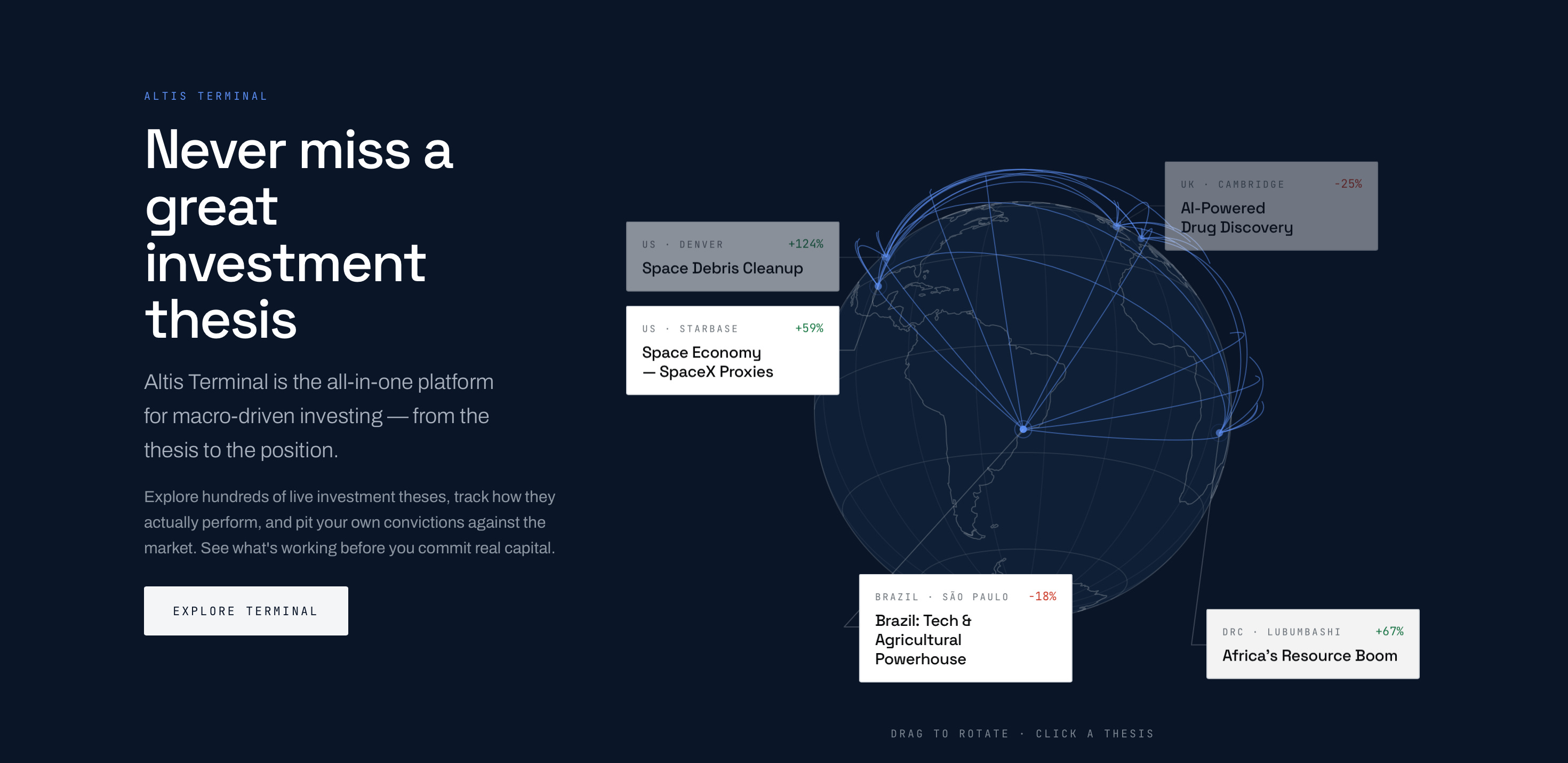
The methodology described in this edition is also the reason we built Altis Terminal.
A newsletter can introduce an investment thesis. The Terminal makes it possible to follow that thesis over time, see the portfolios built around it, examine every documented trade, and understand whether new market evidence is validating or weakening the original idea.
Never miss a great investment thesis.
Tomorrow, we will begin opening Altis Terminal to Macro Notes Premium subscribers. We have already started activating access for existing Premium and Founding members, who will receive their invitations progressively.
The platform brings together hundreds of portfolios and investment theses covering AI infrastructure, energy, semiconductors, financial systems, space, robotics and other structural markets.
More than ten active contributors have already begun publishing and documenting their portfolios on the Terminal, and more research teams and independent contributors will be added after launch.
Altis Terminal will normally cost $499 per year as a standalone product.
However, if you subscribe to Macro Notes Premium today for $300 per year, complete access to the Terminal will be included in your subscription—along with all Macro Notes Premium research.
That means access to:
Hundreds of investment theses and research portfolios
Transparent, timestamped trade histories
Real-time portfolio performance
Detailed thesis updates and market events
Research published by more than ten active contributors
New portfolios, contributors and analytical tools added over time
Tomorrow marks the beginning of the public opening. Subscribe today to secure Macro Notes Premium and Altis Terminal access together for $300 per year.
The next buyer of AI infrastructure
The next chapter of the AI infrastructure build-out is no longer being driven solely by American technology companies.
Governments increasingly view domestic computing capacity as strategic infrastructure—closer to energy, telecommunications or defense than to an ordinary cloud service.
McKinsey estimates that sovereignty requirements could influence between 30% and 40% of global AI spending by 2030, creating a market worth between $500 billion and $600 billion.
This is the emerging market behind what is now commonly called sovereign AI: the effort by countries to secure greater control over the compute, data, models and infrastructure on which their economies will increasingly depend.
France announced more than €109 billion of investment commitments for AI infrastructure projects. The UAE launched plans for a five-gigawatt AI campus in Abu Dhabi, including a one-gigawatt Stargate UAE compute cluster.
Japan committed more than ¥10 trillion in public support for its domestic AI and semiconductor sectors, with the objective of mobilizing more than ¥50 trillion in combined public and private investment over the following decade. Singapore has committed more than S$1 billion to AI compute, talent and industry development as part of its National AI Strategy 2.0.
These countries do not all have the resources—or the time—to develop an entirely independent semiconductor supply chain.
But they can finance data centers, secure accelerators, purchase rack-scale servers, create sovereign cloud regions and ensure that strategically important data and models remain within their jurisdiction.
That creates a new category of buyer and a new infrastructure market.
We began documenting this shift on October 17, 2024, through our Sovereign AI Infrastructure portfolio. As of August 11, 2026, the Locked portfolio had generated a total return of +199.3%.
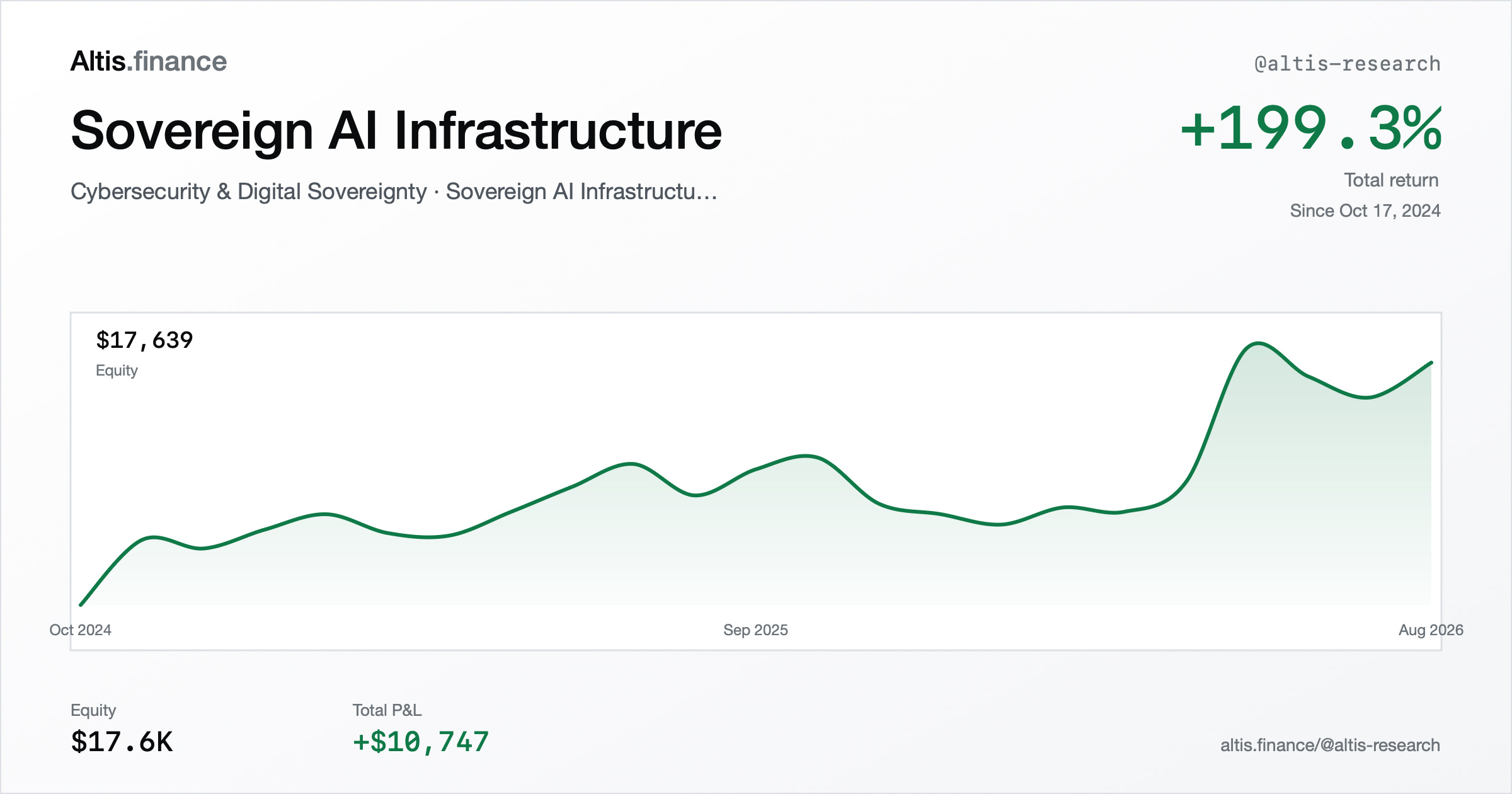
The return is impressive, but it is not the most useful part of the story.
What matters is how the portfolio reached it.
One original position was removed when governance, legal and export-control risks changed the investment case. Its capital was redeployed into another company offering exposure to the same underlying demand with a stronger risk profile.
A cloud-infrastructure position was later sold after the financing required to fulfill its enormous AI backlog materially changed the balance-sheet equation.
The thesis survived, but its expression evolved.
In the rest of this edition, I will open the complete portfolio: why we created it, why each company was selected, which positions generated the return, what forced us to sell or redeploy capital, and whether sovereign AI infrastructure still offers an attractive opportunity after a 199% gain.