One of the things I look for when following an investment thesis is whether the market can expand beyond the customers that initially made it successful.
An industry can grow because its existing customers spend more. But it can also grow because a new group of customers starts buying the same products for a different reason.
The second mechanism is particularly interesting when those products are difficult to manufacture, essential to the customer, and supplied by a relatively small number of companies.
I think this is an important part of the next phase of AI infrastructure.
Much of the discussion still revolves around how much Amazon, Microsoft, Alphabet, Meta, and the leading AI labs will spend on computing capacity. That spending matters, and the economics behind it deserve close attention.
But it may no longer be sufficient to look only at the investment decisions of technology companies.
As AI becomes more useful, governments have their own reasons to secure computing capacity. Banks, industrial companies, and other institutions handling sensitive data may also need infrastructure that gives them more control over how AI is deployed.
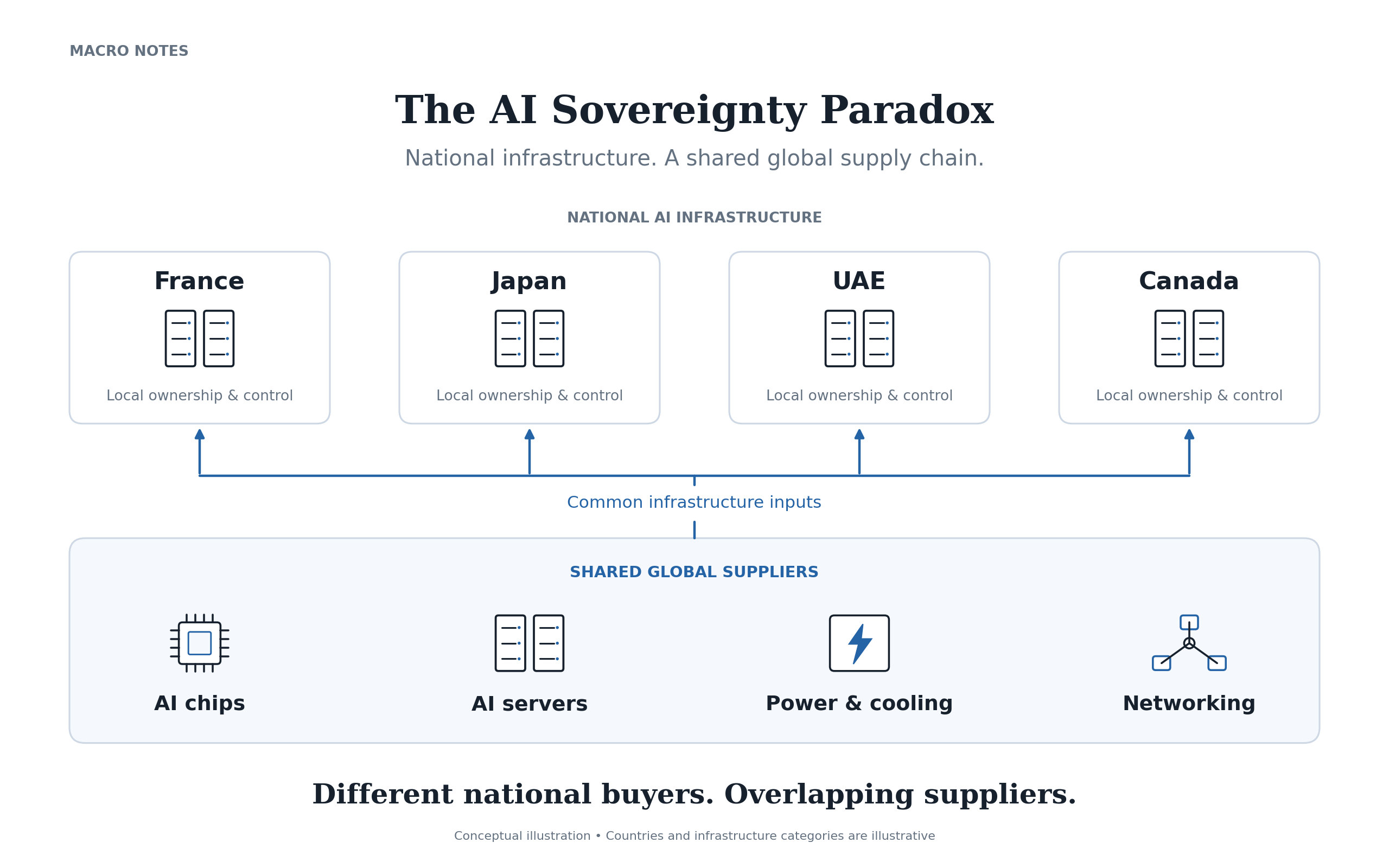
The products required will often be familiar: accelerators, servers, memory, networking equipment, cooling systems, and electrical infrastructure.
What changes is the customer, the purpose of the investment, and the conditions under which that infrastructure must operate.
That is the part of the sovereign AI thesis I want to examine more closely today: how a demand for greater control could broaden the market for the companies supplying AI infrastructure.
Why countries would invest in their own capacity
In August, I wrote about the sovereign AI race and the opportunity it could create across the infrastructure value chain.

The starting point remains relatively simple.
A country can use a foreign AI service without owning the infrastructure behind it. For many applications, that is an efficient solution. The provider finances the equipment, maintains the software, and spreads those costs across a large customer base.
But the calculation can change when AI becomes part of activities that a government considers strategically important.
A public institution processing sensitive records, a bank analyzing customer data, or an industrial company integrating AI into production may have requirements that extend beyond the quality of the model itself.
Where is the information processed? Who operates the system? Which rules govern access? Can the customer continue using it if its relationship with the provider changes?
Those requirements can influence where computing capacity is built and who is allowed to operate it.
A government does not necessarily need to develop every component domestically. It may instead finance local capacity, support a regional provider, or establish procurement rules that give important institutions more control over their deployment.
For an investor, the consequence is concrete: the same technological shift that increased demand from American cloud companies can also create demand from customers with different operating and strategic priorities.
The opportunity extends beyond national models
One way to approach sovereign AI is to ask which countries will develop their own large language models.
That is part of the story, but I think it leaves out a potentially important source of infrastructure demand.
Training creates a model. Inference is the computing work required to use it.
A country can therefore have reasons to invest in domestic infrastructure even if it uses a model originally developed elsewhere. The objective may be to run that model locally, adapt it to specific tasks, and retain control over the data it processes.
An analysis published by McKinsey on October 5 projects that inference could represent roughly 60% of AI compute demand by 2030.
The implication I draw from this is that sovereign AI should also be examined through the infrastructure required for everyday deployment.
A bank may need a private computing cluster. An industrial group may need systems close to its operations. A public-sector provider may need local capacity serving several institutions.
Whether those investments happen will depend on cost, adoption, and the usefulness of the applications. But the potential customer base extends beyond countries competing to train the largest model.
This is also where the composition of demand may change.
A large training cluster and a system serving an institution’s daily workloads do not necessarily need the same balance of computing power, memory, networking, and software. Understanding that difference matters when selecting the businesses through which to express the thesis.
More local control can still mean more business for global suppliers
There is an important distinction between controlling an AI deployment and producing every technology that makes it possible.
A country can keep sensitive data within its jurisdiction while importing the accelerators used to process it. A local provider can operate the infrastructure while relying on equipment and software developed abroad.
This means that the expansion of sovereign AI does not automatically exclude the companies already supplying the global AI buildout.
It can create another route to market for them.
The more interesting question is which parts of the system customers will buy internationally, which they will source locally, and which requirements create opportunities for more specialized suppliers.
In June, NVIDIA said that 35 AI supercomputers were in development across Europe. In September, it announced an Australian infrastructure initiative targeting up to two gigawatts of buildout by 2027 through cloud and data-center partners.
The Australian announcement describes planned capacity across a local ecosystem, rather than a single government order. Nevertheless, it illustrates how infrastructure demand can develop through several types of buyers and operators.
The European Commission’s July call for up to seven AI gigafactories provides a different example: up to €10 billion in public support intended to attract at least €20 billion in private investment.
These projects have different funding structures and deployment risks. What connects them is the need to assemble an entire computing system, with several companies supplying the components and services required to make it usable.
Follow the spending through the value chain
McKinsey estimates that sovereignty requirements could influence 30–40% of global AI spending by 2030, representing a market of approximately $500–600 billion.
The estimate covers spending shaped by sovereignty requirements across the AI ecosystem. Only part of it will become infrastructure revenue, and some will be spending redirected from existing providers.
The number gives an indication of potential scale. The investment case still has to be built company by company.
This is where I find it useful to return to the value chain.
An infrastructure operator needs to finance assets, secure customers, and keep those assets sufficiently utilized. An equipment supplier needs to deliver a competitive product at a margin that justifies the investment required to manufacture it.
Both can benefit from the same market, while producing very different returns for shareholders.
A large contract may be attractive for one company and financially demanding for another. A growing backlog may indicate strong demand, but its value depends on customer funding, delivery schedules, and the cash required to fulfill the orders.
I therefore want to understand how an investment in sovereign AI moves from an announced project to an order, from an order to revenue, and from revenue to cash flow.
The companies that capture the largest share of spending will not necessarily be those that offer the most attractive investment.
Where I want to take the research next
The reason to revisit this thesis is to understand how the demand is developing and whether the companies positioned to serve it still offer attractive economics.
In the Premium section, I will examine:
The listed businesses exposed to sovereign computing capacity and local AI deployment.
Their position in the value chain, the evidence of customer demand, and the margins they can potentially earn.
How exposure to inference could change the investment case across servers, memory, networking, cooling, and power.
The financing, valuation, and execution risks that could offset the growth opportunity.
The developments that would strengthen the thesis—or require us to change how we express it.
A structural thesis becomes useful when it helps us identify specific businesses, understand why their economics could improve, and establish what would prove that reasoning wrong.
That is the analysis I want to develop in the rest of this edition.