

Over the past three decades, we’ve moved from exploring space to building a space economy.
Space is no longer just about exploration, research, and science.
It is now a market.
A market dominated by SpaceX, which has gone public, but with plenty of other players too.
I like to focus on investment themes that attract less attention.
Right now, everyone is obsessed with AI.
Wondering whether it’s a bubble or not.
So before we talk about the space economy,
Here is a quick look at my five-stage framework for understanding a bubble.
Phase 1 — The innovation race: massive investment, research, and technological development.
Phase 2 — My favorite: “Is this a bubble?” Everyone is asking the question. Usually, when everyone is asking, it means it is one.
Phase 3 — The exit door. For VCs, this is the time to take the cash while it’s still available. So companies go public, and investors exit.
Phase 4 — The bloodbath. I had to censor the explanation of this phase.
Phase 5 — The race to build the best business begins. Companies with promising technology and a viable business model start to stand out. The others disappeared in the bloodbath.
We are somewhere between phases 3 and 4.
During this stage, my view is simply that the best approach is to reduce exposure and wait for phase 5 to start identifying the real winners.
The space economy is in a very different position.
Of course, SpaceX is closely tied to AI. It has become an AI company through its merger with xAI and its acquisition of Grok.
And by the end of this edition, you’ll understand why that makes much more sense than it might seem, and why AI and space are part of the same equation.
But first and foremost, SpaceX is still a space launch company and a satellite internet company. The latter is actually the largest contributor to its earnings.
The launch market is, of course, the entry point. But it is a small market with a handful of customers: the military, NASA, and a few private clients. Not everyone can afford a launch to put a satellite into orbit, for example, even though SpaceX has brought the price down.
But with Starlink, it has become a broader market. And behind SpaceX, an entire economy has recently taken shape, with several submarkets and different problems to solve: regulation, space debris, satellite imagery.
This is the research we’re working on this month, and the basis of the project we’re building for Founding subscribers:
Introducing Macro Notes Research & Models — Starting with SpaceX & the Space Economy

Today, I’m excited to introduce Macro Notes Research & Models, a new initiative that represents an important step forward in how we research investment opportunities at Macro Notes.
One of the theses we’ve been following in Macro Notes Terminal concerns satellite internet becoming a new layer for internet providers. The main idea is simple. For providers, in a very competitive market, it has always been a battle over territory: installing antennas to cover as much ground as possible. In Europe, for example, some operators maintain monopolies in certain areas, gain an advantage because they cover places their competitors don’t, or sometimes make their towers available to competitors.
Different types of agreements exist. One of the best ways to establish a position in this market is to acquire other providers to cover more territory.
Satellite connectivity opens up a new possibility: offering customers an uninterrupted connection in areas without coverage, often places that are impossible to cover economically because of the cost of installing antennas and other infrastructure.
The original thesis was: okay, providers will offer more expensive plans so their customers can have an uninterrupted connection.
The problem is, will there be enough customers to make satellite connectivity profitable?
This is no longer a market of monopolies like it was 20 years ago. It is a market of price wars and competition.
The French provider Free made a name for itself by drastically cutting internet prices, forcing its competitors to match them.
All it takes is one player willing to give up substantial margins to gain market share, and everyone else has to follow.
If one player decides to sacrifice its margins to offer a plan with satellite connectivity included,
Everyone will want the satellite plan. Every provider will have to match it and offer one too.
The question is simply whether an innovation is attractive enough for mass adoption.
My conviction is that satellite connectivity is. But the providers billing the end customer will not be the biggest winners once this race gets going.
The thesis is still in its early stages, with a three- to eight-year horizon, and we’ve already built a portfolio in Macro Notes Terminal that has returned 230%.
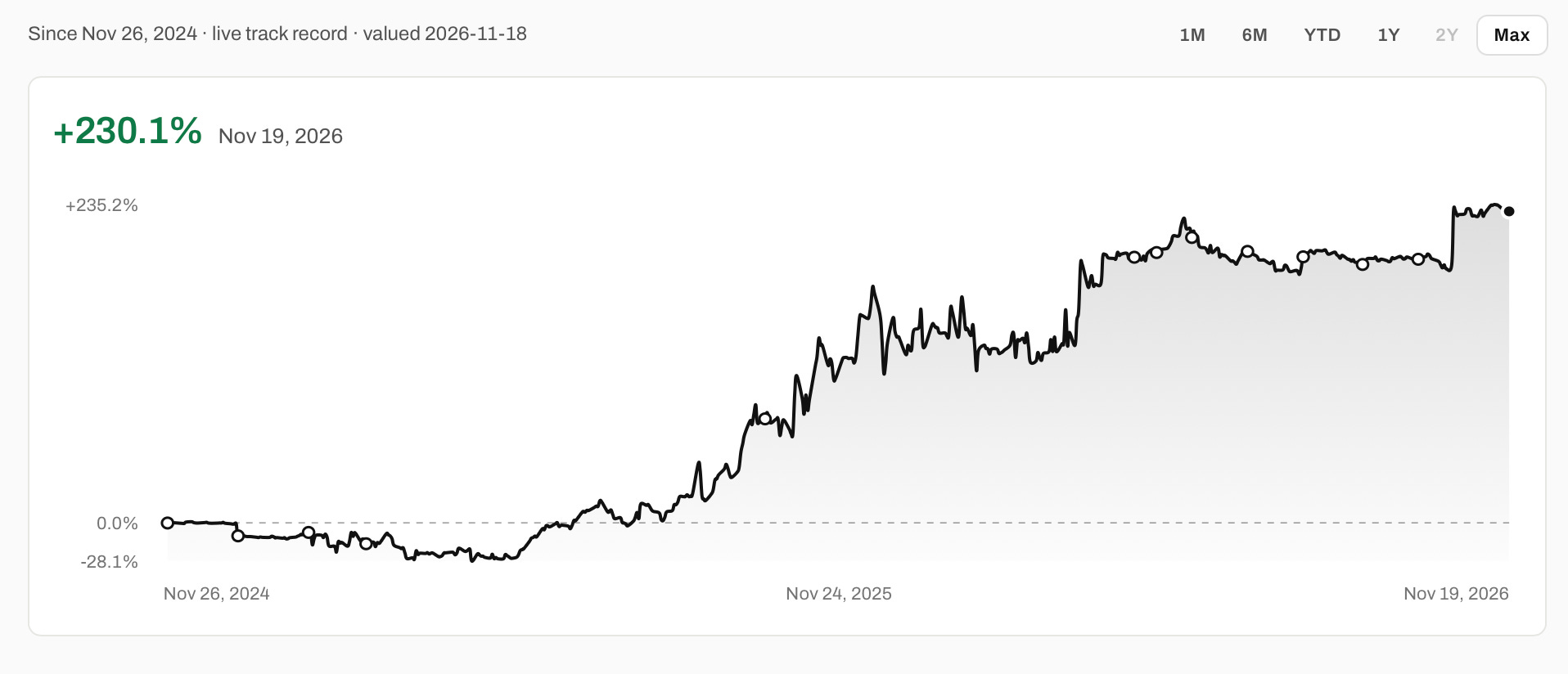
You can follow the thesis as it develops in the Terminal, which gathers evidence every day, records important events, and brings in evidence that challenges the thesis to assess whether it is gaining traction, losing momentum, and so on.
The big question for us is who will benefit from this innovation. SpaceX is one of the winners, but it isn’t the only one. We’re studying three other companies that could have even more potential in this specific market: to capture more margin and build better businesses.
But today’s space economy is about much more than internet connectivity. There are other layers to understand if you want the broader picture.
One of the areas I find most interesting, and one of the most promising, is the development of molecules in microgravity. Early experiments, including those conducted aboard the ISS, have produced crystal suspensions that are more uniform and less viscous than their counterparts on Earth.
The appeal mainly comes from how matter moves and organizes itself. On Earth, particles can settle at the bottom of a container, and differences in density create movement within a liquid. Microgravity reduces these effects and can allow certain crystals to form more uniformly.
For a drug, physical form matters a lot. The same molecule can assemble into several different crystal structures. This can affect how it dissolves, its stability, or how the body absorbs it. Space therefore offers an additional environment in which to search for a useful form. The benefit depends on the compound being studied.
Potentially, two businesses could be built around this idea:
Research and development in orbit: selling pharmaceutical companies experiments, data, and processes that could improve a drug. This is the model that, to me, has the strongest evidence behind it today.
Routine manufacturing in orbit: producing commercial batches and bringing them back to Earth. This requires proving that the benefits outweigh the costs of launch, return, operations, and meeting pharmaceutical quality requirements.
We’ve started developing several theses for Macro Notes Founding members. This is probably one of the most promising avenues, although there are not yet any concrete applications or models publicly available that would allow us to assess how this market will develop and which players it will be built around.
And that is why we’ve been investigating further: to understand exactly how large this market could be, which companies could benefit, and how much it could affect the pharmaceutical industry.
We collect and assemble new data every day to improve our space economy model.
The second interesting market is data centers in space.
Space offers enormous advantages, but also enormous constraints. Or rather, new constraints, and each one creates an opportunity.
That is why I don’t reduce the space industry to SpaceX. In building this model, we’ve already identified 20 different companies addressing different constraints related to space. Debris, regulation, and so on.
To understand the benefits and the submarkets opened up by the low-cost access to space that SpaceX is making possible, here are a few concrete examples:
Data centers and AI in orbit: using solar energy and performing computations directly in space.
Semiconductor materials: growing specialized crystals under conditions different from those in factories on Earth.
Specialized optical fibers: aiming to produce fibers, including ZBLAN, with fewer defects and better transmission performance.
Biological tissues and bioprinting: printing three-dimensional tissues for research and, potentially, future medical applications.
Satellite servicing: extending satellites’ lifespans, repositioning them, and developing repair or refueling capabilities.
Orbital transport and logistics: moving satellites after launch, delivering payloads, and organizing transfers between orbits.
Commercial stations and laboratories: selling governments and industrial companies laboratory time, accommodation, and experimental capacity.
Space-based solar power: capturing solar energy in orbit and transmitting power to receivers, with the long-term goal of supplying Earth.
Defense infrastructure: detecting and tracking missiles through constellations of sensors.
Lunar resources: using local resources for construction, refueling, and mission operations.
And now we come to the most important point of this edition, and why I opened by talking about AI.
The first three markets are directly related to AI infrastructure: data centers and AI in orbit, semiconductor materials, and specialized optical fibers.
And the markets involving satellite constellations are indirectly related, because internet access is really about access to AI and deploying the technology everywhere in the world.
Space and AI are part of the same equation.
My thesis is that most of the problems related to AI infrastructure and its cost will be solved in space.
I’m continuing to invest in AI infrastructure, as I have over the past three years, while trying to understand the next stage.
And after months of reading and analyzing the space market, it’s clear.
On November 30, we’ll share our complete research, model, and dataset with all Founding members.
Upgrade to the Founding plan so you don’t miss any of it.
Space isn't escaping phase 4 so far: from Oct 6 to Nov 20 the UFO space ETF fell 19%, Rocket Lab 39% and AST SpaceMobile 63%, while SPY lost 11.5%. Is that your entry point, or is space still trading as part of the AI story?