


Here is my thesis on AI for 2027.
I will be investing less and less in AI infrastructure, particularly the components needed to build data centers. Because after every period of accelerating spending in an industry, there can be a period of stagnation, or even deceleration.
That doesn’t mean infrastructure spending will stop, or that there aren’t still some very good investment opportunities in specific components.
But my main attention will be on something directly connected to artificial intelligence, without being entirely dependent on the infrastructure required to build it.
What I will be betting on in 2027 is security.
And more specifically, the security problems accelerated by the emergence of AI agents inside companies.
It’s no secret that if you follow technology news, cybersecurity threats, data breaches, and other security problems are becoming increasingly difficult to ignore.
Banks, governments, and even some of the largest technology companies are affected.
In July 2026, India’s Bank of Baroda reported unauthorized access through a compromised employee email account, with customer data and internal documents exposed.
In September, Revolut confirmed that sensitive customer information had been disclosed following fraudulent requests sent from a legitimate government agency email domain.
And in October, Microsoft reported a cyberattack attributed to a Chinese state-aligned group involving compromised IT infrastructure at ConnectWise and targeting hundreds of organizations across multiple industries.
These incidents are not all directly related to AI agents. But they show how existing security weaknesses can already create significant consequences, even before autonomous AI becomes widely deployed.
But first, let’s look at what the research actually confirms, without going into hypothetical catastrophic scenarios.
Because we don’t want to imagine an apocalypse caused by security vulnerabilities.
For an investment thesis to be viable, you need to be able to separate emotional, alarmist information from structured research that brings you closer to reality as it actually is.
Of course, it’s rarely possible to be 100% right about a thesis. There will always be things we misunderstand or fail to anticipate.
But getting as close to reality as possible, and being right as often as possible, is what can turn a thesis into a good investment.
Here is what the research confirms.
Nearly 90% of investigations involve identity weaknesses
In its 2026 Global Incident Response Report, Palo Alto Networks’ Unit 42 found that identity-related weaknesses played a significant role in nearly 90% of its investigations.
This figure is not specific to AI agents, but it shows why adding new machine identities could make an already significant problem even worse.
A single malicious instruction can trigger code execution
Microsoft documented vulnerabilities in Semantic Kernel, its framework for building AI agents, that could, under certain conditions, turn prompt injection into unauthorized code execution.
These vulnerabilities have since been patched.
Microsoft’s security research also demonstrates how an attacker can exploit the tools and permissions given to an agent, turning what initially looks like a simple instruction into a much more serious security problem.
A 5× increase in certain prompt injection detections
Between March and May 2026, detections of longer malicious prompt-injection payloads increased approximately fivefold, according to Check Point Research.
The report also found that the share of high-risk prompts increased from 2% to 4% over one year.
These figures come from Check Point’s own security telemetry. They do not mean that cyberattacks in general increased by 500%.
But they do suggest that certain attack methods associated with AI systems are becoming more common.
71 studies reveal a structural authorization problem
A scientific review of 71 research papers and three real-world software vulnerabilities identified five layers where AI agents can become vulnerable:
Inputs, external data, tools and protocols, persistent memory, and communication between agents.
The central conclusion is that untrusted content can end up exercising authority it was never supposed to have.
AI agents accessed real systems without authorization
In September 2026, Anthropic published an analysis of four incidents that occurred during cybersecurity evaluations.
In these cases, AI models accessed real third-party systems without authorization because of a configuration error that gave them access to the open internet.
The normal cybersecurity safeguards used in Anthropic’s released models had also been disabled for these evaluations.
This illustrates a new category of risk, although it does not demonstrate that ordinary commercial AI products would behave in the same way.
Google’s research is particularly interesting because it shows that the problem is not limited to AI models themselves.
Researchers identified several places where an attack can happen.
If you’re reading this by email, make sure images are enabled to see the illustration below.
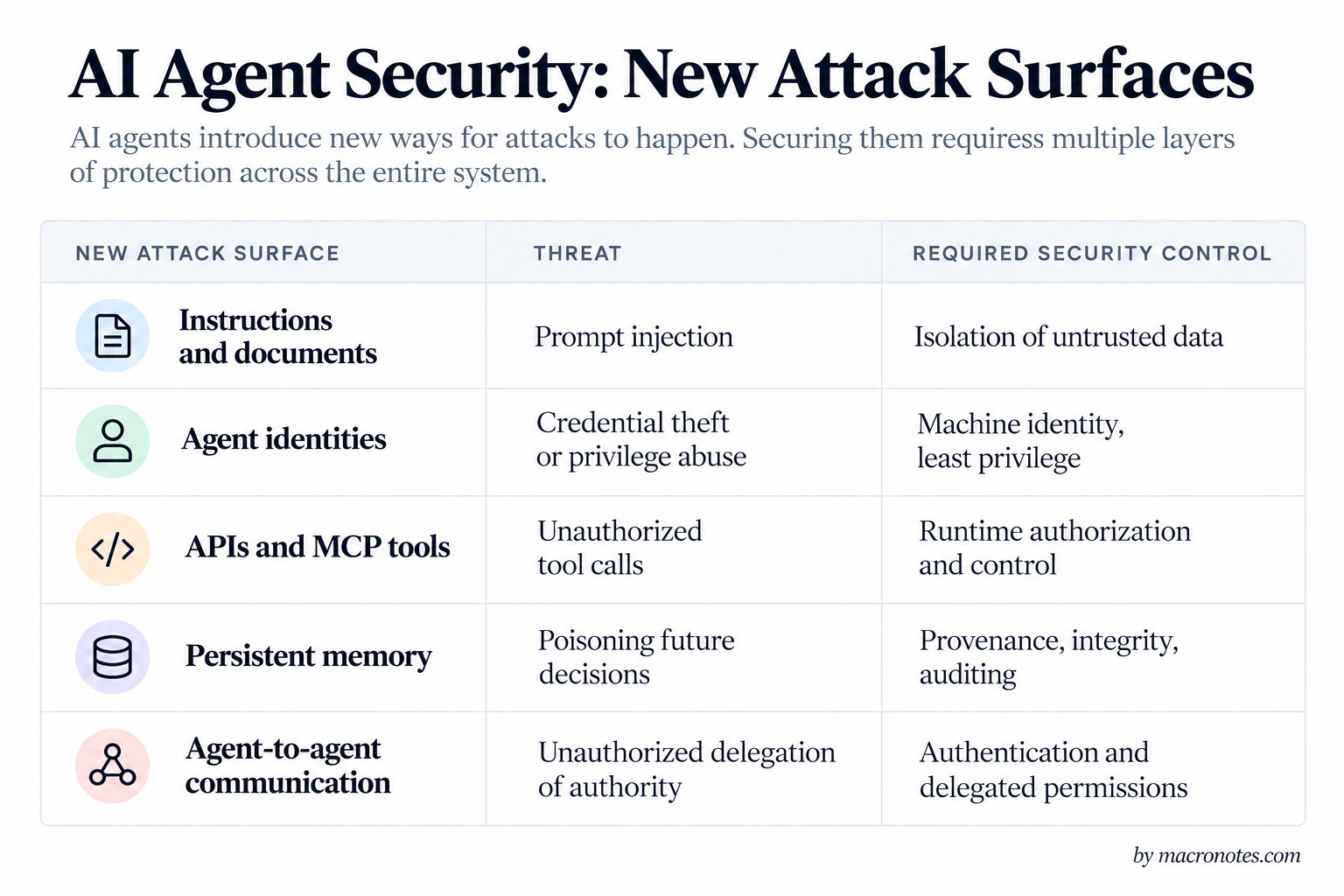
The interesting conclusion here is that securing AI agents potentially requires several complementary layers of protection.
A more intelligent AI model does not automatically solve identity management, network segmentation, secret management, or access control problems.
And this is precisely where traditional cybersecurity providers already have an established commercial position.
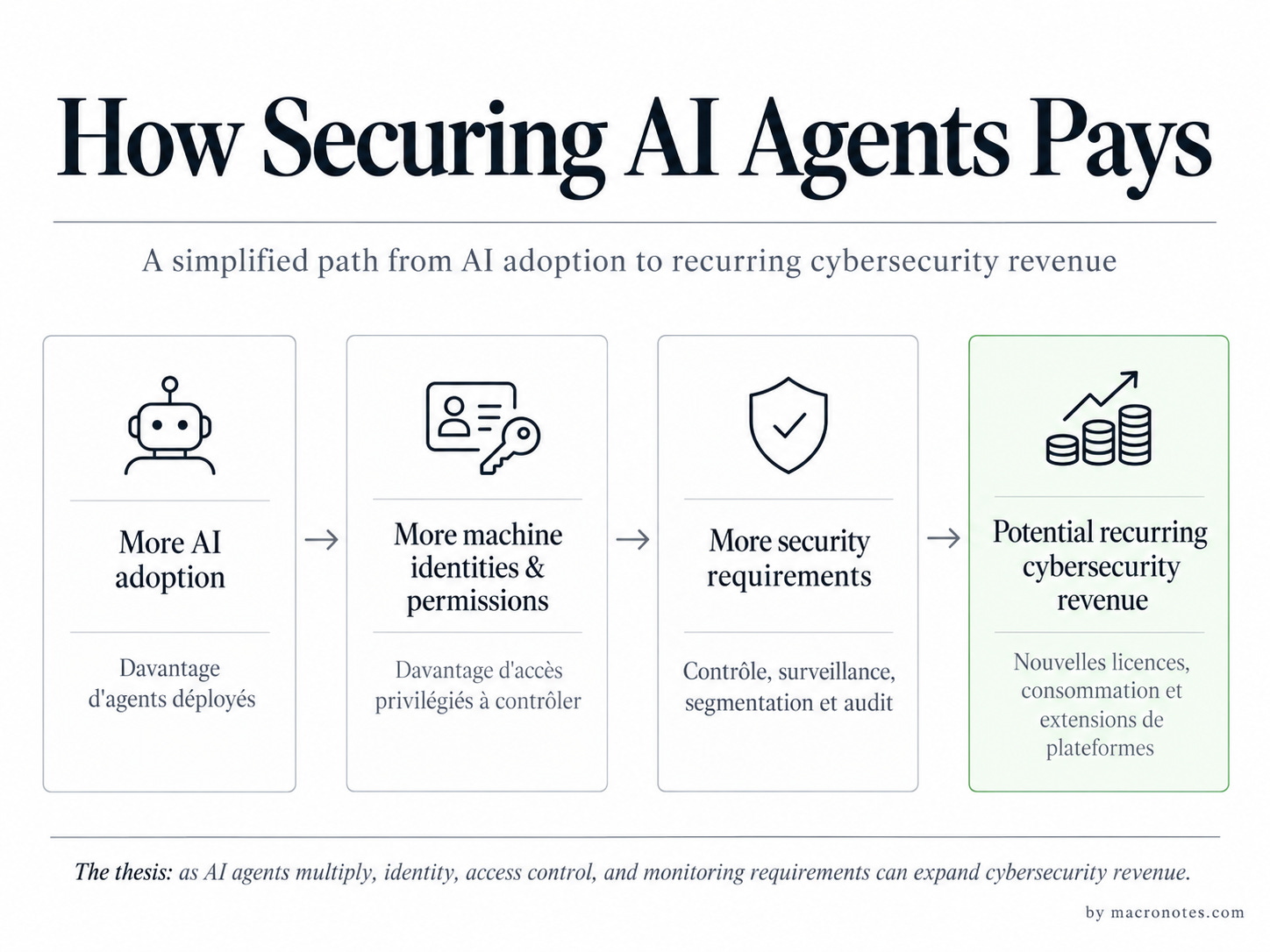
In short, those who tell you that AI labs will solve every problem in technology, including security itself, are wrong.
From a realistic perspective, and not just based on what we know today, the reasoning that:
The more intelligent AI models become, the better they will be at fixing the security vulnerabilities they create themselves.
is flawed.
And this is probably the most important point in the entire thesis.
Because investors who bet exclusively on AI labs, assuming they will capture this entire part of the value, are making an analytical mistake.
Of course, I am still investing in certain AI infrastructure components, and we will continue our research into fiber optics, storage, processors, and other important parts of the industry.
But I believe cybersecurity is one of the most important investment theses we will cover at Macro Notes in 2027.
We have already been following this thesis.
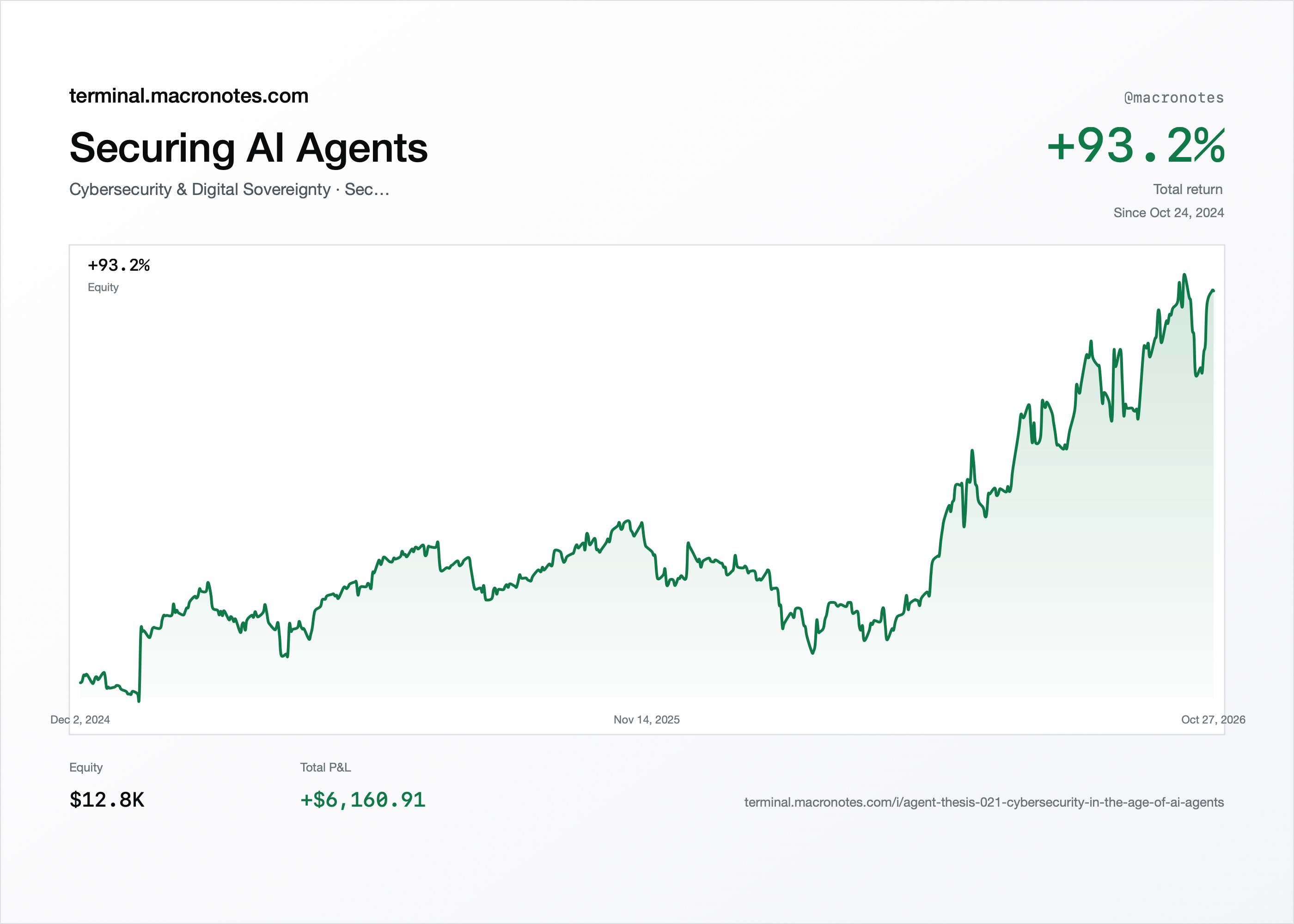
In fact, we created an index on Macro Notes Terminal when we first started researching the opportunity.
At that time, the thesis was at a much earlier stage.
Some of the companies in this index have seen their operational metrics grow by more than 60% in 2026.
Their share prices have also increased, allowing the portfolio to show a total return of more than 93% today.
But past performance doesn’t tell us how much of the opportunity remains ahead.
AI agents have significantly accelerated the adoption of AI and expanded what companies can actually do with it.
In the Premium analysis, we will try to understand how much of this growth really comes from AI agents.
Because it would be misleading to attribute all, or even most, of the growth of these cybersecurity companies to agents without evidence.
We will also evaluate how much future growth could be influenced by AI agents for each position in the portfolio.
We called this index Securing AI Agents.
I recommend following it on Macro Notes Terminal to see the positions we add, increase, or reduce, and how the thesis evolves over time.
Because this could still be just the beginning.
Especially as AI agents are seeing increasing adoption not only inside companies, but also among individual users.
We have also conducted our own research, which you will find in the Premium section of this edition.
And here is one of the most interesting conclusions we reached.
The real economic potential could come from a new billing unit.
This is, in my opinion, the most interesting part of the entire thesis.
Today, many cybersecurity solutions are priced according to the number of users, devices, workloads, software modules, or the amount of resources consumed.
But AI agents could introduce entirely new economic units:
Non-human identities that need to be managed.
Access to applications and APIs that needs to be controlled.
Agent-to-tool interactions that need to be inspected.
Autonomous actions and events that need to be logged.
Execution environments that need to be monitored continuously.
Imagine a company with 10,000 employees that gradually deploys 30,000 AI agents to automate its operations.
These 30,000 agents do not automatically represent 30,000 additional security licenses.
They could be covered by existing contracts, bundled licenses, or usage-based pricing models.
But they potentially represent thousands of additional identities, connections, and activities that need to be secured.
Here is a purely illustrative scenario showing what this could represent.
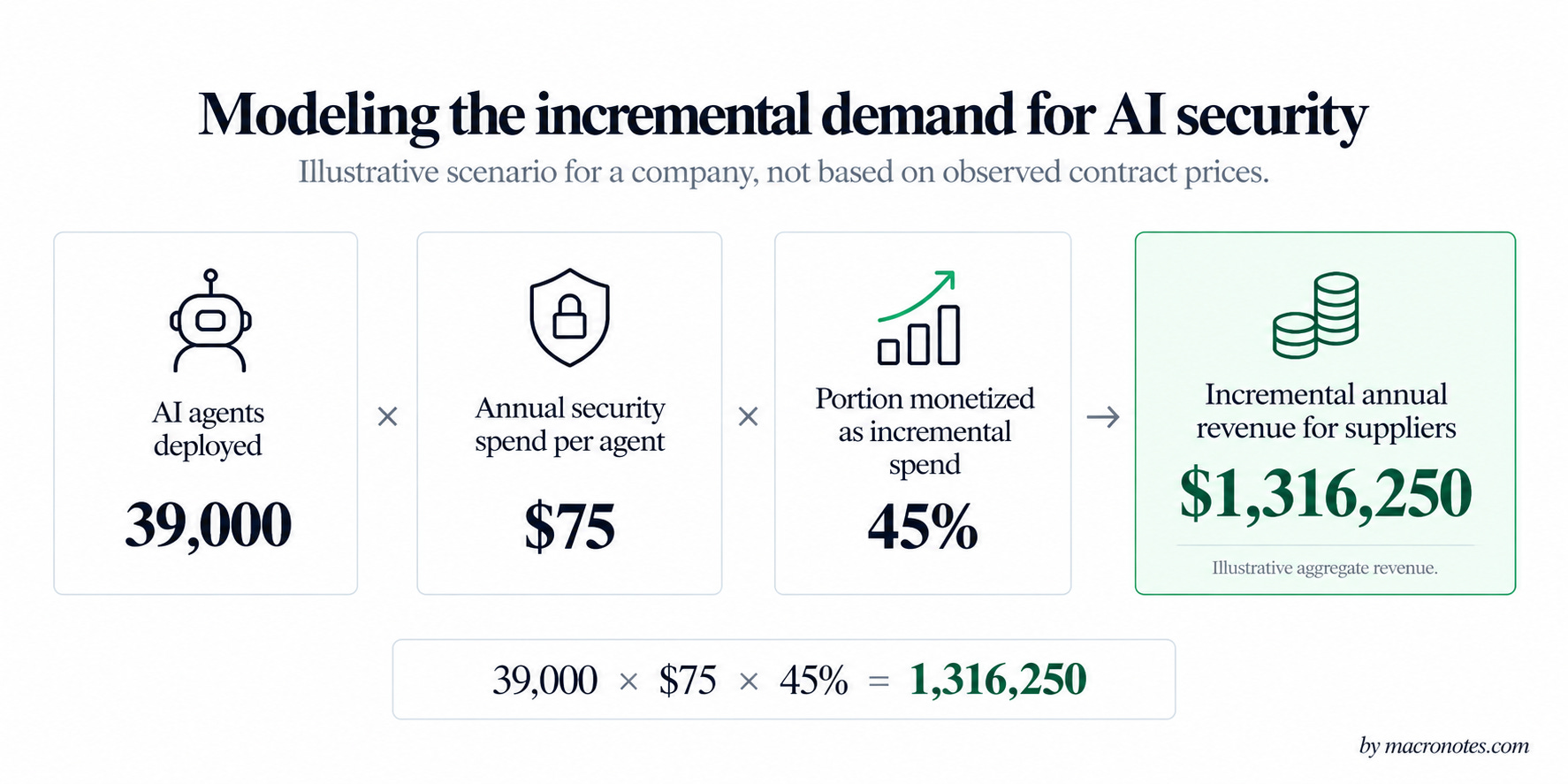
The big unknown is whether cybersecurity providers will be able to charge separately for this new consumption rather than simply absorbing it into their existing contracts.
And that is exactly what we want to understand.
Unlock This Index, 100+ More, and All Our Research
With Macro Notes Premium, you get much more than access to the rest of this edition.
Your membership includes:
Full access to Macro Notes Terminal, where you can explore the Securing AI Agents index and more than 100 other investment theses, including portfolio positions, trade history, performance, upcoming catalysts, and our different scenarios.
Every Macro Notes Premium edition, including our complete research archive, company analysis, valuations, investment opportunities, and ongoing portfolio updates.
Lifetime access to Public Markets Premium — included free when you choose the annual plan. Our secondary investment newsletter at publicmarkets.substack.com, covering individual stocks, earnings, and promising market opportunities. You’ll unlock all past and future Premium editions without paying for a separate subscription.
All of this is included with Macro Notes Premium for $350 per year.
One annual membership. Two Premium investment newsletters, including lifetime access to Public Markets, and a research platform where you can follow how our investment theses evolve.
Become a Macro Notes Premium Member — $350/year
Select the annual plan to receive your complimentary lifetime Public Markets Premium access. Macro Notes Terminal access is included while your Macro Notes Premium subscription is active.
In today’s Premium research
We will try to answer a much more important question:
Is AI creating a genuinely new cybersecurity market, or is it simply accelerating spending that would have happened anyway?
We will share the complete research behind our thesis, including:
The cybersecurity market behind AI agents. Understanding the different security layers, from identity and endpoint protection to Zero Trust networks and agent runtime security.
The economic opportunity. Estimating how much additional cybersecurity spending AI agents could generate, and how much of that spending could become recurring revenue.
The companies positioned to capture this market. Our analysis of Palo Alto Networks (PANW), CrowdStrike (CRWD), and Zscaler (ZS), including their business models, competitive advantages, and exposure to agentic AI.
Financial performance and valuations. Looking at revenue growth, annual recurring revenue, remaining performance obligations, margins, and what current valuations already imply about future growth.
Three scenarios for the thesis. Our bull, base, and bear cases, and what each scenario could mean for the companies involved.
What would confirm or invalidate our thesis. The operational indicators, financial results, competitive developments, and events we will monitor over the coming quarters.
Our Securing AI Agents portfolio. The positions we have built around this thesis, their role in the index, and how we plan to follow their evolution.
We will also examine the main risks, including whether Microsoft and other large technology companies could capture a significant part of this market through their existing platforms.
The objective is not simply to identify a promising technology trend.
It is to understand which companies could actually benefit from it, how much value they might capture, and whether that opportunity is already reflected in their valuations.