


For the past six months, I have deliberately held off on publishing a new update to our European defence thesis.
I was waiting for a development that justified taking another close look at the investment case.
That changed on October 14.
European defence has become a major geopolitical and macroeconomic investment theme since Russia’s full-scale invasion of Ukraine in February 2022.
It is also a long-term theme. We have generally built our defence portfolios around a roughly five-year investment horizon.
But that horizon comes with uncertainty. Conflicts are difficult to predict, and their military, political and economic consequences can change quickly.
Part of our team is based in Eastern Europe. That gives us a regional perspective on developments we follow closely. Our investment conclusions still have to be supported by public information, contracts and financial results.
Before I explain the October 14 announcement, I want to address a mistake that can lead investors to draw the wrong conclusion from exactly this kind of news.
A bigger budget does not automatically mean bigger profits.
When governments allocate more money to a sector, the immediate reaction is often straightforward: the market is getting bigger, so the companies we own should benefit.
They might.
But more spending can also attract more suppliers, finance new factories and remove the shortages that previously supported high prices.
That matters because scarcity is often central to an investment thesis.
We have discussed ammunition shortages before. When customers need more than manufacturers can deliver, suppliers may be able to secure better prices and more attractive contracts.
As new capacity becomes available, that balance can change.
A market can grow while becoming less profitable for the companies serving it.
This is part of the capital cycle: growth attracts investment, investment expands supply, and additional supply can eventually put pressure on prices and margins.
To understand the investment opportunity, we have to follow both demand and supply.
The mechanism often starts with good news.
Imagine governments announce a substantial increase in ammunition purchases.
Demand rises. Existing producers receive more orders. Because production cannot expand immediately, some may be able to negotiate better prices.
The opportunity attracts investment. Manufacturers expand, competitors enter the market, and governments help finance new capacity.
The factories arrive later. Several companies may bring their facilities online at roughly the same time, each having planned for strong demand.
Capacity can grow faster than purchases. Suppliers compete to keep their factories busy. Customers gain negotiating power, and margins can fall.
The problem appears when the industry collectively builds more capacity than customers can absorb at profitable prices.
Each company may have made a reasonable decision individually: “Demand is growing, so we should expand.”
But if enough competitors make the same decision simultaneously, the result can be overcapacity.
This can happen even without new entrants. Existing producers can create the imbalance by expanding too aggressively.
Consider a simple, hypothetical example.
Initially, customers buy 100 units a year, and factories can produce 100.
A few years later:
Customers buy 150 units: demand has increased by 50%.
Factories can produce 200 units: capacity has increased by 100%.
The industry is therefore operating at 75% of capacity.
The market has grown substantially. Yet manufacturers now have unused capacity and an incentive to cut prices to win orders.
What matters for pricing is how supply grows relative to demand.
And a small reduction in prices can have a much larger effect on profits.
Suppose a product sells for €100, with total costs of €90. The manufacturer earns €10.
If competition pushes the selling price down to €95, while costs remain unchanged, profit falls to €5.
A 5% price decline has cut profit per unit by 50%.
Costs can fall as production scales or efficiency improves. The question is whether those savings are enough to offset the pressure on selling prices.
Keep that mechanism in mind as we turn to the announcement.
On October 14, the European Commission allocated €168.2 million to eight industrial projects under the European Defence Industry Programme, or EDIP.
The Commission expects the projects to mobilise €1.26 billion in industrial investment, supporting production across 17 sites in 14 EU member states and Norway, with results expected from 2027.
The funding targets components used in missiles, drones and ammunition, including explosives and propulsion.
This is funding to expand industrial capacity. The orders that use that capacity will determine its commercial value.
The €1.26 billion represents expected industrial investment. It is not a pool of guaranteed sales or profits to divide between the beneficiaries.
For investors, the announcement raises a more interesting question: which companies could turn this investment into a meaningful improvement in their earnings?
There are two main ways that could happen.
The first is to sell more of the components manufacturers need.
A supplier makes powders, explosives or propulsion systems. As its customers increase production, they buy more of those components.
The supplier can benefit if it expands output while maintaining attractive economics after operating costs and the investment required.
We need to examine its competitive position, contracts, costs and the capacity its rivals are building.
The second is to secure the components needed to deliver more finished ammunition.
A manufacturer can have plenty of orders but struggle to fulfil them because its suppliers cannot deliver enough inputs.
By producing some of those inputs itself, it can reduce that constraint and increase deliveries.
The financial opportunity comes from turning more of its orders into sales and cash receipts, provided the additional business justifies the investment in internal production.
A company can benefit from both mechanisms: supplying its own factories and selling components to other manufacturers.
That brings us to the investment thesis.
We are looking for companies that can turn European rearmament into sustained production and earnings growth through their control of critical ammunition components.
The most promising situation would be a company whose ability to produce increases as customers commit to buying more, under contracts that leave it with satisfactory profits.
We would then need to determine how much of that improvement is already reflected in its share price.
To see why resolving a component shortage could matter, consider another hypothetical example.
A manufacturer has sufficient customer orders to support €500 million in annual sales, but component constraints currently limit deliveries to €350 million.
Removing that bottleneck could make an additional €150 million of annual sales possible.
If those additional sales generate a 15% incremental operating margin, after associated operating costs and depreciation, they would contribute €22.5 million in additional annual operating profit.
For a business previously earning €50 million, that would represent a 45% increase in operating profit.
These are illustrative assumptions, not forecasts for a company on our watchlist. The calculation also leaves financing costs, taxes and the cash investment to be assessed separately.
But it shows where the potential value can emerge: an improvement in the supply of a critical component can affect earnings across a much larger finished-product business.
The size of the opportunity depends on how much profitable production the constraint is preventing.
That is what we will investigate in the Premium section.
I will share our watchlist of listed companies exposed to this thesis, explain why each belongs on it, and examine where resolving a bottleneck could make a material difference to earnings.
Follow our defence research in Macro Notes Terminal
At Macro Notes, the research continues after an edition is published.
We already follow several specific defence themes through portfolios available in Macro Notes Terminal (formerly Altis Terminal):
Counter-UAS as a Procurement Line — the systems and suppliers helping armed forces defend against drones.
Aligned Defense Industrial Base — defence supply chains and procurement relationships among allied countries.
Space Force as a Budget — government spending on defence-related sensors, missiles and satellites.
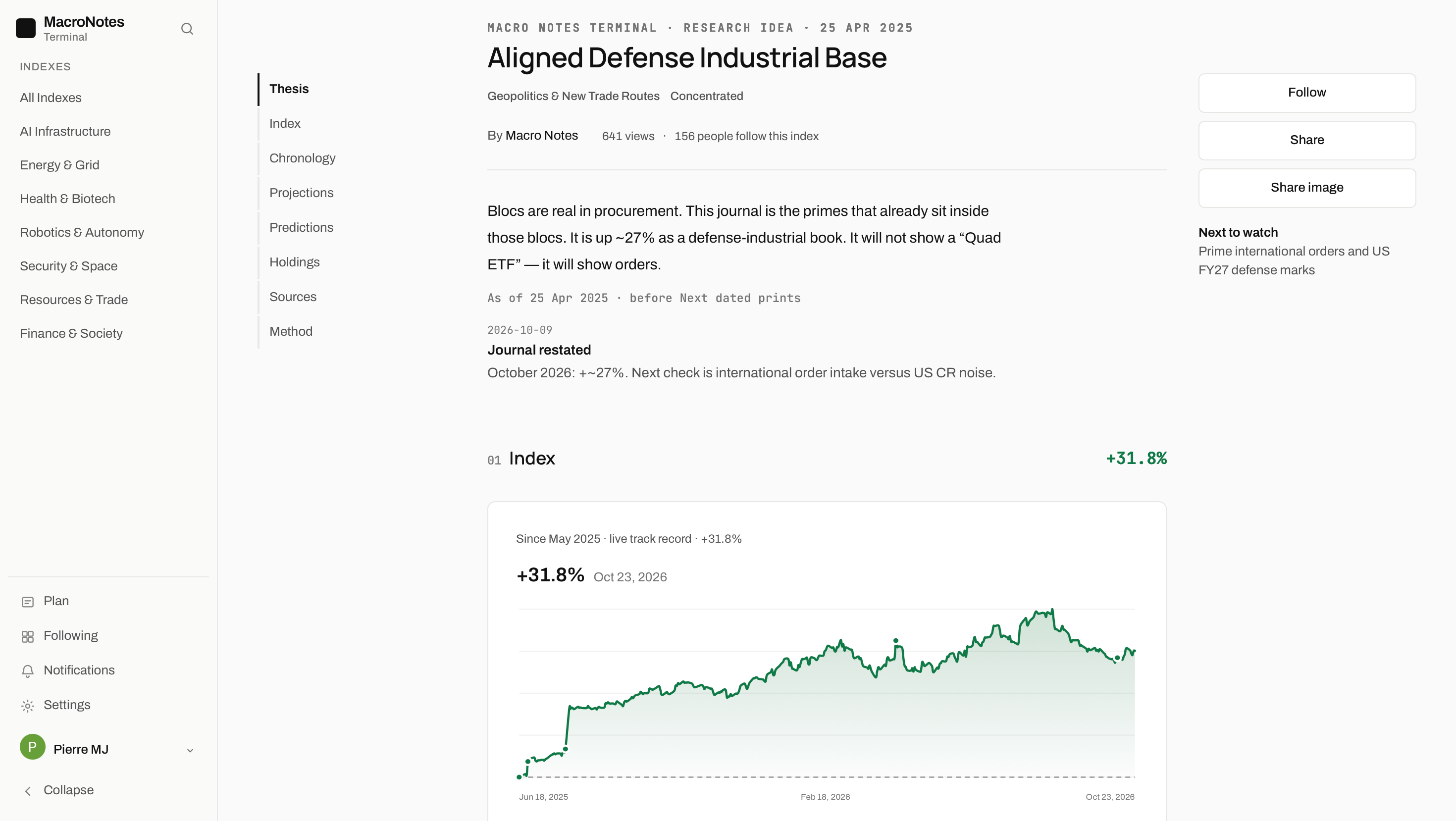
These portfolios cover distinct parts of the defence industry and give you a way to follow our research as it develops.
For Premium members, the Terminal brings together portfolio positions, important events and research updates. You can follow when we initiate, add to, reduce or close positions, alongside the reasoning behind those decisions.
It also makes our approach to managing each thesis visible: how we adjust exposure, respond to new information and reassess the investment case.
This month, we will launch a new portfolio focused on ammunition and its critical supply chain.
It will be available in Macro Notes Terminal. The company analysis in today’s Premium section will provide the research foundation, with subsequent updates explaining how we select positions and manage the portfolio as the thesis develops.
You will be able to follow the opportunity from the initial research through to portfolio construction and the decisions that follow.
Never miss a great investment idea.
Macro Notes helps you discover promising macro investment theses, understand which companies could benefit and follow the research as it develops.
As a Premium member, you get:
Every Premium edition and the complete Premium archive.
Full access to Macro Notes Terminal and our thematic portfolios.
Position updates and research notes, so you can follow how our theses evolve and how we manage exposure.
Discover your next investment thesis—and keep following it as new information changes the opportunity.
Become a Macro Notes Premium member →
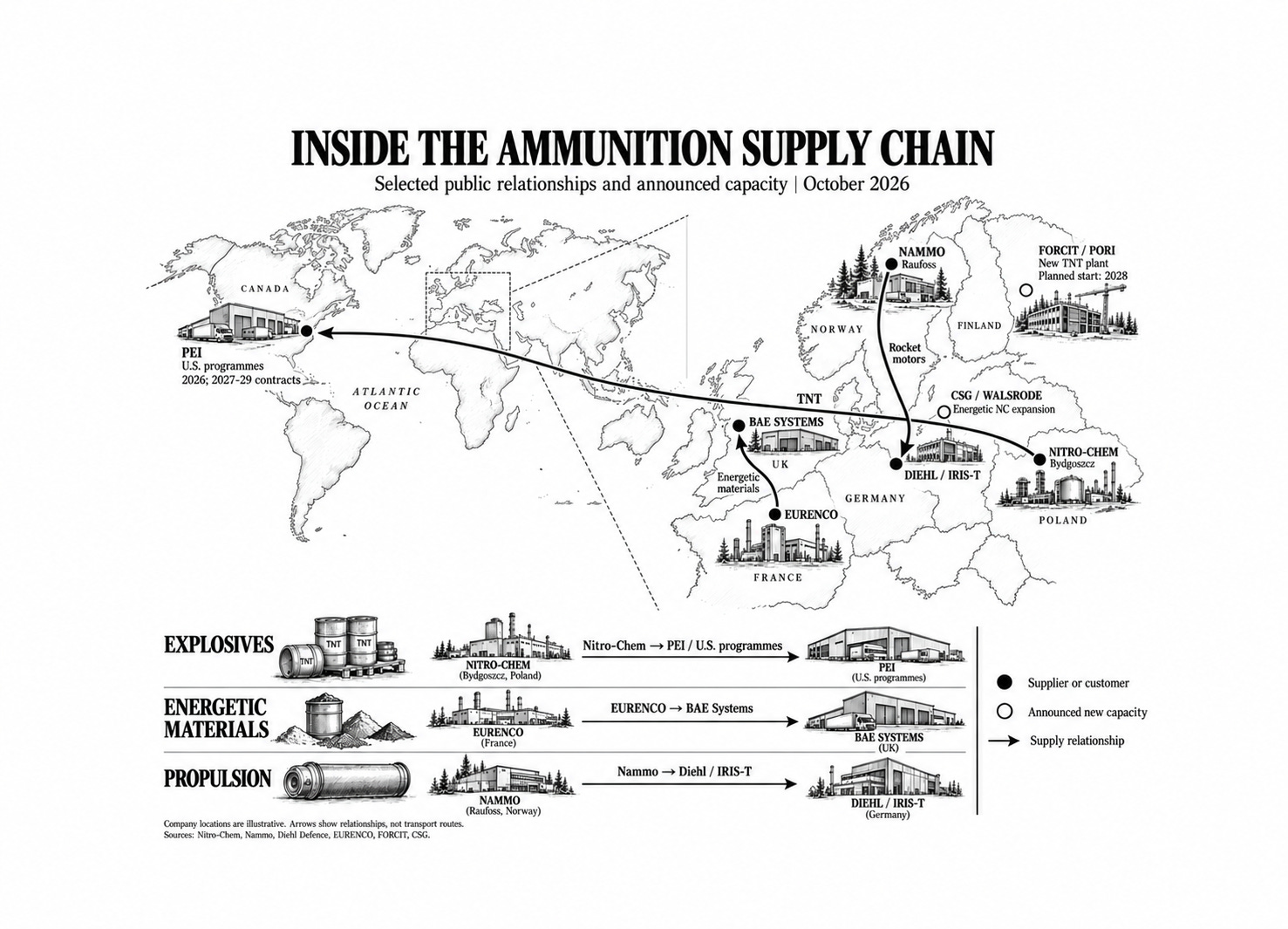
In the Premium section, we will work through six questions:
Where is the money going? The projects, beneficiaries and parts of the supply chain behind the announcement, including the listed parent companies investors can actually follow.
Which companies have the strongest industrial positions? Their component exposure, production capabilities, competitive advantages and dependence on external suppliers.
How much could earnings improve? Company-specific scenarios for additional deliveries, margins and operating profit, distinguishing contracted business from capacity that still needs customers.
Who could lose pricing power? Where competing expansion plans could weaken the investment case, even while the overall market grows.
What does the share price already assume? Valuation, debt and investment requirements, and whether the potential earnings improvement leaves an attractive opportunity.
What would justify taking a position? The orders, production milestones, financial results and risks that would support the thesis—or lead us to reconsider it.
The goal is to identify where solving an industrial constraint could create enough additional earnings and cash flow to matter to shareholders.
You will come away with a watchlist, the assumptions behind each investment case, and the evidence we want to see before committing capital.
Let’s start with the companies.