


I’m writing this edition from a desk high up in a tower in Warsaw. Down below, the city is doing what it always does on a Monday: trams gliding toward Śródmieście, queues forming outside the kantors, someone haggling over the price of an apartment they won’t buy. Nothing—absolutely nothing—betrays what landed last week on the desks of the Polish presidency, a few kilometers from here.
If you’ve followed this newsletter for a while, you know I’ve spent a fair amount of time reporting on the ground in Poland—not least to cover the European rearmament trade, that moment when the continent stopped collecting its peace dividend and started paying it back. That’s part of why I’m still here. And it’s why this week’s story doesn’t read, to me, like just another dispatch.
Here are the facts, and I’m going to be precise about what they are and what they aren’t…
What was said
On July 3, The Telegraph and the Polish outlet Onet reported, citing sources close to President Karol Nawrocki, that US intelligence has warned Warsaw on several occasions that Russia is preparing an armed “provocation” on Polish soil—potentially within months. The scenarios floated: drone strikes on critical infrastructure such as power plants, simulated air raids designed to force Poland to activate its air defenses, and—in the most extreme version—a limited ground incursion by Russian or Belarusian troops from Kaliningrad or Belarus. One source close to the presidency put it plainly: US intelligence systematically informs Poland of each new Russian plan against NATO’s eastern flank.
The goal, according to these sources, wouldn’t be to seize territory. It would be to test Article 5 and fracture the alliance—goad one member state into invoking collective defense, so that the others, the US foremost among them, conclude the reaction was premature. A wedge driven into NATO, without a single conventional military objective being met.
Before we continue, here’s a message from the sponsor of this edition:

A handful of funds in the US and Europe are quietly replacing junior analyst work with autonomous AI agents.
We just published a whitepaper that breaks down what these systems actually do, where they add edge versus where they fail, how the early adopters are integrating them into their process, and what the next 18 months look like for analysts and PMs.
If you are an allocator, analyst, or PM trying to understand whether this is hype or signal, the whitepaper is written for you.
Free, no signup wall.
The whitepaper is published by DataToBrief, the AI research platform institutional investors use to generate thesis memos, run macro screeners, and monitor active positions.
Real threat, or theater?
That’s the question that matters, and it has to be asked before anything else—because the answer determines whether you read the rest of this as an investment thesis or as noise.
Two things can be true at once.
The first: these are anonymous sources, relayed by two outlets owned by the same group (Axel Springer), based on intelligence no one outside can verify.
Russian analysts dismiss this kind of leak as an instrument of political pressure, and by the sources’ own admission, Moscow hasn’t made a final decision. Lithuanian intelligence, for its part, says it sees no signs of preparation for a large-scale attack. So: caution. This is not an established fact—it’s an attributed warning.
The second thing that can be true: this didn’t come out of nowhere.
The pattern you’ve already forgotten
Here’s what makes the July warning impossible to wave away: it isn’t the first time. It’s the second act.
On the night of September 9, 2025, somewhere between 19 and 23 Russian drones crossed into Polish airspace—most of them coming in from Belarus. Prime Minister Donald Tusk called it an “unprecedented violation.” Airports over Warsaw, Modlin, Rzeszów, and Lublin shut down. Polish F-16s scrambled alongside Dutch F-35s, backed by Italian AWACS surveillance planes, a Belgian tanker, and German Patriot batteries on high alert. At least three or four drones were shot down—most of them by the Dutch F-35s.
Read that last part again. It was the first time in history that NATO fired shots and downed Russian assets on alliance territory since the full-scale invasion of Ukraine began. Tusk told parliament it “changes the political situation,” and said Poland was closer to conflict than at any point since World War II. Warsaw invoked Article 4—the clause that convenes allies to consult when a member feels its security is threatened.
And here’s the tell, the detail that turns a single night into a pattern. Poland’s foreign minister, Radosław Sikorski, was blunt: the assessment of Polish and NATO air forces was that the drones didn’t veer off course—they were deliberately directed. Russia, predictably, denied it, implying its drones didn’t even have the range to reach Poland. Debris analysis said otherwise: Gerbera-type drones, a Russian derivative of the Iranian Shahed, the kind that can fly as a cheap decoy or carry an explosive charge.
Now widen the lens, because September wasn’t isolated either. Days later, a lone Russian drone breached Romanian airspace—by Romania’s own count, the eleventh such incident. Later that month, three Russian MiG-31s entered Estonian airspace for twelve minutes en route to Kaliningrad. NATO’s response was to stand up a new air-defense mission for the eastern flank, named Eastern Sentry. The alliance’s own secretary-general, Mark Rutte, put it flatly: this was not an isolated incident.
So when I sit here reading that US intelligence is now warning of a deliberate provocation—drones on a power plant, a simulated air raid, maybe a few soldiers “lost” across the border—I’m not reading a hypothetical. I’m reading the logical next step in a sequence that already has a body count of downed drones and a house damaged near Lublin. The question was never really whether Russia probes NATO’s edge. It’s what happens the day a probe is designed to draw blood.
Why a provocation, and not an invasion
This is where most readers’ intuition fails, so it’s worth slowing down.
The instinct is to imagine tanks pouring across a border—2022 all over again, but pointed at a NATO member. That’s almost certainly not the play. An outright invasion of Poland would be strategic suicide: it triggers Article 5 cleanly, unifies the alliance overnight, and pits Russia against the combined weight of NATO. Moscow doesn’t want that war. It wants something far cheaper and far more corrosive.
The logic is coercion, not conquest. You don’t invade to take land; you provoke to extract concessions. The prize isn’t a Polish province—it’s a crack in the alliance’s credibility. The ideal Russian outcome, according to the European officials quoted in the reporting, runs like this: stage an incident ambiguous enough to be deniable—drones that “strayed,” a helicopter on a “rescue mission,” soldiers lost to a GPS glitch. Dare Poland to respond with force. If Warsaw shoots, Russia cries provocation. If Warsaw invokes Article 5 and the US hesitates—if Washington decides the response was disproportionate—then the sacred clause, an attack on one is an attack on all, is revealed as negotiable. And once it’s negotiable, it’s broken.
There’s an even darker version. Push Poland to the brink, then withdraw—not because you were forced out militarily, but because a negotiation gave you what you wanted. The reporting suggests Moscow could make an end to Western aid for Ukraine the price of that withdrawal. Poland gets its territory back; Russia gets Kyiv’s lifeline cut. That’s a win Moscow books without winning a single battle—the logic of Munich in 1938, where the threat of force extracted concessions without a shot. Coercion has always been cheaper than conquest for a power betting its adversary values peace more than principle.
Which is exactly why the market’s calm is so revealing.
The mispricing
Here’s the part that should make an investor sit up.
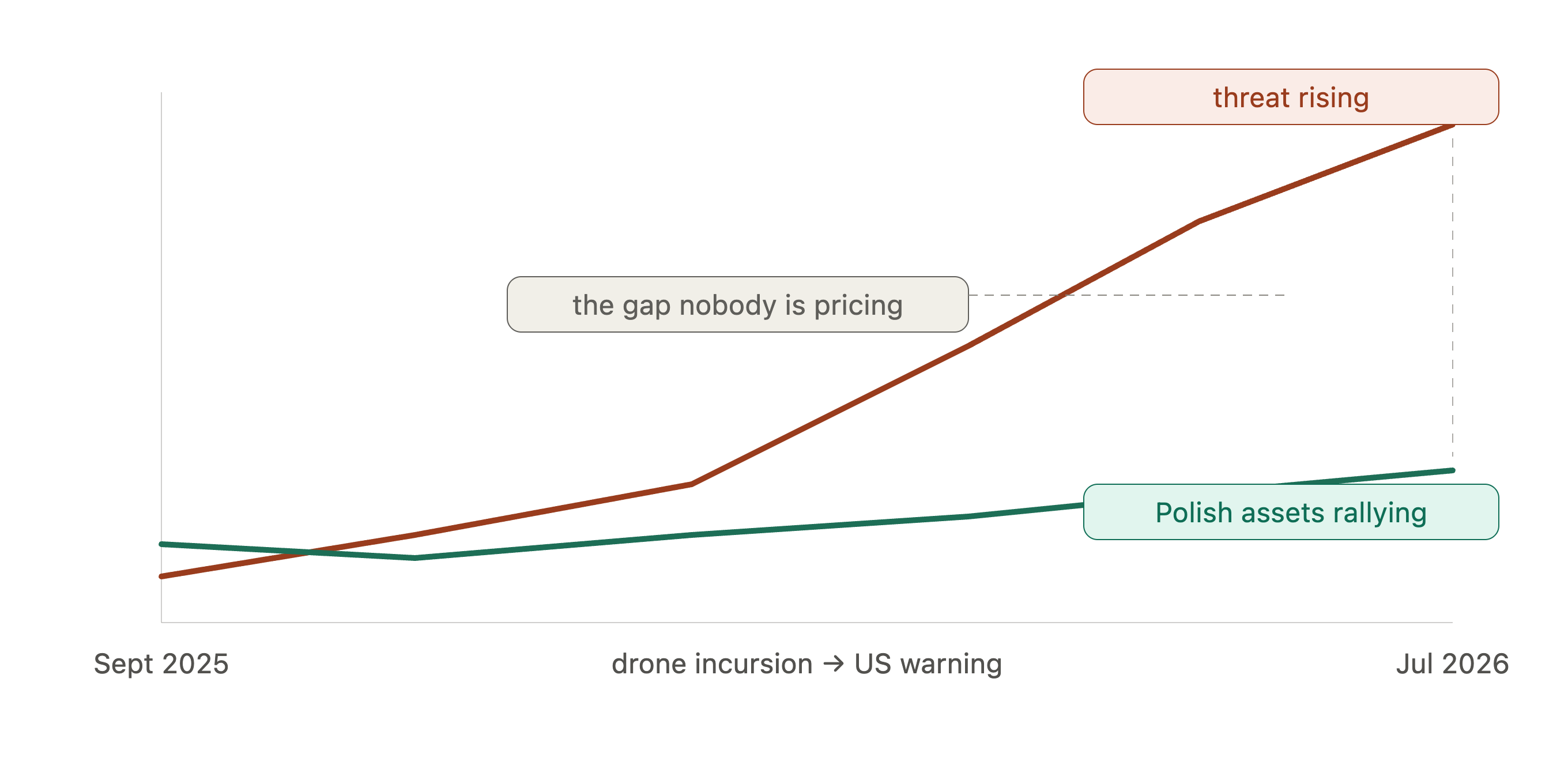
At the precise moment US intelligence is warning Warsaw of an imminent provocation, the Polish market is moving in the opposite direction. As I write, the Polish 10-year government bond yield has fallen nearly half a point over the past month, sitting around 5.2%. The zloty is up roughly 2% on the month and more than 3% on the year. Rates dropping, currency climbing—this is the price action of a country the market considers safer than it did a month ago.
Let that sink in. The single most exposed frontline state in NATO, the logistical spine of the entire Ukraine aid effort, home to some 10,000 US troops, is being told by American intelligence that Russia may hit its power grid within months—and its assets are rallying.
This is not a conspiracy or a mystery. It’s how markets treat tail risk they can’t price. A low-probability, high-impact event with no clear timing doesn’t fit into a spreadsheet, so it doesn’t show up in the price—until it does, all at once. The market isn’t stupid; it’s just structurally blind to the risks it can’t model. The VIX has no line item for “NATO cohesion.” Sovereign spreads have no field for “false-flag incursion.”
That blindness is the gap between the whisper and the price. And a gap between what intelligence services are saying and what prices are saying is, for anyone paying attention, not a warning to flee. It’s the setup.
Why this is already in your portfolio
Let me get to the part you’re actually here for—because most of you aren’t reading this from Warsaw. You’re in New York, in London, in Singapore. And I can already hear the question: why should a Russian provocation on a Polish power plant matter to my portfolio?
Here’s the honest answer. Think back to February 2022. Plenty of investors treated the invasion of Ukraine as a regional event—a tragedy, yes, but a contained one. They were wrong. It repriced energy across the planet, broke supply chains, ignited the worst inflation wave in forty years, and forced central banks into a hiking cycle that shredded bond portfolios from San Francisco to Sydney. A war “over there” turned out to be a war in everyone’s portfolio.
Now raise the stakes. Ukraine is not in NATO and not in the EU. Poland is both. It’s one of the European Union’s largest economies, the logistical backbone of every weapon flowing east, and a treaty ally of the United States. An incident on Polish soil isn’t a border story—it’s an Article 5 story, which means it’s a US story, a UK story, a story for anyone holding a single euro, dollar, or share of a defense contractor. If Ukraine sent a shock through the global economy, this would send a larger one—because this time the line being tested is the one the entire post-1945 order is built on.
And here’s the part that applies to you even if you never touch a defense stock. This isn’t only about making money on the way up. It’s about not losing it on the way down—because the assets that get hit won’t be the obvious ones. You can hold zero European defense names and still be exposed through positions you think of as neutral: your energy exposure, your EU equity index, your emerging-market bonds, your “safe” European bank. The goal of this edition is symmetrical: how to be positioned for the upside, yes—but first, how to stop being unknowingly short the very scenario intelligence services are warning about.
So over the next sections, and in the updates to follow, here’s what I’m going to work through:
The real impact on the global economy if this escalates—not the headline panic, but the second-order effects that actually move portfolios.
Which sectors get hit—and here I’ll push back on the consensus, because some of the “safe” names are more exposed than people think.
Which sectors get stronger—and they’re probably not the ones you’re picturing. The reflexive “buy defense” trade is only half right, and I’ll explain why.
How to position a portfolio to avoid a serious drawdown and tilt your exposure toward the upside—concrete, not hand-wavy.
Here’s where it gets actionable…