


Today’s edition is a guest post from MarketFighter, an investor who takes a very different approach from the thesis-driven research we usually publish at Macro Notes.
Instead of trying to forecast where markets are heading, his strategy systematically reacts to what markets are already doing.
I thought it was worth sharing because it offers a very different answer to a question every investor eventually faces: how much of investing should actually depend on our judgment?
Outperforming the market in the long run is a goal many of us share. We have different strategies, different mindsets, and different perspectives. But for most of us, the ultimate objective is the same.
I spent 15 years investigating and experimenting with all sorts of strategies. I read all the books and studied all the academic research.
Eventually, I settled on a simple, rules-based strategy that beat the S&P 500 in 22 of the last 26 years.
I’m an engineer from Denmark turned full-time investor and writer. I quit my job at 41 thanks to the returns from my strategy. Now I share my approach and my trades at The MarketFighter Strategy on Substack.
I was invited to write this guest post for you about how it works and how simple systematic investing can be the key to higher returns.
Why this approach is different
Before I explain how a rules-based approach can work, let me just briefly show the returns my strategy has delivered (measured in USD) since I started trading it actively in March 2021:
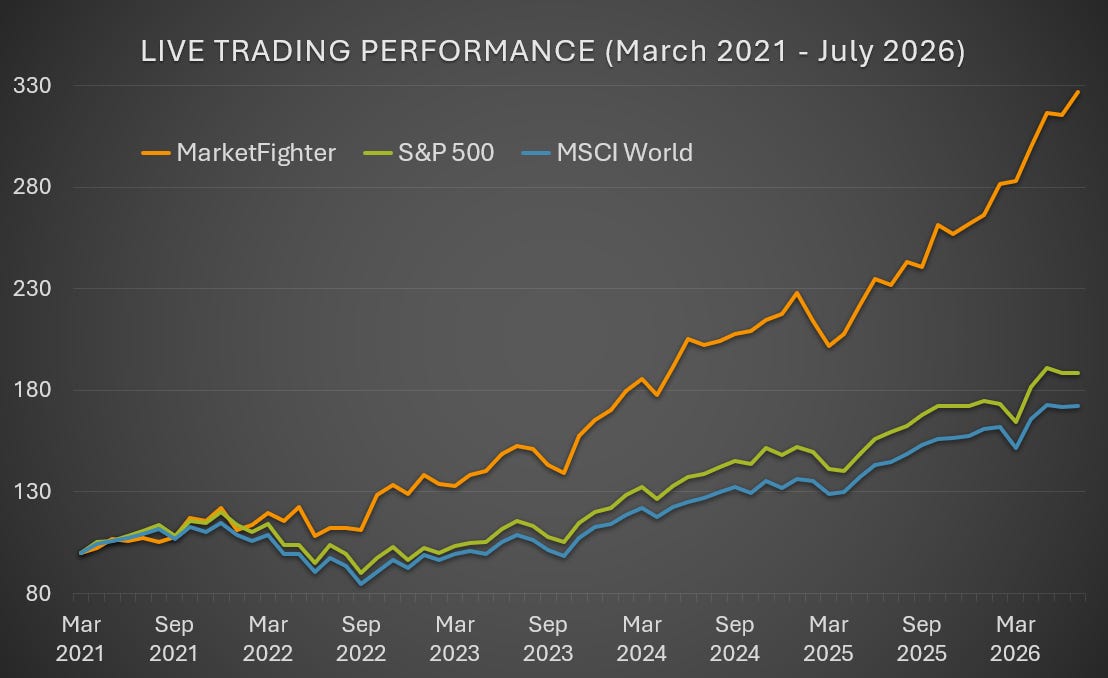
These results were achieved entirely through trading ETFs once a month (or less), spending approximately 15 minutes each time.
Investing in stocks usually involves some or all of the following:
Political analysis
Global macro analysis
Individual business analysis
Earnings analysis and company valuation
Technical analysis and chart reading
Forecasting
The systematic approach I finally settled on deals with none of the above. Instead, it focuses entirely on a set of predefined rules, rooted in academic research.
Traditional market analysis relies on investors being able to predict or anticipate future events that the market hasn’t priced in yet. Unfortunately, as you may know, all research shows that incredibly few are able to consistently succeed in this endeavor.
Even when you get the thesis right, the timing and execution has to be right as well. In the long run, you have to repeat this process, but with new trends, new markets, and new companies.
When I finally realized my chances of succeeding this way were minimal, I gave in to a humble investing mindset around six years ago.
This is a counter-intuitive philosophy that does not allow for any attempts to predict the future or be smarter than the market. I accept that I simply don’t know what will happen.
It’s the same way most index investors think. Index investing is the simplest form of systematic investing and the easiest way to apply the humble investing mindset.
But listen now: Most people stop here, which is a shame. Because there are so many options for optimizing the index approach with simple rules that most people never get exposed to.
Different results require a different approach
Although market-cap weighted indices like the S&P 500 compound at roughly 10% annually in the long run, the average investor only gains around 3% according to data.
None of us think we are average investors. Yet, all research shows it’s an incredibly small number of people on this planet who are able to somewhat consistently beat the market in the long run, without luck playing the major role.
Overconfidence, fear and greed, FOMO, recency bias, and all sorts of other human emotions play a much larger role than we like to think. All of these human instincts were designed for us to survive on the savannah. Not for doing well on financial markets.
Knowing how bad our chances of beating the market are and how most people never succeed, I came to an important conclusion: If you want a different result, you need a different process. I needed to find a different way to approach the market.
Now let me give you a brief idea of my journey towards this.
How my journey shaped my strategy
I started investing with a small amount of money when I was 18. I got completely hooked, but like most beginners I was overconfident and had no idea what I was doing.
I took some hits, and got humbled by the market. I was not the natural talent I thought I would be, but I kept learning from my mistakes, and my eagerness to succeed in the market only grew with the effort I put into learning and growing.
I’m a software engineer. I spent 15 years developing complex software applications for a living. There’s no doubt this background has shaped the way I approached the market and eventually ended up trading it.
You can find opinions and advice pointing in all directions, but if you apply a more rational and scientific approach to optimizing returns, there’s really only one thing that matters, if you ask me:
What are the most reliable and consistent factors for outperformance in the markets, historically?
We all know that past performance is never a guarantee of future returns. But if something has worked well across multiple decades and business cycles, history shows it has a high probability of continuing to do so.
Utilizing persistent market anomalies
The factors I’m talking about are based on persistent market anomalies resulting from human behavior. I’m sure you’ve heard of the most well-known examples:
Value
Momentum
Quality
Size
These are all quantitative and rules-based factors, and if you had bought stocks filtered by these over the past century, you would have significantly outperformed the market.
The problem with these factors is that each of them also exposes investors to long multi-year periods of underperformance from time to time.
That’s where strategic asset allocation and rotational strategies become interesting. My research led me to several other sources of more persistent market patterns that turned out to work with relatively high consistency.
Eventually, I spent months trying to put together all these pieces into a system I could easily trade for myself and my family.
Enter rules-based investing
When you invest systematically (rules-based), the core idea is that every trade you execute is entirely based on predefined rules. No personal opinions, no second-guessing, no emotions or discretionary analysis.
It’s the same approach many successful hedge funds apply.
But in my case, I wanted a long-term system that didn’t require my attention on a daily basis. I wanted a strategy with a high probability of long-term outperformance without being riskier than a market-wide index fund.
The system I settled on
Unlike most systematic strategies that focus on individual stock picking (and mostly apply to active traders), I chose to go for an optimized version of index investing, following a more passive approach.
I built a system based on the best ingredients I found in research: Quantitative factors, relative momentum, sector rotation, and defensive crisis rules.
Instead of trying to predict future events in the world, it reacts to market price trends regardless of what caused them.
Focusing on historical consistency and robustness in returns, I defined a universe of 15 ETFs divided into two baskets: One for factor-focused ETFs and one for sectors.
Then I set up rules to check the relative momentum in each basket once a month. I let the system pick the strongest one from each basket, based on these rules. Here’s an illustration of the concept:
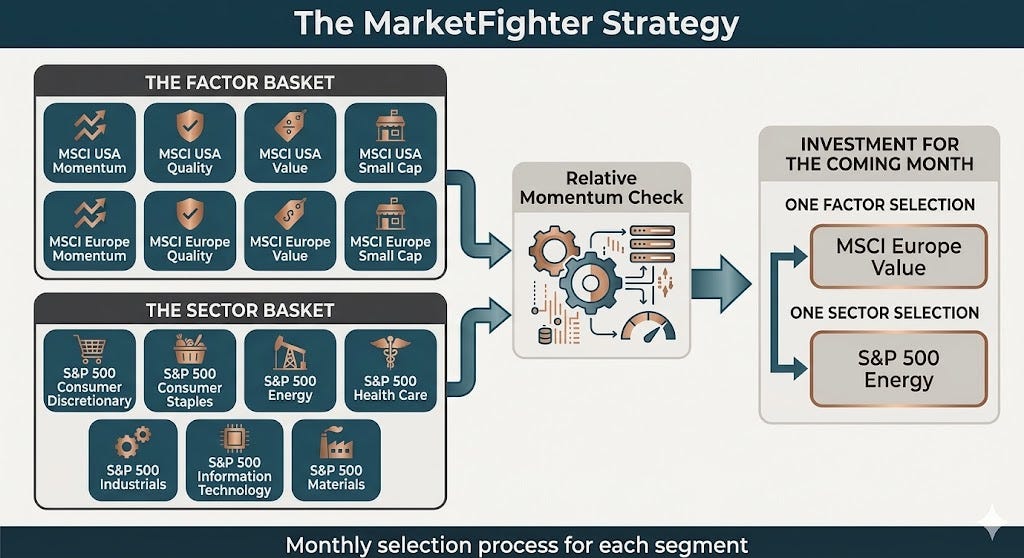
I run this process once a month, when the closing prices of the last trading day are settled. Then I allocate my money 50/50 into the two selected ETFs. After that, I do nothing until the next month has passed.
On top of this setup, I apply a drawdown protection rule consisting of three simple checks, all based on momentum as well. If all of them apply, I exit the market and wait for the next monthly signal. That’s it.
Testing and results
The beauty of entirely rules-based strategies is that they can be back-tested by applying the same rules on historical data. This way you can simulate historical performance to see how well it has worked.
Not all backtesting is beautiful, though. It comes with a lot of pitfalls, and simplicity often beats a system with many parameters and inputs. My system reads one thing only: Monthly closing prices. Nothing else.
I did the backtest on data from 2000 to 2020. Since then, I have traded it actively from 2021 until now. Here are the results by calendar year, measured in EUR and compared to the MSCI World Index (also in EUR):
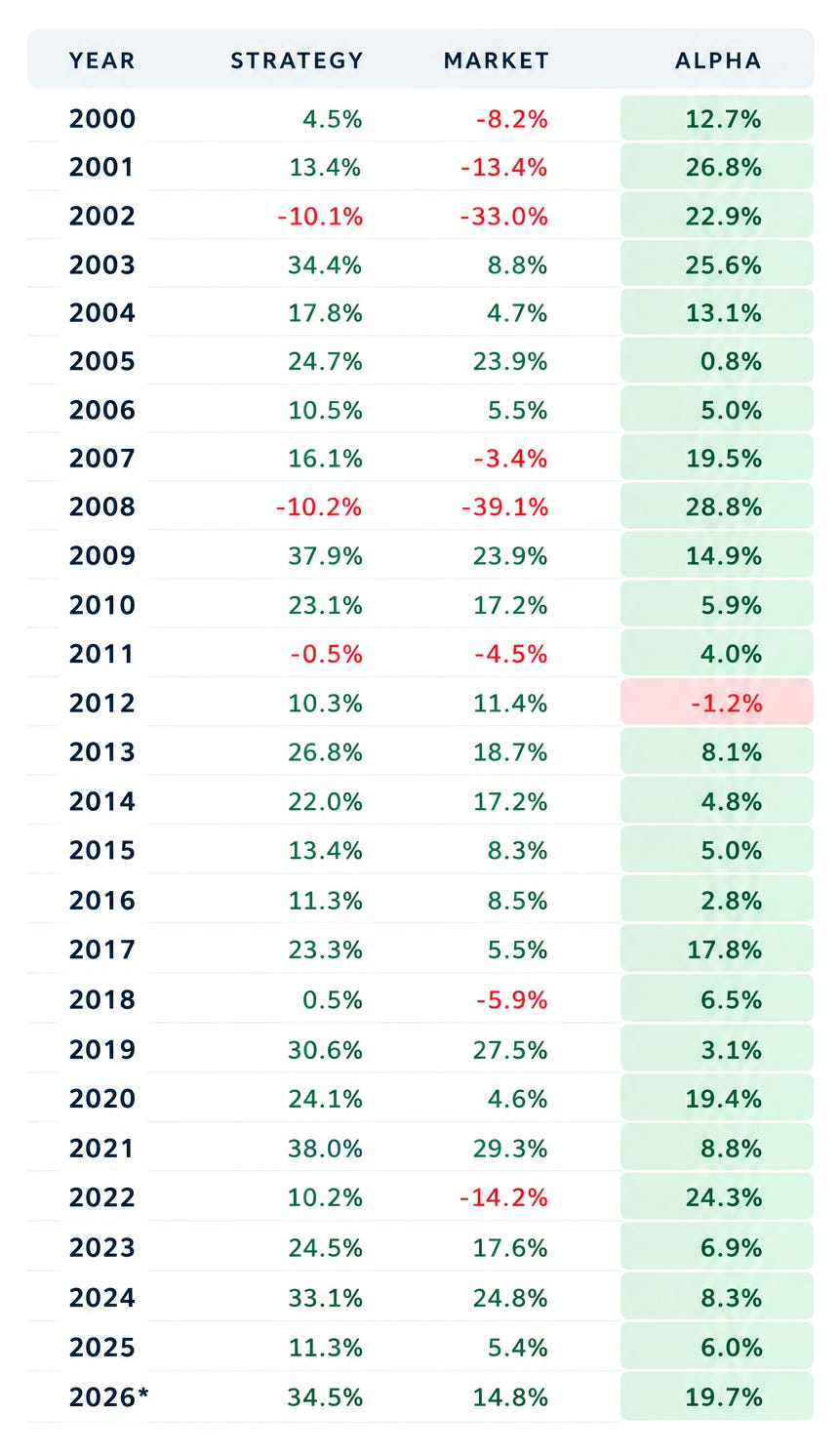
The numbers are return percentages, and the 2026 number is a year-to-date figure as of closing prices on September 23.
I chose the MSCI World Index as my main benchmark, because my strategy involves both US and European stocks. But as I mentioned in the beginning, a comparison to the S&P 500 (and measuring everything in USD) shows outperformance in 22 of the last 26 years.
Now you’re probably thinking: So, what’s the catch? Here it is: Executing a strategy like this requires a specific mindset. You can’t succeed with a systematic strategy if you’re not ready to follow the rules, no matter what happens. This demands strict discipline.
It may sound easy, but if you have strong opinions about the market and the system signals a trade that goes against these opinions, you may find it very hard to stick to the strategy. I’ve had to unlearn old habits and force my brain not to interfere.
My personal outcome
For me personally, this strategy has had a huge impact on my life. What works for one investor will not work for everyone, but I finally found my own way of conquering the market.
After five years of quietly trading this for myself and my family, I decided it was time to share it with others who might be interested.
Due to the returns I had achieved, I was able to quit my job earlier this year to live off the strategy and spend more time on my passion for investing as well as other things in life.
That’s when I started sharing my strategy on Substack. Once a month, before the markets open on the first trading day, I send out the trading signal my system generates. This reveals the two ETFs I will be holding for the coming month.
I strongly believe in transparency and open communication, which is why I share complete performance updates in public every month.
Thousands of investors are already following along, and I’m truly proud of what I have achieved just by approaching investing from a different perspective and taking the path less traveled.
If you found this post interesting and want to learn more about how it works, feel free to join our growing community at The MarketFighter Strategy.
Thanks for reading!

Disclaimer: The MarketFighter Strategy is for educational and informational purposes only. It is not financial advice, and the author is not a licensed investment advisor. Investing in ETFs involves significant risk, and past performance is never a guarantee of future results. You are solely responsible for your own trades and financial outcomes. Read the full Disclaimer here.
I’ve been using this Strategy since April and honestly, I like how simple it makes things. I used to spend a lot of time trying to pick the right stocks, but now I can just wait for the monthly signal and get on with my life :). And so far, the returns have actually been better than what I was doing myself.
Own systems while simple rules keep beating SPX.