Here is what almost every analyst I know gets wrong about robotics.
They ask: “When will humanoid robots be ready?”
That is the wrong question. It implies a binary — a single moment when robots cross some threshold from “not ready” to “ready,” like a drug receiving FDA approval.
That’s not how this works. That’s not how any general-purpose technology has ever worked.
The right question — the one with actual investment implications — is: “At what level of capability does the economics start to flip?”
And the answer is: the economics are already flipping. Right now. In specific sectors. For specific tasks. In ways that most people in finance haven’t noticed — because they’re too busy watching Tesla demos and waiting for a robot that can fold their laundry at home.
The market is waiting for a “ChatGPT moment” — one dramatic product launch that changes everything overnight. That’s not how this plays out. The real disruption is happening quietly, sector by sector, warehouse by warehouse, factory by factory. And the companies positioned for that disruption — not the domestic robot dream — are where the returns will be made.
Let me show you what I mean.
The math is already working — you’re just looking in the wrong place
A warehouse worker in the United States costs $55,000-$65,000 per year fully loaded — salary, benefits, payroll taxes, workers’ comp, training, and turnover costs that run 40-60% annually in logistics. That worker operates one shift. Call it 2,000 hours a year.
Agility Robotics’ Digit — the first humanoid robot commercially deployed in a real warehouse, at Amazon — costs approximately $250,000 at current pilot pricing. At that price, the math doesn’t work yet.
But here’s what almost nobody in the financial press is covering.
Goldman Sachs documented that the manufacturing cost of a humanoid robot dropped 40% in a single year — from $50,000-$250,000 to $30,000-$150,000 per unit. That’s not an industrial equipment cost curve. That’s a consumer electronics cost curve.
Unitree’s G1 ships today for $16,000. EngineAI announced its T800 at CES 2026 — a full-size humanoid, 1.73 meters, 75 kilograms, 450 Nm of joint torque — for $25,000. Tesla’s Optimus target: $20,000-$30,000.
At $25,000, operating 16 hours a day, 360 days a year, the three-year total cost of ownership drops below $15,000 per year. One-third the cost of a human warehouse worker. Triple the uptime. Zero turnover.
The robot doesn’t need to be a general-purpose household assistant. It just needs to move totes from shelf A to conveyor B, sixteen hours a day, without quitting.
That’s not a vision. That’s what’s happening. Digit is operating at Amazon. Figure 01 is at BMW. Toyota Canada just signed a commercial Robots-as-a-Service contract with Agility Robotics at its Woodstock plant. Boston Dynamics’ Atlas is fully allocated for 2026 — every unit shipping to Hyundai’s Metaplant in Georgia and Google DeepMind, with additional customer deployments planned early 2027.
These aren’t press releases. They’re multi-year capital commitments from companies that don’t spend money on toys.
The breakthrough that matters isn’t hardware — it’s the software nobody is covering
Everyone focuses on the physical robots. The demos. The backflips. The walking. That’s the wrong place to look.
The most consequential development in robotics over the past eighteen months happened at a San Francisco startup that most investors have never heard of.
Physical Intelligence — founded in 2024 by researchers from Google DeepMind, Stanford, and UC Berkeley — built a model called π0 (pi-zero). Think of it as GPT for physical movement. A single AI system, trained on data from seven different robot platforms performing 68 tasks, that can control any robot arm, any dual-arm setup, or any mobile manipulator — and learn new tasks from as little as 1-20 hours of demonstration data.
The demonstrations are not trivial.
π0 autonomously unloads a dryer, carries laundry to a table, and folds each item into a neat stack. Uncut video. Single policy. No teleoperation. No scripting. When a researcher deliberately interferes mid-fold — pulling a shirt away — the robot recovers and continues.
But here’s the detail that stopped me: during table bussing, π0 spontaneously developed a behavior nobody programmed. It shakes trash off plates before stacking them into the bin. That’s not a pre-coded instruction. That’s emergent reasoning — the same kind of contextual intelligence that, in language models, signaled the jump from GPT-3 to GPT-4.
Andrew Ng compared π0 to “GPT-1 for robotics — an inkling of things to come.”
In November 2025, Physical Intelligence raised $600 million at a $5.6 billion valuation. Jeff Bezos, Google’s CapitalG, Thrive Capital, Lux Capital all wrote checks. By March 2025, they had released an upgraded version using reinforcement learning with corrections: doubled throughput on tasks like espresso machine operation and laundry folding, decreased failure rates over hours of continuous operation.
Why does this matter for investors?
Because it solves the core bottleneck that has held robotics back for decades. Unlike language AI — where the internet provides trillions of training tokens — there is almost no large-scale robotics data. Deepak Pathak, a professor at Carnegie Mellon and CEO of Skild AI, states the problem bluntly: “Unlike vision or language, there is almost no robotics data internet.”
π0 cracks this by transferring knowledge from internet-scale language and vision training into physical robot control — then fine-tuning with small amounts of real-world data. The same architecture that lets GPT-4 understand context in a paragraph lets π0 understand context in a physical scene.
And it’s not alone. NVIDIA released GR00T N1 as an open foundation model for humanoid robots. Google DeepMind’s RT-X project — contributions from 21 institutions across 22 robot platforms — has become the ImageNet of robotics. A research team published GraspVLA, a model pre-trained entirely on one billion frames of simulated grasping that transfers to real-world manipulation with high accuracy — potentially eliminating the need for expensive real-world training data altogether.
The implication for investors is clear: value in humanoid robotics is shifting from hardware to software. The company that builds the best robot body may matter less than the company that builds the best robot brain. And right now, the robot brain companies are being valued by AI investors, not by robotics investors — creating a pricing gap that public markets haven’t noticed.
What actually works today — and the honest gap nobody talks about
I want to be direct about the current state of the technology, because I think credibility is more valuable than hype.
Most of what you’ve seen on social media about humanoid robots is misleading. The viral videos — backflips, Kung Fu, cooking — are overwhelmingly teleoperated, pre-scripted, or edited to remove failures. The gap between the Instagram version and the factory floor version is enormous.
What works reliably in March 2026:
Flat-surface locomotion at 1-2 m/s. Solved across multiple platforms. Pick-and-place with standardized objects — boxes, totes, components in predictable size ranges. Following natural language commands through AI models — “grab the red box, put it on the top shelf” — and executing. Repetitive manufacturing tasks: loading, sorting, machine tending. These are commercially deployed, not lab demos.
What doesn’t work yet — but is closing faster than expected:
Fine dexterity was the hardest unsolved problem — until this year. At UC San Diego, Xiaolong Wang’s team built robotic hands that manipulate delicate objects by touch alone, no vision required. NVIDIA’s DexMimicGen generates massive dexterous training datasets from just a few human demonstrations. Matrix Robotics unveiled the first robotic hand with 27 degrees of freedom — matching human anatomy — with biomimetic skin and zero-shot task generalization. None of these are in commercial products yet. But the timeline from lab to product in AI has compressed from a decade to 2-3 years.
Battery life remains at 2-4 hours — versus 8 hours for a human worker. Solid-state batteries may push this to 6-8 hours by 2028-2029.
Unstructured environments — a messy apartment, a construction site — still break robots. Every commercial deployment still requires human teleoperators at a ratio of roughly 1 human per 5-10 robots.
Here’s my core investment thesis, stated as clearly as I can:
The domestic robot everyone is dreaming about — the one that cleans your house, cooks your meals, and takes care of your elderly parents — is a 2033-2038 product at the earliest. Probably later for mass adoption.
But the industrial robot that moves totes in a warehouse, loads parts in a factory, inspects components on a production line, and handles hazardous materials in a mining operation — that robot is deploying now, at price points that are reaching economic viability, with a software stack that is improving at the pace of AI, not the pace of traditional manufacturing.
The market is pricing humanoid robotics as if everything depends on the domestic dream. I’m positioning for the industrial reality.
The Elon Musk distortion — what he gets right, what he gets wrong, and why it doesn’t matter
Musk says work will be optional in 10-20 years. A Yale Budget Lab report found that since ChatGPT launched, the labor market has experienced “no discernible disruption” from AI. Physical robotics faces steeper constraints than software — as economist Ioana Marinescu puts it: “We’ve been at making machines for centuries, and you often run into decreasing returns.”
Musk says Optimus will perform surgery by 2030. In March 2026, Optimus drops a coffee cup 5-10% of the time. That claim is marketing, not engineering.
Musk says 80% of Tesla’s value will come from Optimus. This I take seriously — not for the timeline, but because Tesla is converting Fremont factory space for Gen 3 production and targeting annual capacity of one million units. Real capital allocation follows real conviction.
Musk says robots will eliminate poverty. Technology has never eliminated poverty. Distribution systems do. The cotton gin didn’t liberate enslaved people. The internet didn’t close the wealth gap. Every transformative technology creates enormous value — the question is who captures it.
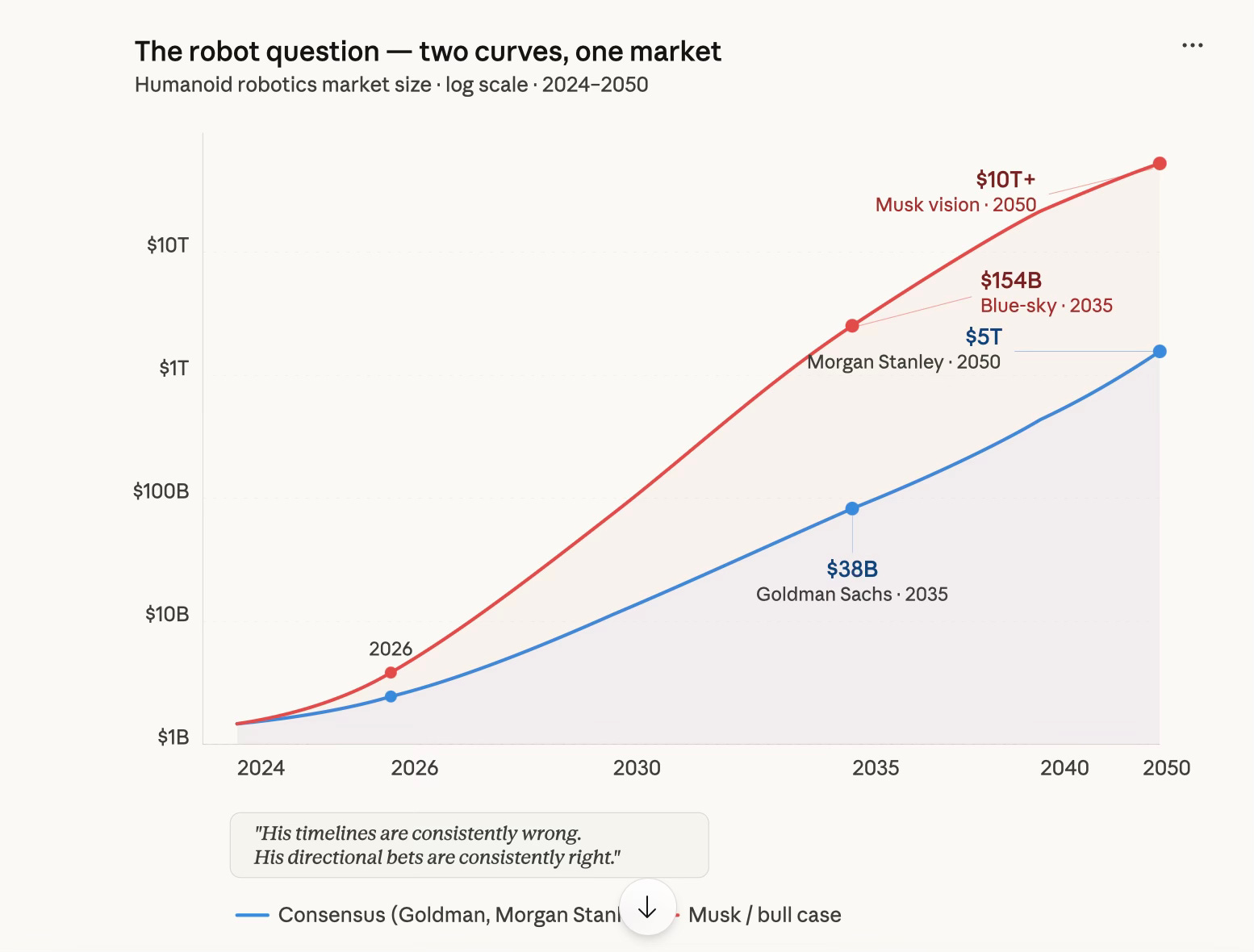
But here’s what matters for investors: Musk’s timelines are consistently wrong. His directional bets are consistently right. He was years early on EVs and right about the market size. He was years early on reusable rockets and right about the cost curve. He is almost certainly years early on humanoid robots.
Goldman Sachs projects the humanoid market at $38 billion by 2035 — revised upward sixfold. Blue-sky: $154 billion. Morgan Stanley: $5 trillion by 2050 including the full ecosystem. The range is enormous because forecasts depend on cost curves and adoption speed.
I’m positioning around the Goldman base case with optionality toward the higher numbers. And I’m doing it through the companies that win regardless of which robot platform dominates — the same “picks and shovels” approach I applied to AI infrastructure and European defense.
The China wildcard
China has designated humanoid robotics as a strategic national priority. State subsidies are flowing at a scale that dwarfs Western investment. Chinese companies — Unitree, Agibot, Fourier, UBTECH — are shipping production units at price points Western competitors cannot match.
This is the EV playbook. The solar playbook. The drone playbook. Identify a strategic technology, flood it with state capital, scale production until Western margins collapse.
SoftBank just announced plans to acquire ABB’s robotics business for $5.375 billion — signaling that one of the world’s largest tech investors sees industrial automation as the next platform.
Global robot density has more than doubled in seven years — from 74 to 162 robots per 10,000 employees. Total operational stock: 4.6 million industrial robots worldwide, up 9% year-over-year. The installed base is accelerating before humanoids even reach commercial scale.
The countries and companies that control the robotics supply chain — actuators, sensors, rare earth magnets, AI compute — will capture a disproportionate share of value. Right now, that supply chain is forming around Asia, exactly as it did with smartphones and EVs.
What I built — and what’s behind the paywall
I’ve spent three months mapping this sector the way I mapped European defense, AI power infrastructure, and copper before it. Same methodology. Same rigor.
What I found: the smart money — corporate, venture, sovereign — is deploying capital at an accelerating rate, while public equity investors are still debating whether robots are “real.” The gap between private market conviction and public market pricing is the widest I’ve seen since I started covering AI infrastructure.
Here’s what premium subscribers get:
My 14-position robotics portfolio. Every ticker, entry zone, position size. Four categories: pure-play builders, component chokepoints, AI infrastructure, and disruption shorts. Including the one company I consider the single best risk-adjusted entry — a component supplier inside six of the twelve leading platforms, trading at a valuation that implies the market hasn’t noticed.
The full supply chain map. A humanoid has ~10,000 components. I mapped the chokepoints where one or two companies control global supply. A Japanese precision actuator company at 14x forward earnings. An American sensor company that’s become the standard for robotic force-torque feedback, priced like a boring mid-cap.
Break-even economics by vertical. At what price does deployment become profitable in warehousing vs automotive vs healthcare vs agriculture? The answers determine which sectors adopt first — and which companies to own for each wave.
The China report. Three investable companies for Western portfolios, priced as if China’s robotics ambition doesn’t exist.
6 catalysts with timing. Tesla Optimus Gen 3. Atlas at Hyundai. Figure AI Series C or IPO. NVIDIA GTC robotics. SpaceX IPO spillover. One EU regulatory decision that reshapes adoption.
The sectors facing destruction. Temporary staffing ($200B+ annual revenue at risk). Workers’ comp insurance. Offshore manufacturing logistics. Specific companies, specific short theses.
Position sizing for a pre-revenue sector. Why no position exceeds 5%. My barbell framework. The three scenarios that kill this thesis and how I’m hedged.
The anchor position in this playbook is not a robot manufacturer.
It’s a forty-year-old precision engineering company that supplies critical motion control components to six leading humanoid platforms. Recurring revenue from maintenance contracts. No analyst coverage from major U.S. banks. A forward multiple that would look cheap for a mature industrial — let alone a company at the center of a $5 trillion secular shift.
It’s invisible because its name doesn’t contain the word “robot” and its investor presentations still lead with legacy customers. That’s exactly why it’s mispriced.
That company, my full thesis, and exact entry zone are in the premium edition.
🔒 The Full Robotics Playbook - 14 Positions. Supply Chain Map. The Sectors That Will Be Destroyed. My Investment Framework for the $5 Trillion Machine Revolution.