

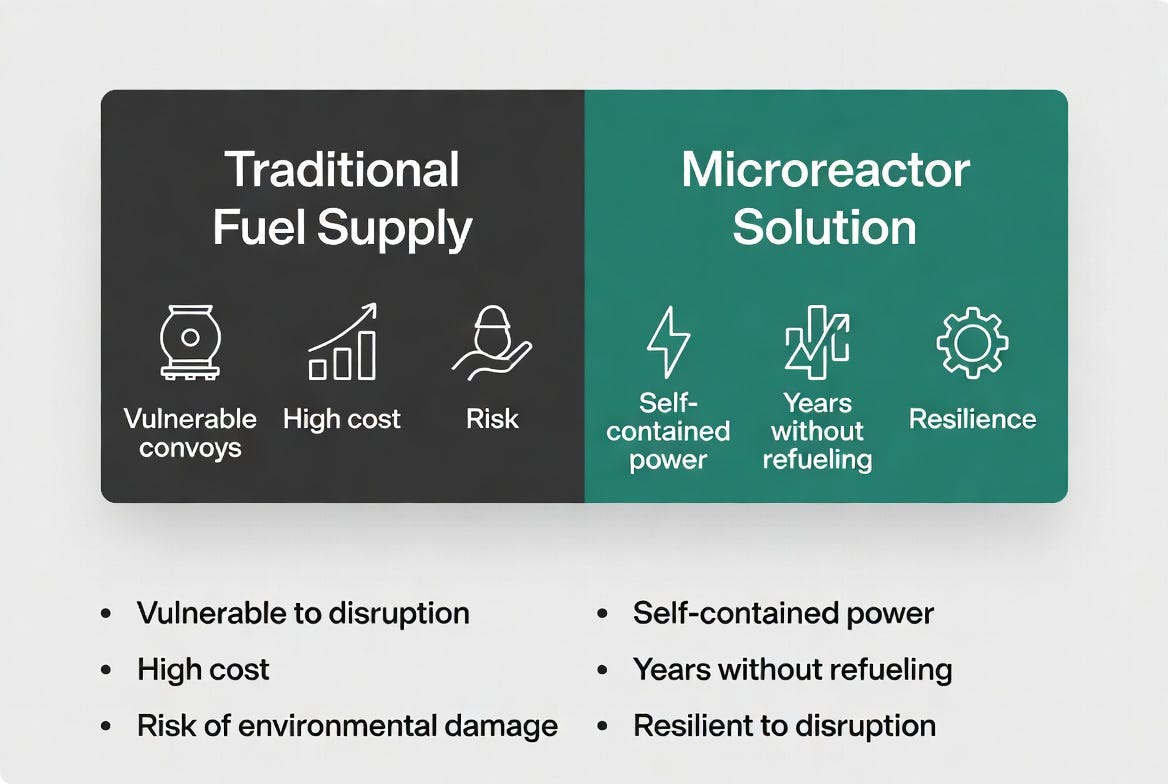
The Pentagon has a weak point: its bases and operations still depend heavily on vulnerable, expensive, and increasingly risky fuel convoys.
This is exactly why microreactors are no longer just a research project. They are becoming an operational and strategic priority. And the US military is moving faster than most investors realize.
At Macro Notes, we then conducted in-depth research — reviewing DoD solicitations, company filings, program updates, and speaking with people directly involved in these initiatives — to understand exactly what is happening and what it means for investors. Here is what we found.
A single forward operating base can consume tens of thousands of gallons of fuel per day. In places like Afghanistan or across the Pacific, protecting and moving that fuel has historically cost the US military several dollars per gallon delivered — sometimes much more when you factor in convoy security, casualties, and lost equipment.
This is not just an accounting problem. It is a strategic vulnerability.
Adversaries know exactly where the weak point is. In a high-intensity conflict, fuel convoys become high-value targets.
We have reached the point where the cost and risk of traditional fuel supply chains are becoming unacceptable for a 21st-century military that wants to project power in contested environments.
The solution the military has chosen
Instead of trying to protect ever-longer supply lines, the Department of Defense has decided to bring the power plant to the base.
Microreactors — compact, factory-built nuclear reactors typically under 20-50 MW — are designed to be transportable (some by C-17 or even truck), to operate for years without refueling, and to provide 24/7 carbon-free baseload power with minimal manpower.
This is not science fiction anymore.
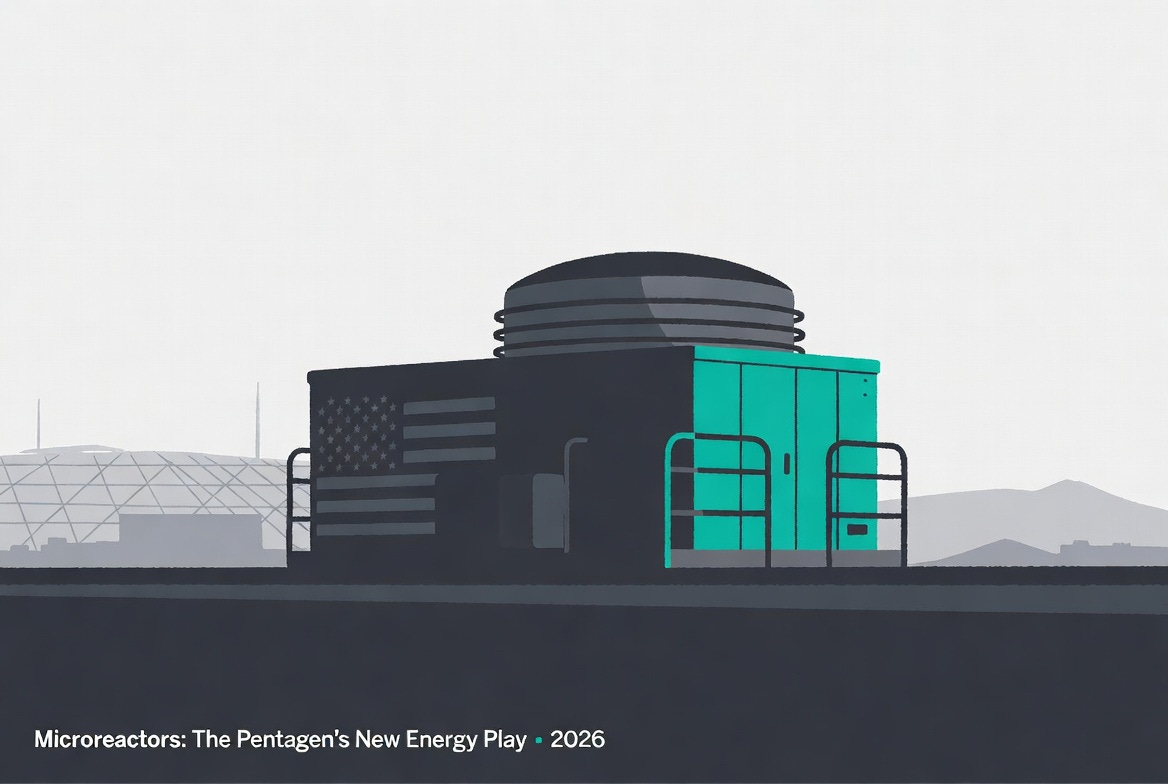
Project Pele (DoD Strategic Capabilities Office) has already broken ground at Idaho National Laboratory. BWXT is building the prototype. The goal is a transportable microreactor that can be rapidly deployed to austere locations.
Even more significantly, the US Army launched the Janus Program in late 2025. It aims to install microreactors directly on domestic military bases, with a target of initial deployments around 2028. Nine installations have already been shortlisted.
The Air Force, for its part, has selected Oklo to deploy its Aurora microreactor at Eielson Air Force Base in Alaska, with operations targeted as early as 2027.
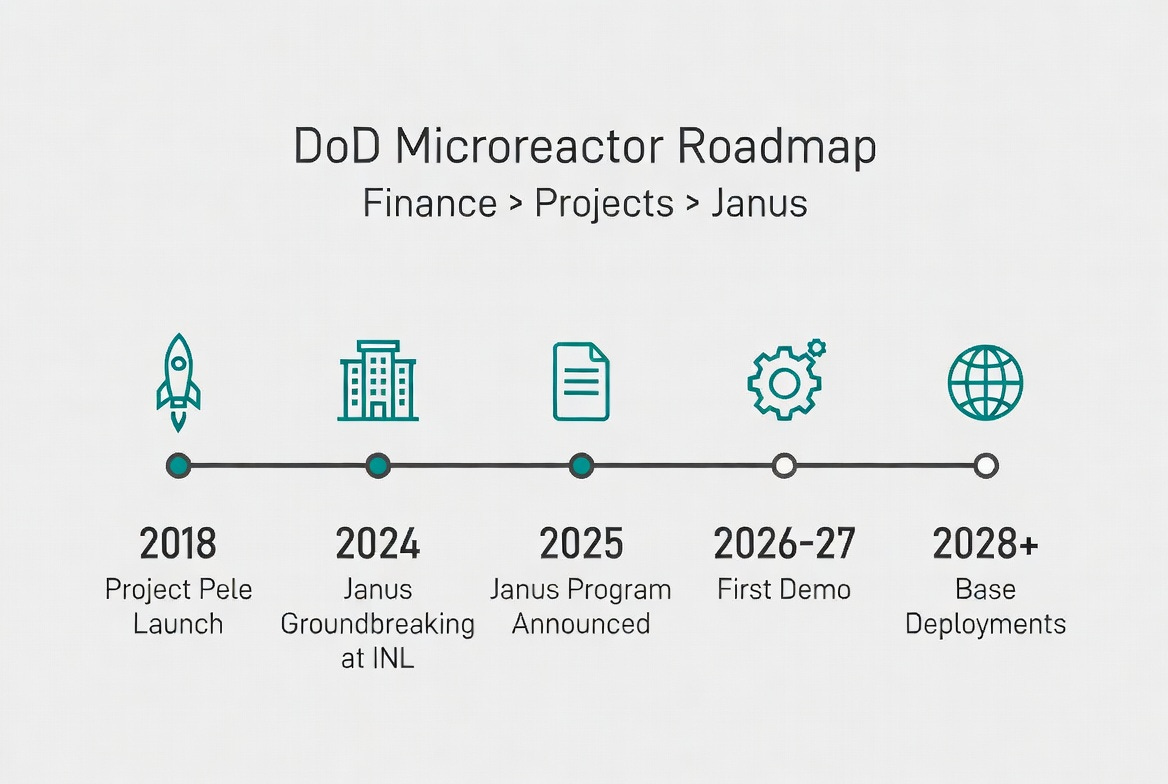
This is no longer a research program. It is moving into execution mode.
Why this matters for investors
We believe microreactors for military and remote applications represent one of the most asymmetric setups in the entire energy transition right now, for three reasons:
Government is the anchor customer — This dramatically de-risks the first units (something commercial SMRs are still struggling with).
The need is urgent and non-discretionary — Energy security for critical installations is not optional. Budgets will be found.
The commercial spillover is massive — Once the technology is proven and licensed for military use, the same designs become credible for remote mining, Arctic operations, data centers, islands and disaster relief. The total addressable market is far larger than pure defense.
At Macro Notes, we have been tracking the advanced nuclear space closely. What strikes us about the microreactor segment for military and remote power is how under-appreciated the momentum has become relative to the broader SMR narrative.
The companies that can actually deliver first-of-a-kind units in the next 24-36 months are pulling ahead fast — and the market has not yet fully priced the implications.
For paid Macro Notes subscribers, we deliver the complete investor package:
Detailed head-to-head on the companies best positioned (public and private), with our assessment of who is most likely to win DoD and commercial contracts
Precise timeline of milestones through 2028-2032 (licensing, demonstrations, first base deployments, commercial scale-up)
Valuation framework and portfolio construction ideas (how we think about sizing positions in this theme)
Full risk assessment (regulatory, technical, fuel supply, political and execution risks) with our mitigation views
Downloadable tracker of all active microreactor programs, offtake discussions and key catalysts
The shift from “protecting fuel convoys” to “bringing the power plant with you” is one of the most under-the-radar but strategically important transitions happening in defense and energy today.
The companies that execute on it will have very strong positioning for the next decade…
Macro Notes is part of Altis.finance, a specialized financial research firm that publishes dozens of in-depth newsletters across multiple verticals.
Our mission is straightforward: deliver high-quality research that helps our readers identify where long-term value is shifting and build concentrated positions designed to compound over time.
Most of our subscribers are fund managers, family offices, and sophisticated retail investors who share the same philosophy — focusing on structural shifts rather than short-term noise.
As a paid member, you get full access to all our research and an invitation to our private Telegram group, where you can exchange ideas directly with other premium investors.