


Today on Macro Notes, I want to talk about the Arctic.
A piece of news has flown somewhat under the radar, yet it has important geopolitical implications—and could support a new investment cycle, with opportunities for a few companies positioned to benefit.
The Arctic has long been strategically important, particularly during the Cold War. Today, that importance is becoming clear again.
To put it simply, whenever tensions rise between the West and Russia, the Arctic becomes an even more sensitive region.
That was true during the Cold War, and it is true today.
When we talk about the Arctic, we are talking about maritime routes and a meeting point between Europe, North America, and Russia. We are also talking about access to the North Atlantic, which connects Europe to some of its most important economic and military partners.
But you don’t read Macro Notes for a history lesson. You read it to understand how macroeconomic and geopolitical changes create investment opportunities.
In this newsletter, I’ve covered popular themes such as space, AI infrastructure, and European defense. But, to be honest, some of the most interesting macro investing opportunities, with potentially attractive risk-reward profiles, can be found in less fashionable areas.
So I’ve spent the past few days researching this subject. It is a theme I’ve had on my watchlist for some time, particularly since Russia’s full-scale invasion of Ukraine.
So why is the Arctic strategic?
As I mentioned earlier, maritime routes are a major part of the story. But the region also hosts communications infrastructure and military installations.
Each major power wants to protect its infrastructure and interests.
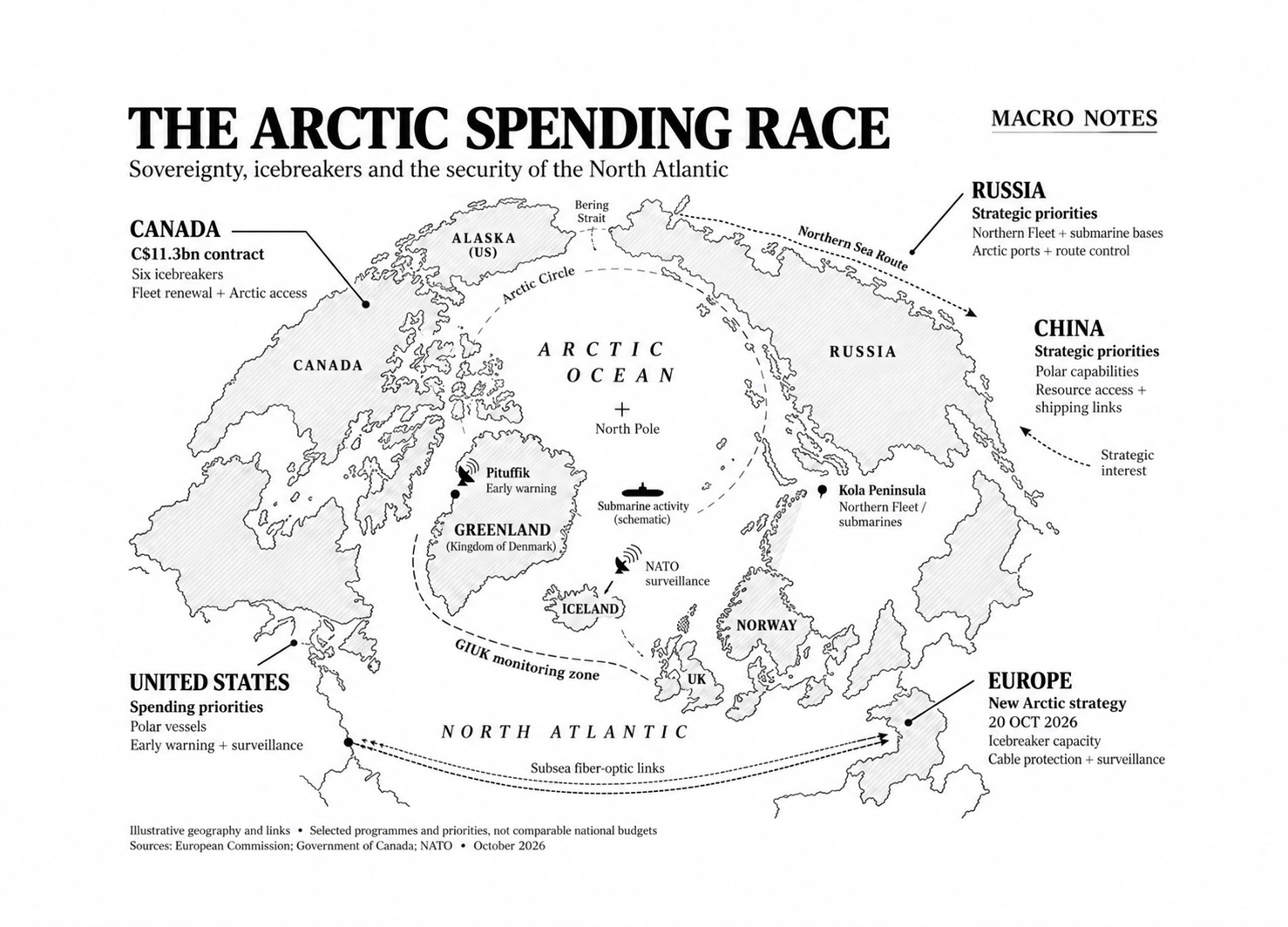
Russia wants to protect its military capabilities in the High North, its resources, and its control over the Northern Sea Route.
China wants access to resources and an additional maritime option between Asia and Europe.
The United States and Canada want to protect their sovereignty, monitor their maritime approaches, and renew their fleets and operational capabilities.
For Europe, a major priority is securing the High North and protecting its connections with North America. NATO explicitly identifies the Arctic as a gateway to the North Atlantic, with vital trade, transport, and communications links between the two continents.
With Russia’s war in Ukraine continuing and tensions with the West remaining high, that last point is particularly important.
The reason is straightforward: look at what depends on those connections.
Trade: approximately €993 billion in goods were exchanged between the EU and the United States and Canada combined in 2025, across all modes of transport. This is the scale of the trading relationship, rather than the amount passing through any single maritime corridor.
Energy: the United States supplied 58% of the EU’s LNG imports in 2025, equivalent to roughly a quarter of its total gas consumption, according to ACER.
Communications: submarine fiber-optic cables carry 99% of intercontinental internet traffic worldwide. This figure covers the global network, including the cables connecting Europe and North America.
A small geographical clarification matters here: those transatlantic cables mainly concern the North Atlantic, rather than just the Arctic Ocean. Our broader research theme covers both regions, because activity in the High North can affect the security of infrastructure and maritime routes farther south.
This does not mean that controlling an Arctic route would give Russia control over all transatlantic trade. It does mean that the ability to threaten these connections would create a serious vulnerability.
A prolonged disruption could raise shipping and insurance costs, delay industrial supplies, and put pressure on energy prices.
To give you a sense of the scale, a €10/MWh increase applied to the EU’s entire annual gas consumption would represent roughly €36 billion in additional costs. That is an illustrative sensitivity calculation using 2025 consumption—not a forecast of the impact of an Arctic crisis. Contracts, hedging, and changes in consumption would affect the actual bill.
These strategic priorities translate into demand for specialized vessels, polar capabilities, communications equipment, operational infrastructure, and maritime surveillance.
For Europe, they also strengthen the case for protecting underwater infrastructure and improving its ability to operate in difficult northern conditions.
Then, two days ago, a development appeared in my news feed that made me take a closer look.
On October 20, 2026, the European Union presented its new Arctic strategy.
It includes plans to strengthen European icebreaker capabilities, improve maritime surveillance, and support the monitoring, protection, and repair of submarine cables in the North Atlantic–Arctic region.
This was the announcement that pushed me to go deeper into the subject and examine the investment implications more closely.
It also follows another, more concrete development: on August 24, 2026, Canada awarded an C$11.3 billion contract, excluding taxes, for the design and construction of six new icebreakers.
Here, we have an actual industrial commitment.
These ships will replace aging vessels and operate in several regions, including the Arctic during the summer. So this is partly a fleet-renewal story, alongside the need to strengthen Canada’s northern capabilities.
The European announcement suggests that Europe is moving further in a direction already supported by industrial commitments in North America.
There is still an important distinction: a strategy sets priorities; funded contracts create orders. The European plans will need to translate into budgets and procurement before we can measure their full commercial impact.
For investors, the next step is to look closely at how that money could be spent.
How large is the addressable market? Which companies are already supplying the relevant equipment? Which parts of the supply chain could capture the most attractive margins? And where could additional orders make a meaningful difference to a company’s earnings?
A large shipbuilding contract does not automatically produce attractive profits. The terms, execution costs, and equipment suppliers all matter.
That is why I want to follow the spending beyond the headline announcements: from government priorities to contracts, from contracts to suppliers, and from suppliers to operating results.
The opportunity is to identify a company for which this investment cycle could meaningfully improve earnings—and then determine whether its current share price already reflects that potential.
Discover the next macro investing opportunity — and follow the thesis as it develops.
Until December 31, 2026, you can join Macro Notes Premium for $350 per year and keep this annual rate for as long as you remain subscribed.
Premium gives you access to:
All our Premium editions and the full archive, exploring the macro investment theses we believe have the greatest potential, the companies exposed, and the risks that matter.
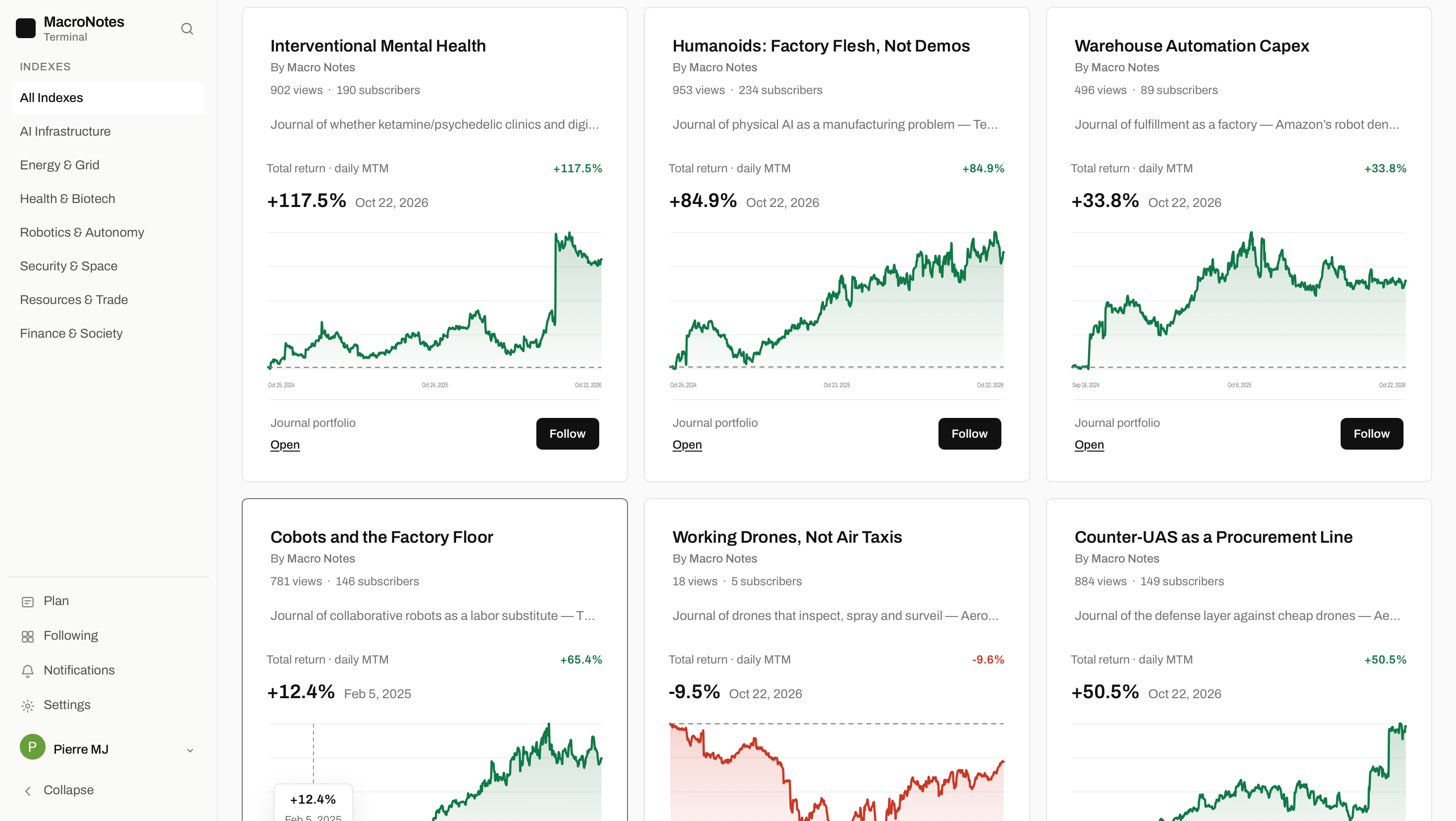
Macro Notes Terminal, where you can follow more than 100 investment theses through portfolios updated in real time.
Our trades as they happen, so you can follow when we initiate, add to, reduce, or close positions.
A history of important events and analyst notes, explaining how each thesis is evolving.
Forward-looking scenarios, outlining possible developments and the milestones that could strengthen or weaken the investment case.
Macro Notes helps you discover promising macro investing ideas. The Terminal lets you follow what happens next—from the initial thesis to the positions and the decisions along the way.
Join for $350 per year and keep your rate while your subscription remains active.
Become a Macro Notes Premium member →
Macro Notes Premium - Arctic Spending Race (Part 1)
At Macro Notes, we don’t only cover investment theses once they have been confirmed and become obvious. Much of our research focuses on theses that are still emerging, when there is more uncertainty—and potentially more opportunity.
Today’s edition explores one of those themes: an emerging macro thesis with significant potential.
In the Premium section, we’ll take the next step: build an initial investment framework, identify the companies worth watching, and examine what would make them attractive investments.
Here’s what you’ll find:
Where the spending is going: the programmes behind the headlines and the parts of the supply chain that could benefit.
A shortlist of stocks to watch: what each company contributes, why it matters, and how meaningful this opportunity could be for its business.
An initial company analysis: operating performance, competitive position, valuation, and what the current share price may already reflect.
The events we’re waiting for: contracts, funding decisions, and financial milestones that could strengthen the thesis and justify starting a position.
The risks and scenarios: what could delay the opportunity, weaken the investment case, or lead us to change our view.
This is the beginning of our coverage. Future Premium editions will follow the thesis as new information becomes available and explain if and when we decide to build positions, including the reasoning behind those decisions.
As a Macro Notes Premium member, you’ll also be able to follow the thematic index once it is added to Macro Notes Terminal, alongside our subsequent research and portfolio updates.
Discover the thesis today—and follow how it develops, from the first watchlist to potential positions.