

In June 2025, Neuralink announced a $650 million funding round.
In January 2026, Merge Labs, another company working on brain-computer interfaces, announced $252 million in funding. Two months later, Science Corporation raised $230 million.
Then, in September, Precision Neuroscience raised another $250 million, bringing its total funding to $430 million.
And these are just a few examples.
According to Neurofounders, 363 neurotechnology companies tracked in its database recorded approximately $2.64 billion in financing during the first half of 2026, across 81 transactions. The figures include equity financing, debt, grants, and some public-market activity.
The capital is flowing into several areas, from brain-computer interfaces and neuromodulation to neural imaging, diagnostics, and new forms of computing.
Many of these technologies are still in their early stages, and their commercial potential remains uncertain.
But something interesting is happening.
Investors are committing increasingly significant amounts of capital to technologies that could fundamentally change how humans interact with machines, how neurological conditions are treated, and potentially how certain parts of our economy function.
And this brings me to a question I have been thinking about.
Could neurotechnology become the foundation of the next trillion-dollar markets?
I am not suggesting that it will. We are still far from knowing which technologies will succeed, how quickly they could be adopted, or whether their economic impact will ever reach that scale.
But I think it is a question worth investigating, because we have seen a similar pattern before.
How Trillion-Dollar Markets Begin
Think about the Internet.
In its early commercial years, it was difficult to imagine how a new communication network would eventually transform retail, advertising, payments, media, and software.
Yet those changes helped create entirely new markets and some of the most valuable companies in the world.
The smartphone followed a similar trajectory. What initially looked like a new generation of mobile phones eventually enabled entire industries around mobile applications, digital advertising, payments, mobility, and location-based services.
Electric vehicles offer another example. The transformation extends beyond car manufacturers, affecting batteries, electricity infrastructure, charging networks, materials, and the traditional automotive supply chain.
And now we are watching something similar unfold with artificial intelligence.
A few years ago, companies such as OpenAI and Anthropic began attracting substantial amounts of private capital to develop increasingly capable AI models.
Today, the economic consequences extend far beyond those laboratories.
Demand for computing power has triggered hundreds of billions of dollars in infrastructure investment, benefiting semiconductors, data centers, networking equipment, and electricity infrastructure.
NVIDIA is one of the clearest examples of how a technological transformation can create extraordinary opportunities in public markets.
Its Data Center business grew from approximately $15 billion in fiscal 2023 to more than $193 billion in fiscal 2026.
But the transformation does not stop with infrastructure.
AI is also beginning to reshape cybersecurity, enterprise software, professional services, and potentially the economics of human labor.
Some of these markets could expand significantly. Others may be disrupted, with economic value shifting from established companies toward new business models.
And many of these changes are only beginning.
What connects these examples is not simply that a new technology created a large industry.
It is that a single technological breakthrough can trigger structural changes across multiple industries, creating or transforming markets worth hundreds of billions, and potentially trillions, of dollars.
The greatest opportunities are not necessarily concentrated in the companies that originally developed the technology.
They can emerge years later, in entirely different sectors, as the innovation changes how businesses operate, how consumers behave, and where economic value is captured.
Finding the Next Trillion-Dollar Opportunities
This brings me back to neurotechnology.
The hundreds of millions of dollars flowing into companies such as Neuralink, Merge Labs, Science Corporation, and Precision Neuroscience are interesting.
But those funding rounds are not themselves the investment opportunity I am looking for.
What matters is the possibility that these companies are helping develop technologies that could eventually transform much larger parts of the economy.
Today, the most tangible applications are medical: restoring certain neurological functions, helping people with paralysis interact with digital devices, and developing new treatments for disorders of the nervous system.
These markets could already become significant.
But what if future advances make neural interfaces safer, more capable, less invasive, and accessible to a much larger population?
Could they create new ways to interact with computers? Change parts of the robotics industry? Transform certain medical treatments or assistive technologies? Eventually enable entirely new categories of software and services?
These possibilities are far from certain, and some may never become commercially viable.
But this is exactly the kind of research I find interesting.
If a new technological capability has the potential to change several industries, the opportunity is not simply to identify which startup will succeed.
It is to understand the economic transformations that could follow, estimate how large those changes might become, and identify which publicly traded companies could capture the resulting value.
This is also where private markets become particularly useful.
When venture capital firms begin committing substantial amounts of money to an emerging technology, they may be revealing an early shift in technological possibilities and expectations about future markets.
That does not mean their expectations are correct. History is full of heavily funded technologies that failed to become commercially successful.
But these investments can provide an early signal worth investigating, sometimes years before the economic consequences become visible in public-company earnings.
I think this creates an interesting approach to global macro investing.
We can observe where private capital is concentrating, investigate the technological capabilities being developed, and work several steps ahead to understand which industries could be transformed.
Then, using a top-down approach, we can move from those potential structural changes toward the companies positioned to benefit.
This is how I want to think about identifying the next trillion-dollar opportunities.
Not by predicting the next trillion-dollar startup, but by identifying the next economic transformations capable of creating trillion-dollar markets.
And ultimately, finding where the resulting value could translate into attractive opportunities in public equities.
The Real Opportunity Is in the Second- and Third-Order Effects
What makes this approach particularly interesting is that the most obvious consequences of an innovation are not necessarily the most valuable investment opportunities.
When AI began accelerating, semiconductors and data centers were relatively obvious beneficiaries.
Anticipating its impact on cybersecurity, software pricing models, professional services, or the economics of labor required looking further ahead.
And I think neurotechnology presents a similar challenge today.
If brain-computer interfaces become commercially viable for certain medical applications, the initial opportunity may be relatively straightforward: medical devices, rehabilitation, and assistive technologies.
But what happens if these technologies become safer, cheaper, and more capable?
Could they eventually create new forms of interaction with computers? Change certain areas of robotics? Enable services that are currently impossible?
These are still highly uncertain scenarios, and some may never materialize.
But this is exactly the type of question I want to investigate.
Rather than focusing only on the industry developing an innovation, we need to think several steps ahead and identify the economic changes its adoption could trigger.
That is where our top-down macro approach becomes particularly useful.
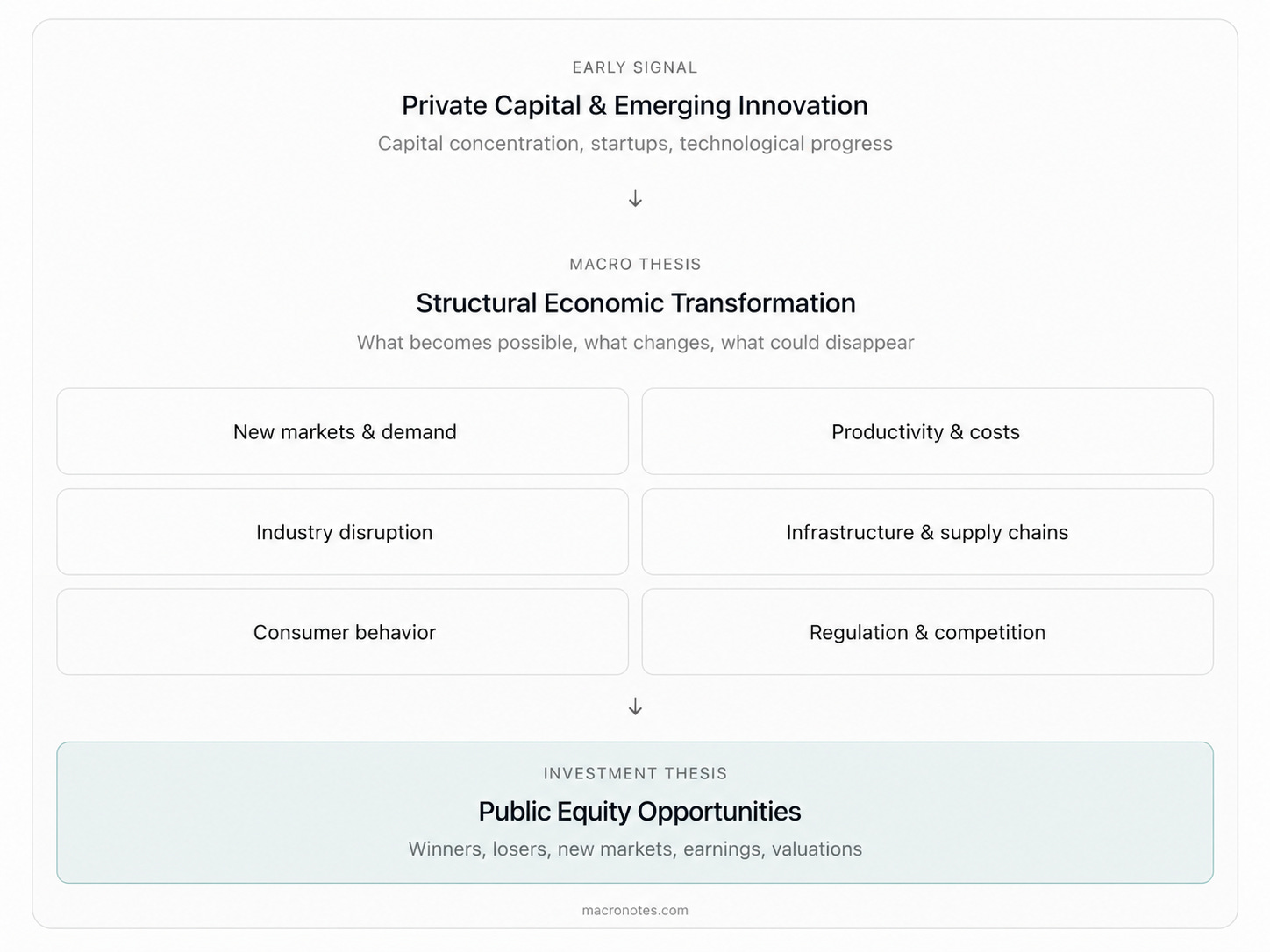
My Research Framework: Private Capital → Structural Change → Public Equity
I want to structure this approach around six steps.
The starting point remains observing private markets, but the research is not about mechanically following money toward startup suppliers.
It is about developing a thesis on the economic transformation a new technology could create, then identifying publicly traded companies positioned to benefit.
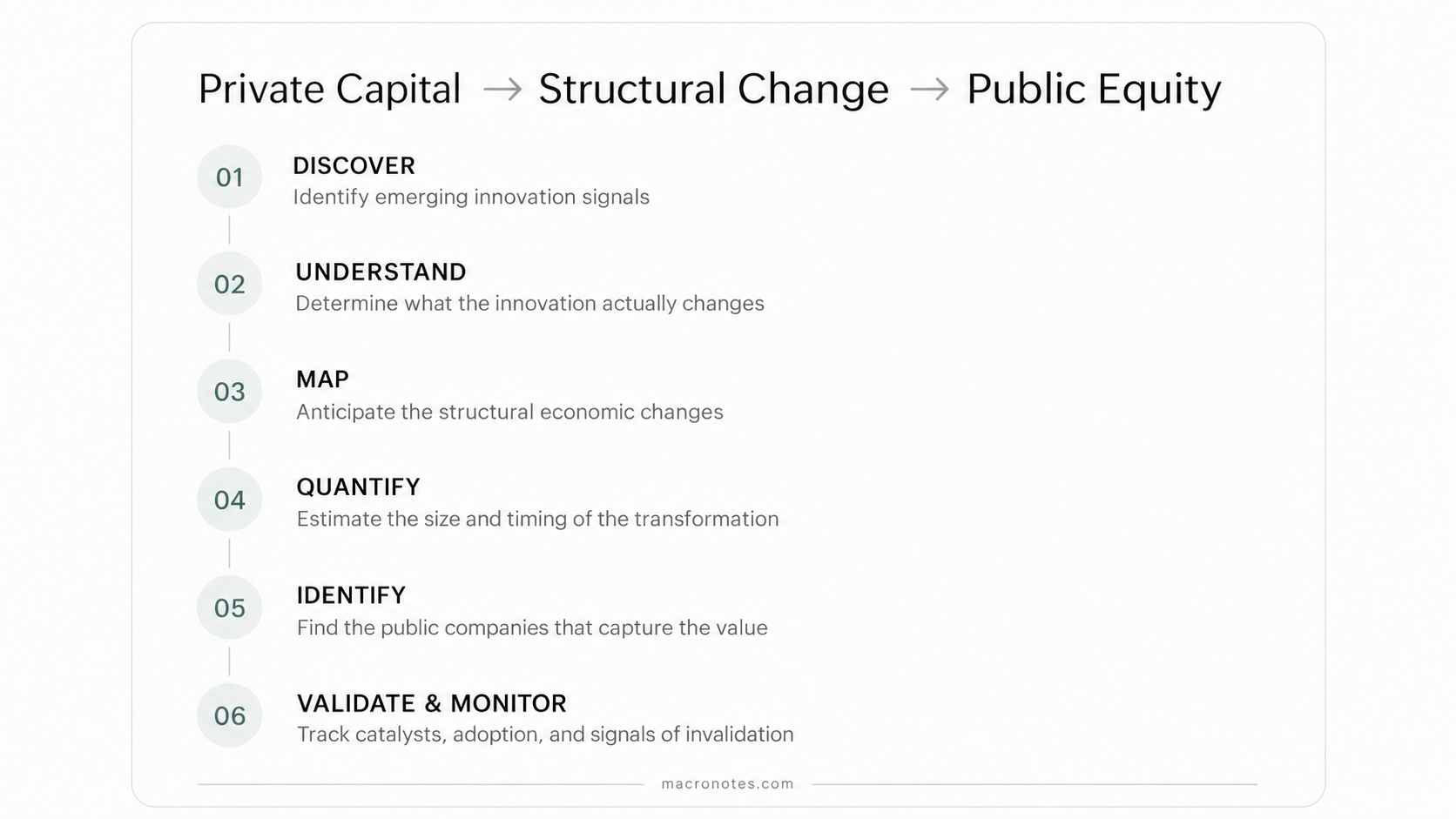
1. Discover — Identify Emerging Innovation Signals
The first step is detecting new technologies that are beginning to attract capital, researchers, entrepreneurs, and investors.
Funding rounds are one indicator among others.
I would pay particular attention to sectors where several startups are simultaneously raising increasing amounts of capital, where investors are moving from funding research toward financing commercialization, and where new technological capabilities are becoming possible.
But these signals must be accompanied by tangible progress. An industry receiving massive funding without credible technological results may simply reflect a speculative bubble.
In neurotechnology, rising investment is interesting because it accompanies clinical progress, the development of new devices, and the emergence of several competing technological approaches.
The question is therefore not simply whether capital is increasing.
It is whether something important is becoming possible.
2. Understand — Determine What the Innovation Actually Changes
An innovation becomes economically important when it changes what companies or individuals can do, how much it costs them, or how they do it.
I therefore want to understand the new capability created by the technology.
Can it automate certain tasks? Reduce a significant cost? Improve an existing product? Make a previously impossible service accessible? Remove a physical or economic constraint?
For AI, that capability includes automating and assisting with certain cognitive tasks.
For electric vehicles, it involves a different architecture for propulsion and energy storage.
For brain-computer interfaces, it involves measuring and using certain neural signals to interact with external systems, with particularly tangible prospects in medical applications.
Once we understand that capability, we can begin examining its economic consequences.
But we need to distinguish between what has been technically demonstrated, what appears commercially plausible, and what remains speculative.
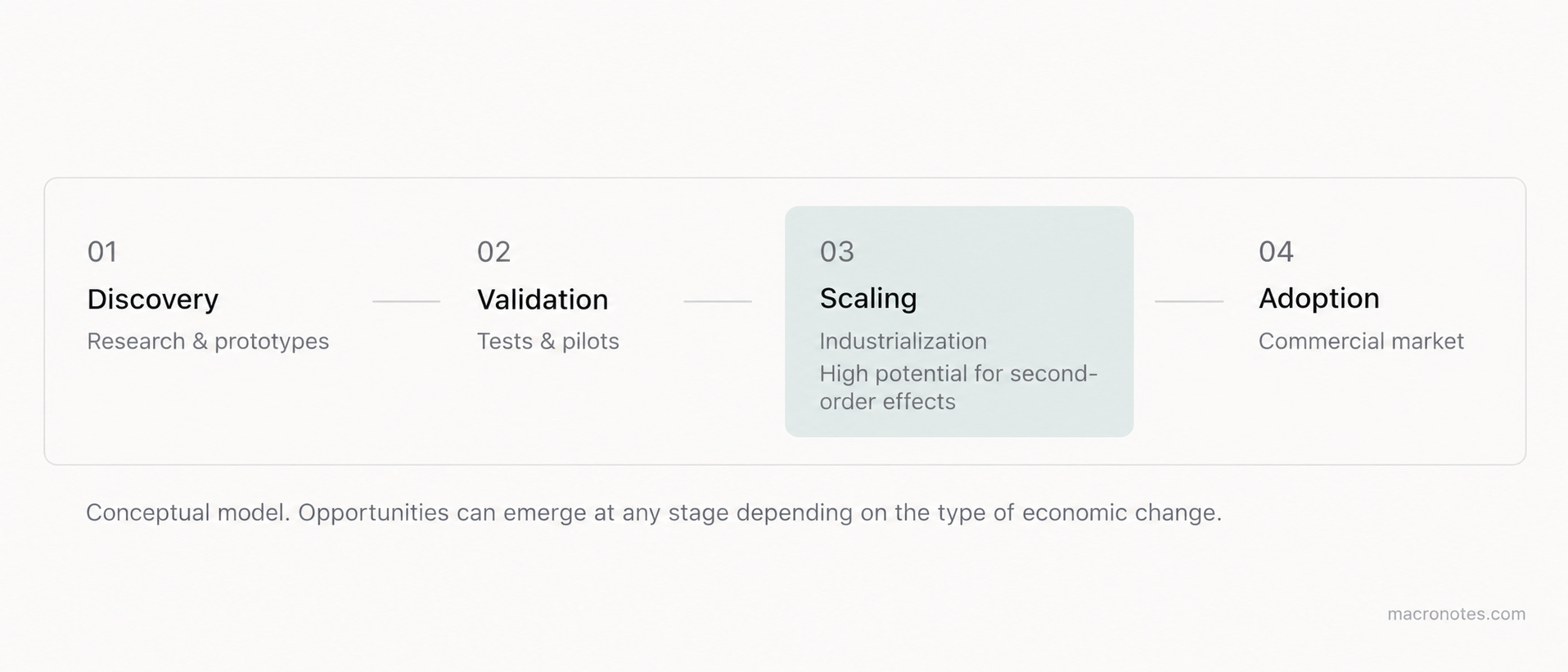
The stage of development also matters. An innovation typically progresses from research and validation toward industrialization and broader adoption.
Each stage can create different economic opportunities, and the largest transformations may only become visible once the technology reaches commercial scale.
Understanding where an industry stands in this cycle helps us distinguish between opportunities that could emerge in the near term and those that remain years away.
3. Map — Anticipate the Structural Economic Changes
This is probably the most important step in the framework.
Starting from the new technological capability, we need to build a map of potential economic transformations.
I would begin with the industries directly affected, then gradually expand the analysis to their customers, suppliers, competitors, and adjacent markets.
I would look for several categories of change.
New markets could emerge. Existing markets could experience accelerating growth. Some types of spending could be replaced by others. Companies could improve their productivity or, conversely, lose their competitive advantages.
The technology could also change consumer behavior, pricing models, regulation, or the competitive structure of certain industries.
For each consequence, I would try to understand the precise economic mechanism.
Why would demand increase? Which spending would be replaced? Who would be willing to pay? Which constraint would disappear? Which companies would have an incentive to adopt the technology?
The objective is to move from a broad vision of innovation toward several hypotheses about economic transformation that can be tested individually.
4. Quantify — Estimate the Size and Timing of the Transformation
Not every potential economic consequence is equally important.
Some innovations create new markets worth a few hundred million dollars.
Others can transform the cost structure of industries representing hundreds of billions of dollars.
We therefore need to estimate the potential magnitude of each change.
I would not simply calculate a theoretical total addressable market. I want to understand the likely pace of adoption, the technical, economic, and regulatory constraints, and the portion of the value that companies can realistically capture.
We also need to distinguish between value creation and value transfer.
When a technology cuts the cost of an activity in half, it can produce a substantial productivity improvement without necessarily creating a new market of equivalent size.
Some of that value might be captured by companies using the technology, some by their customers, and some by the technology providers.
It is this distribution of value that determines where the investment opportunities lie.
Finally, we need to establish a time horizon.
A transformation that could occur within three years does not have the same stock market implications as a technology whose commercial adoption remains uncertain fifteen years from now.
5. Identify — Find the Public Companies That Capture the Value
Once we have mapped and quantified the transformations, we can begin looking for publicly traded companies positioned to benefit.
Some will be directly exposed to the new technology.
Others will benefit from increased demand for their products or services.
Still others could benefit from significant cost reductions, improved productivity, the emergence of new markets, or the weakening of competitors.
And some companies may instead lose part of their business.
What interests me is therefore not simply sector exposure.
It is a company’s ability to capture a meaningful share of the value created by the transformation.
To evaluate that, we need to understand its competitive positioning, business model, the financial materiality of the opportunity, and how much of that potential is already reflected in its valuation.
A technology can transform an entire industry without making every company in that industry a good investment.
6. Validate & Monitor — Turn the Scenario Into an Investment Thesis
The final step is converting our economic hypotheses into investment theses that can be monitored and challenged.
I want to build several adoption scenarios, model their potential consequences for the revenues, margins, and earnings of the companies we identify, and compare those outcomes with their current valuations.
We also need to define the events that would gradually confirm the transformation.
These could include a regulatory breakthrough, a significant reduction in costs, accelerating adoption, the emergence of a viable business model, or a new category of customers.
Conversely, certain developments could invalidate our reasoning: technological limitations, excessive costs, regulatory obstacles, insufficient commercial demand, or more intense competition than anticipated.
This is the logic we already use in Macro Notes Terminal.
We are not simply trying to predict the future of an industry. We develop a thesis about an economic transformation, then follow the data and events that allow us to determine whether that transformation is actually taking place.
From Structural Change to Investment Opportunity
Ultimately, a major technological transformation does not automatically create an attractive investment.
What matters is how much of the resulting economic value a company can capture, and whether that opportunity is already reflected in its valuation.

This is a conceptual relationship rather than a literal financial formula.
Even if we correctly anticipate a technological transformation, we can still make a poor investment if we overestimate its economic impact or pay too much for the companies exposed to it.
The objective is not simply to identify the next major technology.
It is to identify the structural changes that could create significant economic value, determine which companies are positioned to capture that value, and assess whether their valuations offer an attractive opportunity.
Looking Ahead
I don’t think private capital can reliably predict which technologies will succeed, or which stocks will outperform.
But I believe it can provide valuable early signals about where new technological capabilities are emerging.
What interests me is what happens next.
If we can understand how these innovations might transform industries, change economic incentives, and redistribute value, we may be able to identify investment opportunities long before their financial consequences become obvious.
That is the approach I want to develop further at Macro Notes: using private market signals as a starting point for global macro research, then working our way down to industries and individual companies.
The objective is not to predict the next successful startup. It is to anticipate the economic transformations that tomorrow’s technologies could create.
And neurotechnology is an interesting place to start.
In Macro Notes Premium: The Neurotechnology Economy
To apply this approach, I want to return to neurotechnology.
We have observed the recent acceleration in funding, but that alone does not tell us what the economic consequences of these innovations will be.
That is the question we are going to explore in the Premium section.
We will begin by distinguishing between the different technologies, their actual capabilities, their maturity, and the obstacles to adoption.
Then we will develop several scenarios for structural economic change.
What could advances in brain-computer interfaces change in healthcare? What new markets could emerge around assistive technologies and rehabilitation? How might neuromodulation transform certain categories of treatment? And over the longer term, what consequences could a new generation of human-machine interfaces have?
For each scenario, we will estimate the size of the opportunity, its likely time horizon, and the main uncertainties.
We will then identify publicly traded companies that could benefit from these transformations, whether they operate directly in neurotechnology or in adjacent industries.
Finally, we will evaluate which opportunities appear credible and financially significant enough to justify deeper investment research.
The goal is not to find the next Neuralink. It is to anticipate the economic changes neurotechnology could create and identify where value will be generated and captured.
Continue reading with Macro Notes Premium.