Today I Want to Talk About SpaceX Again — And Why I’m More Bullish Than Ever
I’ve spent the last month rebuilding my entire thesis on SpaceX.
I can’t sleep — not because I’m worried, but because what’s about to happen in the next five months might be the single largest wealth creation event I’ll witness in my lifetime.
Let me be direct: I think SpaceX’s IPO will be bigger than Google’s, bigger than Facebook’s, bigger than any tech company that’s ever gone public. Not bigger in terms of hype — bigger in terms of actual, fundamental, world-changing value creation.
Mid-December 2025, CFO Bret Johnsen sent a memo to SpaceX shareholders.
The company is preparing for a 2026 IPO that could raise over $50 billion at a valuation approaching $1.5 to $1.75 trillion. Saudi Aramco’s 2019 IPO — the current record — raised $29 billion. SpaceX is targeting nearly double that.
But here’s what makes my conviction unshakeable: unlike most IPOs built on promises and projections, SpaceX is built on three already-profitable, already-dominant, money-printing machines that are growing faster than almost anyone realizes.
Musk is reportedly targeting mid-June 2026 for the listing — timed with a rare Jupiter-Venus planetary alignment, days before his birthday. Whether you find that brilliant or absurd, it means one thing: we have roughly five months to position ourselves before the floodgates open.
What’s Changed Since I Last Wrote — And Why Everything Is Bigger Than I Thought
I thought I understood SpaceX.
I’ve written about it before, tracked the launches, marveled at the engineering. But over the last month, as I’ve dug deeper into the financials, the competitive landscape, and the second-order effects of what they’re building, my optimism has gone from “this is impressive” to “this might be the most asymmetric opportunity I’ve ever seen.”
Three things changed my thinking:
First, Starlink’s growth is accelerating, not slowing. Most subscription businesses hit saturation curves. Starlink is doing the opposite. They added 1 million subscribers in seven weeks between early November and late December 2025 — that’s 21,275 new paying customers every single day.
When does this slow down? The more I researched, the more I realized: it doesn’t. Not anytime soon. The addressable market is 3.1 billion people across 155 countries, and current penetration is in the low single digits in most markets. Every new satellite launch expands capacity. Every new direct-to-cell partnership opens entirely new revenue streams. Every aviation deal adds high-margin enterprise customers.
The numbers are staggering:
10+ million subscribers as of February 2026 (up from 4.6 million just 14 months earlier)
Revenue: ~$10.6B from Starlink alone in 2025, out of ~$15-16B total company revenue
EBITDA: ~$7.5-8 billion in 2025 — this is not a pre-profit startup, this is a cash machine
Starlink EBITDA margin: estimated at 54%, according to PitchBook/Morningstar
And here’s a number that almost nobody is talking about yet: SpaceX rebranded its Direct-to-Cell service as Starlink Mobile at MWC 2026 and announced 16 million unique users already connected through carrier partnerships — with a target of 25 million by year-end, adding 52,000 new users per day. This is an entirely separate growth vector from the dish-based broadband business. The addressable market? 4.5 billion smartphone users worldwide.
This isn’t a satellite company. This is the most valuable telecom infrastructure ever built, and it’s being constructed by a company that owns the rockets, manufactures the satellites, and controls the entire value chain.
Second, the launch monopoly is even more dominant than I realized. SpaceX completed 167 Falcon 9 launches in 2025 — a new annual record. That’s roughly 85% of all U.S. orbital launches and more than half of every orbital launch on Earth combined.
One private company launched more rockets than China, Russia, Europe, and every other space program in the world — combined.
They’ve achieved 586 successful booster landings out of 599 attempts. The second-place competitor? Still trying to catch up. One booster, B1067, has now flown 33 times. The economics remain brutal:
SpaceX: ~$62 million per launch
Competitors: $150-400 million for equivalent capacity
And this advantage is about to expand exponentially with Starship. Musk says full reusability could reduce costs by another factor of 100. PitchBook estimates that at commercial scale, Starship would reduce satellite deployment costs by roughly 70%. Imagine what becomes possible when you can put payload in orbit for a fraction of today’s cost.
Third — and this is the piece that transformed my entire outlook — the orbital data center thesis is real, it’s happening now, and it could be bigger than everything else combined.
The $10 Trillion Wildcard Nobody’s Pricing In
A month ago, if you’d told me SpaceX was building data centers in space, I would have nodded politely and thought “sure, eventually, maybe in 20 years.”
Then I started pulling the thread.
November 4, 2025: Starcloud launched an Nvidia H100 GPU into orbit — the most powerful compute ever deployed in space — and successfully trained an AI model from orbit. Not a demo. Not a proof-of-concept. They ran Google’s Gemma LLM in space and it worked.
December 2025: Google announced Project Suncatcher — launching orbital data centers with their TPU chips in early 2027.
January 2026: Musk at Davos: “Beyond Earth, the Sun rounds up to 100% of all energy. Solar-powered AI data centers in space could become economically viable within a few years.”
Jeff Bezos: “There will be gigawatt data centers in space within 10 years.”
Eric Schmidt bought an entire rocket company (Relativity Space) to pursue orbital computing.
February 2026: SpaceX merged with xAI and announced its intention to build orbital data centers — then reportedly applied to launch a million data center satellites.
This isn’t science fiction anymore. This is happening. And here’s why it’s inevitable:
The AI industry has a power problem. Goldman Sachs estimates AI could consume 10% of US electricity by 2030 — equivalent to building 60 new nuclear reactors. We’re already seeing data center projects delayed or cancelled because local grids can’t support them. xAI’s own data center in Memphis is burning through billions in infrastructure spending.
Now imagine infrastructure where:
Power is infinite and free (24/7 solar, no weather, no night)
Cooling is natural (radiative heat dissipation into vacuum)
Land use is zero (no zoning, no water, no NIMBY protests)
Latency can be lower than undersea cables for intercontinental traffic
SpaceX’s Starlink V3 satellites launching in 2026 will have 1 terabit-per-second capacity — 10x current generation — with high-speed laser inter-satellite links creating a mesh network in orbit. The constellation already comprises over 9,600 operational satellites, representing about 66% of all active satellites globally. Scale that, add compute to each one, and you have a distributed data center in space powered by the Sun.
If — and I stress if because this is speculative — even 10% of AI compute migrates to orbit over the next decade, we’re talking about a market measured in hundreds of billions to trillions in annual revenue. AWS generates $100B+ annually. Imagine a “SpaceWS” at even half that scale.
This is why I think $1.5 trillion isn’t crazy. I think it might be conservative.
The Elephant in the Room: The SpaceX-xAI Merger
I need to address this head-on because it fundamentally changes the investment thesis — for better and for worse.
On February 2, 2026, SpaceX acquired xAI in the largest merger in history, creating a combined entity valued at $1.25 trillion (SpaceX at $1T, xAI at $250B). When SpaceX goes public, you won’t just be buying rockets and Starlink. You’ll be buying SpaceX + xAI (Grok) + X (formerly Twitter) — all bundled together.
The bull case: This creates a vertically integrated “AI + space infrastructure platform” — Starlink delivers the connectivity, xAI provides the AI models, SpaceX launches the hardware, and orbital data centers tie it all together. It’s the narrative Musk will sell to public market investors, and it’s compelling.
The bear case: xAI lost an estimated $2.5 billion in the last six reported months. X/Twitter remains a financially challenged platform. Some analysts — and I respect their view — see this as a “bailout” of xAI via SpaceX’s IPO halo. Multiple xAI co-founders have departed since the merger, and Musk himself acknowledged that xAI “was not built right the first time around” and is “being rebuilt from the foundations up.”
My take: The merger explains a significant chunk of the jump from $800B (December 2025 secondary) to $1.5T (IPO target). If you subtract xAI’s $250B valuation, SpaceX standalone would be priced at $1.25T — still a premium, but more defensible. The key question is whether xAI becomes a value-add or a drag. I’m cautiously optimistic, but with eyes wide open.
The combined entity’s financials tell a nuanced story: SpaceX generated ~$15-16B in revenue and ~$8B in EBITDA in 2025. xAI added roughly $250M in revenue and $2.5B in losses. Blended, you’re looking at ~$16B in revenue, perhaps $5-6B in net EBITDA, at a $1.5T valuation. That’s roughly 94x 2025 revenue or about 250-300x blended earnings.
Expensive? Absolutely. Irrational? PitchBook’s independent analysis puts fair value between $1.1T and $1.7T, so not necessarily — provided Starship commercializes on schedule and Starlink Mobile scales as projected.
Elon at Davos: The Man Behind the Madness
January 22, 2026, Musk appeared at Davos for the first time ever — after years of calling it “an unelected world government.” The key quote for our thesis came when he said solar-powered AI data centers in space could become economically viable within a few years.
Look, I get it. Musk is controversial. The Twitter chaos, the political entanglements, the DOGE disaster, the endless drama — it’s all real and it’s all exhausting. But none of it changes the fundamental calculus.
This is a man who made electric vehicles mainstream, made rockets reusable, and built a satellite constellation when incumbents laughed at the economics. He’s now worth an estimated $839 billion according to Forbes’ 2026 Billionaires List — the first person in history to surpass $800 billion — and could become the first trillionaire if the IPO prices at the high end.
I’ve learned to separate “Musk the provocateur” from “Musk the builder.” When he says he’s building orbital data centers and deploying robotaxis, my default is: he’s probably 6-18 months late, but he’s going to do it.
The Valuation: Why $1.5-1.75 Trillion Makes More Sense Than You Think
Okay, let’s talk about the number that makes everyone’s head explode.
On the surface, it looks insane:
Tesla: $1.5T market cap on ~$95B revenue = ~16x sales
SpaceX (combined, IPO target): $1.5T on ~$16B revenue = ~94x sales
Typical aerospace: 1.5-3x sales
By traditional metrics, this is ludicrous. But SpaceX isn’t a traditional aerospace company. It’s three (now four) companies in one:
A launch monopoly — 80%+ market share, 167 launches in 2025, costs falling with Starship
A global telecom SaaS business — 10M+ subscribers, ~60-80% annual growth, 54% EBITDA margins, zero terrestrial infrastructure
A nascent mobile connectivity platform — 16M Starlink Mobile users, targeting 25M by year-end
A potential cloud computing platform in orbit — speculative but backed by the infrastructure to actually build it
Comparable companies at similar stages:
Amazon in 2005 traded at 50-60x sales before AWS existed
Netflix at peak growth traded at 40-50x sales
Nvidia currently trades at 30-40x sales
PitchBook forecasts SpaceX revenues of $150 billion and EBITDA of $95 billion by 2040, driven by Starlink’s subscriber base growing toward 1.2 billion and Starship reaching a launch cadence of more than once per day.
If Starlink alone hits $40-50B in annual revenue by 2028, and orbital computing adds another $20-30B by 2030, you’re looking at $60-80B in revenue with blended margins of 30-40%.
That’s $18-32B in earnings. Apply a 25-30x multiple, and you get $450B-$960B in value from those two businesses alone. Add the launch business, Starlink Mobile, and the xAI optionality, and the math starts working.
$1.5T isn’t the value today. It’s the discounted present value of what SpaceX could be in 2030-2035. PitchBook’s sum-of-the-parts analysis validates this range at $1.1T-$1.7T. The asymmetry is favorable for investors with a 3-5 year horizon and tolerance for Musk-amplified volatility.
The Risks — Because Ignoring Them Would Be Irresponsible
No thesis is complete without understanding what could go wrong:
xAI integration risk: The merger adds business complexity, cash burn (~$1B/month for xAI), and regulatory exposure (Grok deepfake investigations in multiple jurisdictions). If xAI becomes a persistent drag on profitability, the market will punish the stock.
Key-man risk: Everything depends on Musk. He’s running Tesla, SpaceX, xAI, X, Neuralink, and The Boring Company simultaneously. The xAI co-founder exodus is a warning sign.
Valuation risk: At 94x revenue, any execution miss — a delayed Starship, a Starlink growth deceleration, regulatory friction — could trigger a severe repricing.
Regulatory and political risk: SpaceX’s 80%+ share of U.S. launches has already prompted antitrust discussion. Musk’s political entanglements add unpredictability.
Capital intensity: PitchBook notes SpaceX’s plan to build 10,000 fully reusable Starship rockets at an estimated $35M each — that’s $350B in capex. The $50B IPO raise is just a down payment.
I’m not ignoring these risks. I’m sizing my positions accordingly. More on that in the premium section.
Why I’m Positioning Now, Not Later
Here’s the hard truth: if you wait for the IPO, you’ll probably miss the best returns.
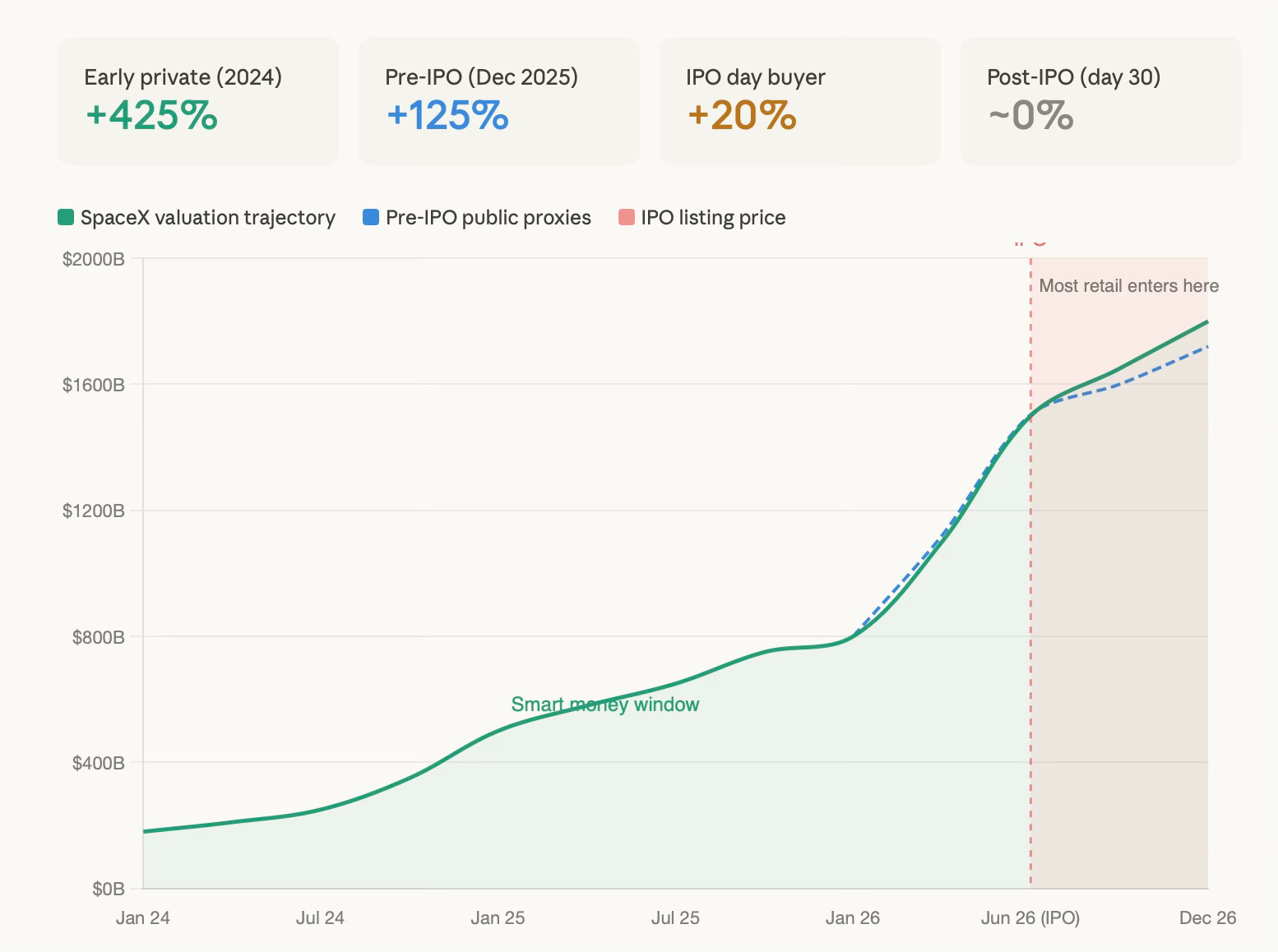
The IPO will likely price at $1.5-1.75T. Let’s say it opens at $1.8-2T on first-day pop. Great, you made 15-20%. But the institutions who bought at $800B in December 2025? They’re up 87-125% before the IPO even happens.
The investors who bought Alphabet in 2015 when Google invested $900M in SpaceX at a $12B valuation? They’re sitting on a 60x unrealized return.
The mega-returns happen in the private markets and in the secondary exposure before the public event.
So over the last month, I’ve been systematically building positions in the publicly-traded companies that give me SpaceX exposure right now:
Alphabet (GOOGL) — Owns approximately 7.5% of SpaceX. At the IPO target, that stake is worth ~$111-131B. Google reported an $8B unrealized gain in Q1 2025 just from SpaceX revaluation. Every quarter, this number grows.
Nvidia (NVDA) — Supplying compute for SpaceX’s autonomous systems, and the primary beneficiary of the orbital data center thesis. Every satellite with compute needs GPUs.
EchoStar (SATS) — Sold $19B in spectrum to SpaceX (of which $8.5B came in SpaceX stock) plus an additional $2.6B deal (entirely in SpaceX stock). Total SpaceX equity: ~$11.1B. This is the purest public-market proxy for SpaceX exposure — high-risk but asymmetric upside.
This is how you capture the value creation before it becomes obvious to everyone else.
In the premium section, I’m revealing my complete playbook:
✅ The exact 5 stocks I’m buying — and why each one offers different risk/return profiles for different portfolio strategies
✅ My personal allocation strategy — how I’m deploying capital across Q1-Q2 2026 to maximize exposure while managing risk
✅ The aerospace suppliers and infrastructure plays that will explode as SpaceX scales — the chip maker, the avionics provider, the component manufacturers
✅ The hidden risks in depth — from xAI cash burn to regulatory threats to Starship timeline risk — and exactly how I’m hedging them
✅ My exact IPO strategy — how to position for allocation, which brokers to use, and what to do if you can’t get shares
✅ The 10-year thesis — why I think SpaceX could be a $3-5 trillion company by 2035, and what that means for returns from today’s entry points
I genuinely believe this is the largest wealth creation opportunity I’ll see in the next decade. I’m not waiting. I’m positioning now, while the narrative is still building and before institutional FOMO drives everything parabolic.
The question isn’t whether to get exposure. The question is how much, through which vehicles, and how fast.
Let me show you exactly how I’m playing this.