


Every time a generation dies, there is a transfer of wealth. In the United States, that transfer now runs at roughly $4.2 trillion a year, and it will climb toward a peak of nearly $6.1 trillion a year around 2034–2035 — some $124 trillion in total is set to change hands by 2048, the largest handoff of wealth in American history. Real estate, businesses, stocks, works of art — all of it passes from the hands of one generation into those of the next. Close to $100 trillion of that total, about 81%, will come from Baby Boomers and older generations.
But for the generation now preparing to pass the torch, there is a structural problem its predecessors never faced.
We won’t unpack it yet — let’s just plant the thread here. This problem has nothing to do with the stocks, the real estate, or the paintings, which move cleanly from a will to an heir. It concerns a category of asset far more delicate to pass from hand to hand — one that, unlike a stock portfolio, can simply cease to exist the day its owner walks away.
This structural problem is critical. It is largely unknown to the general public. And it represents both one of the greatest risks and one of the greatest opportunities the world of private equity has ever encountered.
The most unsettling part is that this problem has already been observed elsewhere. It struck Japan a decade before us — early enough, and hard enough, that we can now anticipate how it ends. By 2025, about 1.27 million Japanese business owners over the age of 70 were projected to have no successor: roughly one-third of all companies in the country. Left unchecked, the government estimated the fallout at some 6.5 million lost jobs and around ¥22 trillion (about $200 billion) in vanished GDP. And here is the twist that should make anyone sit up: nearly half of the businesses closing each year in Japan were still profitable. They didn’t fail. They simply ran out of heirs. The difference, this time, is that the same story is now surfacing in the West — in the United States, in Germany, everywhere a generation of builders is growing old at once.
In this study, that is exactly what we’ll analyze: the nature of this problem almost no one names, why it turns an ordinary transfer of wealth into a silent migration of value — and where, in the end, that value goes.
Why Empires Get Dismantled
I recently watched, for the second time, the excellent series Succession. And with every episode, the same question kept coming back to me: why does a company end up being dismantled?
The show, it must be said, isn’t pure invention. Its creator, Jesse Armstrong, drew on a “holy trinity” of very real models — Rupert Murdoch, Sumner Redstone, and Robert Maxwell — to the point that Murdoch, in his 2023 divorce settlement, reportedly barred his ex-wife from feeding storylines to the producers. The patriarch Logan Roy, his children tearing each other apart over a throne none of them quite deserves: it’s theater, but theater drawn from life.
Succession has this useful quality: it gathers, inside a single fictional company, nearly every factor that can lead to a dismantling. Waystar Royco is at once a story of declining revenue — an old-world media empire that the digital age is overtaking — of scandals eating away at trust, of a hostile takeover from outside, and above all of a succession war in which the heirs tear one another apart. The series is a catalogue: it stacks the causes to dramatize the fall.
But in the real world, these factors rarely act together. So let’s isolate them. The first thing we think of is a profitability problem: the company loses money, the market catches up with it. That’s the intuitive scenario, the one fiction loves. The next is a weak generation: heirs who have neither the hunger, nor the talent, nor the authority of the founder.
That second reflex, the data confirm brutally. Here is the most-cited statistic in the world of family business, and one of the most sobering: only 30% survive the handoff to the second generation, 12% reach the third, and barely 3% the fourth. There’s a proverb for it, echoed in nearly every culture — Americans say “shirtsleeves to shirtsleeves in three generations,” the Chinese say “wealth does not pass three generations,” and the Italians, more poetic, “from stables to stars, and back to stables.” The founder builds, the child maintains, the grandchild squanders.
And yet. Neither profitability nor the weakness of heirs is enough to explain what’s coming today. Because both of those causes still assume an heir in place — someone who takes over and fails. The phenomenon now rising is more radical: increasingly, no one shows up at the door at all. The child doesn’t want the hardware store, the workshop, or the practice; they have their own life, in the city, in another line of work, far from their father’s counter.
But careful — this is where we have to resist the easy answer. “Businesses that work, and that no one wants to take over”: that isn’t the cause. It’s already the consequence. To understand why, we have to go one level deeper, toward an economic phenomenon most people never see — one that explains a baffling paradox.
Here’s the paradox. A healthy business — profitable, debt-free — finds no buyer and shuts down. At the very same moment, a business in free fall, on the brink of bankruptcy, finds a buyer fighting to acquire it. How is that possible? Why does the thing that works die, while the thing that’s sinking gets passed on?
The answer lies in a truth the world of private equity understood before anyone else: value isn’t found where you look for it. A financial buyer isn’t interested in today’s profit — he’s interested in the gap between what something is worth now and what it could be worth tomorrow, in better hands. What draws him isn’t health, it’s undervaluation: a mismanaged, mispriced asset, invisible on the balance sheet, but reactivable. A business barely getting by may hide a dormant treasure; a business running at full tilt has, by definition, already extracted all its value.
The most spectacular example of this logic is LVMH. In 1984, Bernard Arnault bought, for a symbolic one franc, a bankrupt textile conglomerate called Boussac — factories closing, a demoralized workforce, staggering losses. Everyone saw a wreck. Arnault saw a single asset buried in the rubble: the house of Christian Dior. He liquidated the rest, kept the name, and laid down the thesis that would build the greatest luxury empire in history: a prestige asset can be underfunded, mismanaged, diluted — it will always retain a residual value, a story, an aura, that patient capital and competent management can reactivate. He would do it again and again: Tiffany, an aging icon bought at roughly 13 times earnings, whose profits would nearly double under his stewardship. The rule is constant: you don’t buy performance, you buy dormant potential.
Now go back to our hardware store. If no one wants to take it over even though it’s profitable, it’s because, to a buyer, there’s precisely nothing to “reactivate”: the value is already there, visible, entirely captured by an owner who, on leaving, takes his knowledge, his relationships, his reputation with him — that is, the essence of the asset. What’s left is harder to value, riskier to transfer, and above all: stripped of the undervaluation premium that draws capital in.
And to that you have to add the cultural wind. The generation that could take over these businesses no longer wants them — for reasons that go beyond money. In a knowledge economy that has enthroned the white-collar path as the only measure of success, inheriting an “old business” — manual or local — is experienced as a step down. The sociologist Matthew Crawford described this shift in Shop Class as Soulcraft: a society that turned its back on concrete trades to funnel an entire generation of young people toward college, to the point of associating work with one’s hands with inferior status. The surveys bear it out — an overwhelming majority of Gen Z acknowledge a stigma attached to vocational school compared with a four-year university degree. Taking over grandfather’s workshop is no longer a dream of rising; in the dominant imagination, it’s a step backward.
Add it all up: founders aging en masse, businesses that are profitable but whose value walks out the door with their owner, a generation culturally turned away from the “old world,” and — we’ll come back to this — fewer and fewer children even to consider taking over. The result isn’t an accident. It’s a mechanism.
And that mechanism sets off a silent wave: millions of businesses that don’t fail, but simply close. The question is what happens to everything that wave leaves behind.
Where Value Goes to Hide
Let’s pick the thread back up. We’ve established the mechanism: millions of healthy businesses are about to change hands — or vanish — for lack of an heir. Most analyses stop there, on a reassuring question: who’s going to buy them? Consolidators, AI-augmented roll-ups, search funds — a new generation of buyers is already fighting over the best ones. We’ll come back to that, because it’s a real part of the story.
But it’s the easy part. And it isn’t the part that matters most.
Because not all of these businesses will be bought. Far from it. Remember the most brutal figure in this study: today, more than nine out of ten small-business exits happen through closure, not sale. Some of these companies are profitable — but profitable doesn’t mean acquired. Many are profitable and have become unfit for today’s economy: no digital, no scale, no AI, a body of know-how locked inside the head of an owner who’s walking out the door. No one buys them. The curtain falls. They evaporate.
And here’s the scale of it. Of the roughly 6 million American businesses that will face an ownership transition by 2035, McKinsey estimates that barely more than 1 million are viable candidates for sale. Do the subtraction: that leaves something on the order of five million businesses — many of them profitable — that will not be passed on. They’ll simply close. Even at the peak of the wave, annual business exits could reach 665,000 a year, and the overwhelming majority won’t be sales. They’ll be shutters coming down for good.
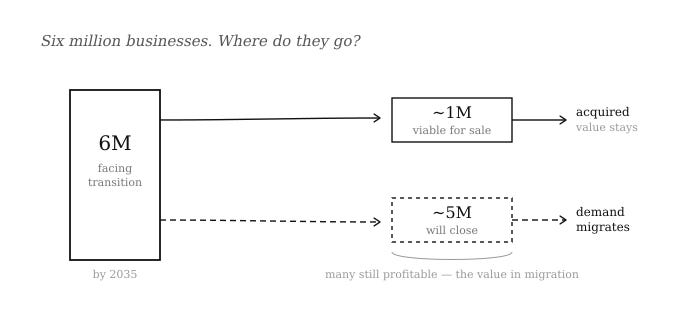
Which brings us to the question almost no one asks — the one at the heart of this edition: when these businesses disappear, where does the value they created go?
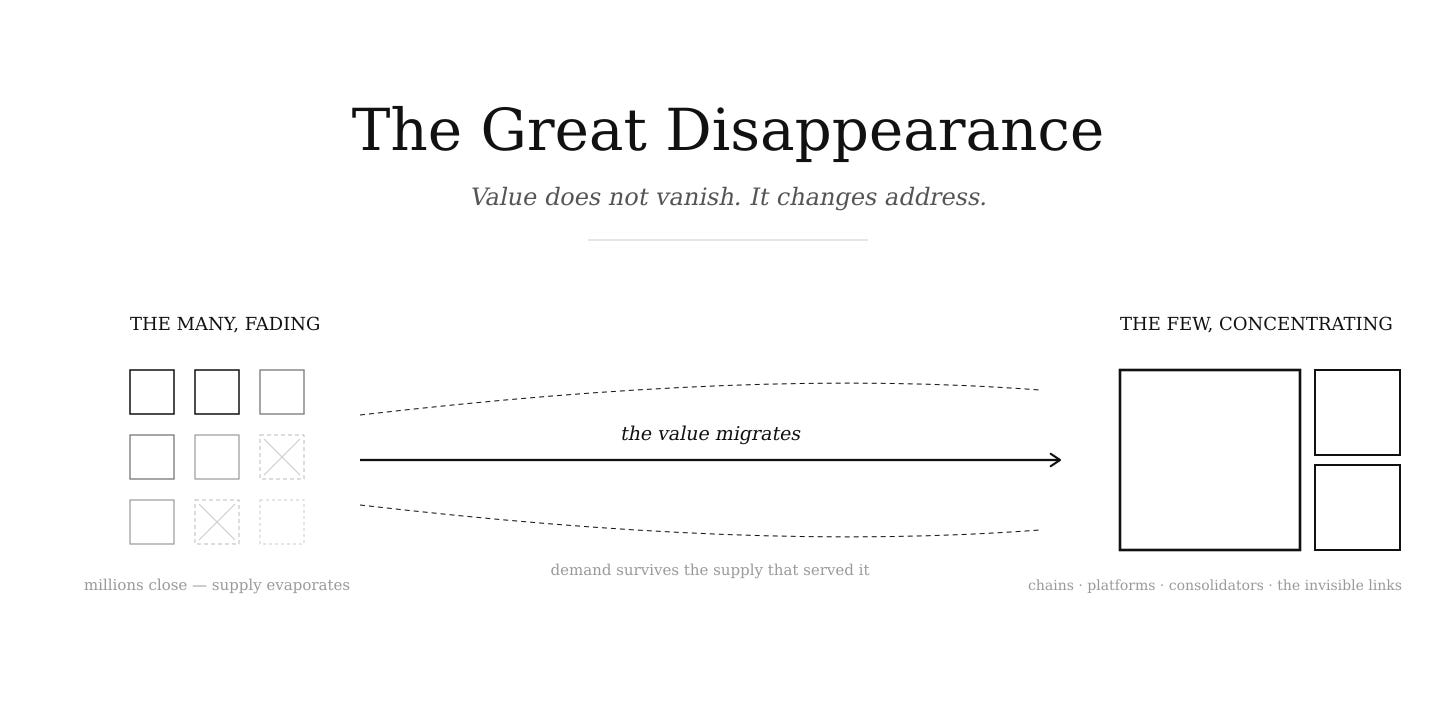
Because it doesn’t disappear with them. That’s the crucial point. A business can die; the need it served does not. People will always need to fix a leak, buy a screw, keep their books straight. When ten thousand hardware stores close, the demand for hardware doesn’t switch off — it moves.
Take that hardware store literally, for a moment. The owner retires; no one takes the counter. But the plumber down the street still needs his fittings on Tuesday morning; the family renovating their kitchen still needs paint, screws, a new hinge. That demand doesn’t evaporate — it splits and reroutes. Part of it flows to the big-box chains, physically present and unbeatable on price. Part of it flows to e-commerce, which solved the “I don’t know which screw I need” problem with search and reviews. Part of it flows to the national trade distributors the professionals now order from directly. And part of it reroutes nowhere profitable at all — leaving a service desert that, in turn, becomes an opening for a new digital entrant. Every closed store is a small redistribution of demand. Multiply it by a few million.
The disappearance of a business, then, is not a destruction of value. It’s a transfer of value — from an operator who has become unfit to one better positioned to capture it. This is the same wave that empties the storefront; we’re simply following it downstream, to where it deposits what it carries away. And it’s happening at a scale the world has never seen, sector after sector, in silence.
We’ve seen this film before, on a smaller screen. When small local banks vanished by the thousand — two-thirds of all U.S. banking institutions have disappeared since the early 1980s — customers didn’t stop needing a bank. The demand migrated to a handful of megabanks, leaving “banking deserts” in its wake and a landscape of value entirely recomposed in favor of the largest players. What played out in banking is about to replay across dozens of sectors at once. That is the real shockwave of the succession wave — and that is where the true opportunity lies.
Investing in this wave, then, isn’t just about betting on who buys. It’s about mapping, sector by sector, where value migrates when supply collapses but demand survives. That is exactly what the rest of this edition does. Here’s what we analyze in the subscriber section:
The framework — the two fates of a business without an heir. Acquisition and disappearance. Why almost everyone looks only at the first, and why the second is where the greatest value creation is hiding. The economic principle that governs everything: demand never dies with supply — it just changes address.
The treasure map — the sector analysis. The core of the study. For each major affected area, we cross three dimensions no one overlays: the scale of the closure wave, the likely fate of the businesses (acquisition or disappearance), and above all — where the orphaned demand migrates. Each sector has its own migration map: the demand from a neighborhood accounting firm that shuts down doesn’t move to the same place as the demand from a local retailer. We trace those routes.
Our proprietary estimate — how much value is about to change address. Everyone quotes the headline wealth-transfer numbers. No one has tried to size the question that actually matters here: how much economic value is carried, every year, by the profitable businesses that will close without ever finding a buyer — the value that isn’t destroyed but migrates elsewhere? We ran our own research to estimate it. We won’t hand you a number pulled from thin air: we show you the method, the sources, the assumptions — and the range they produce. You’ll be able to challenge every step of the reasoning. That’s precisely what separates an estimate you can defend from a figure you copy. As far as we know, no one has framed the calculation this way.
The two families of winners. Those who capture value through acquisition — consolidators, AI-augmented roll-ups, who buy the business to transform it. And those, far more overlooked, who capture it through demand absorption — the platforms, the chains, the digital players already in place when local supply evaporates. The second family is the one no one talks about. It’s often the best positioned.
The public-market investor’s grid. Because this movement, long invisible, has its listed points of entry. We break down several layers of exposure — the consolidators, the serial “compounders” who’ve been compounding capital at this game for decades, the listed demand-capturers, and the macro second-order effects — with the single reading rule that keeps you from buying at the top of the cycle.
The role of AI — accelerant of both scenarios. How artificial intelligence changes the equation in both directions: it suddenly makes it profitable to acquire small businesses that never were (you buy at a “services” margin, you exit at a “software” one), and it accelerates the disappearance of those that don’t adapt, hastening the migration of their demand. A double-edged weapon Japan never had.
The bad vintage. Because an opportunity is only real if you know what can kill it. The 2006-07 Japanese vintage, the risk that AI is over-sold and under-delivered, over-consolidation, the financing wall. What separates the real wave from the bubble — and the signals to watch for.
And your position in the wave. Three concrete lanes, depending on who you are.
Japan has already shown us the opening of the film: there, succession-related deals now account for more than 65% of the entire business-acquisition market — and for all the companies that found no buyer, demand migrated elsewhere, methodically. The West is only in its first act.
The only question that matters now is where value is looking while everyone else watches the closures. Let’s open the map.