

Imagine a factory at three in the morning. The lights are off, because no one inside needs to see. There is a low mechanical hum, the occasional hiss of hydraulics, the soft choreography of machines that do not tire, do not complain, do not go home. No shift change is coming, because there is no shift. This factory ran yesterday exactly as it will run tomorrow, and the only humans who will enter it this week are two technicians who arrive on Thursday to service the presses.
This is not science fiction. Versions of this factory already exist — in Shenzhen, in Austin, increasingly in places you would not expect. And their quiet arrival is dismantling an economic order that has governed the planet for two generations.
For forty years, globalization rested on a single, almost embarrassingly simple idea: make things where people are cheapest to employ. Textiles flowed to Bangladesh, electronics to China, automobiles to Mexico and Eastern Europe — not because those places held any natural genius for manufacturing, but because their labor could be had for a fraction of what a worker in Stuttgart or Detroit demanded. The map of global production was, in essence, a map of wages. Capital was a tourist, forever in search of the next low-cost destination.
But what happens to that entire logic when the worker no longer needs to be cheap — because the worker is no longer human?
That is the question this edition exists to answer. And the answer, I will argue, amounts to the largest reconfiguration of where the world’s wealth is created since the Industrial Revolution itself.
The Two Curves That Are About to Cross
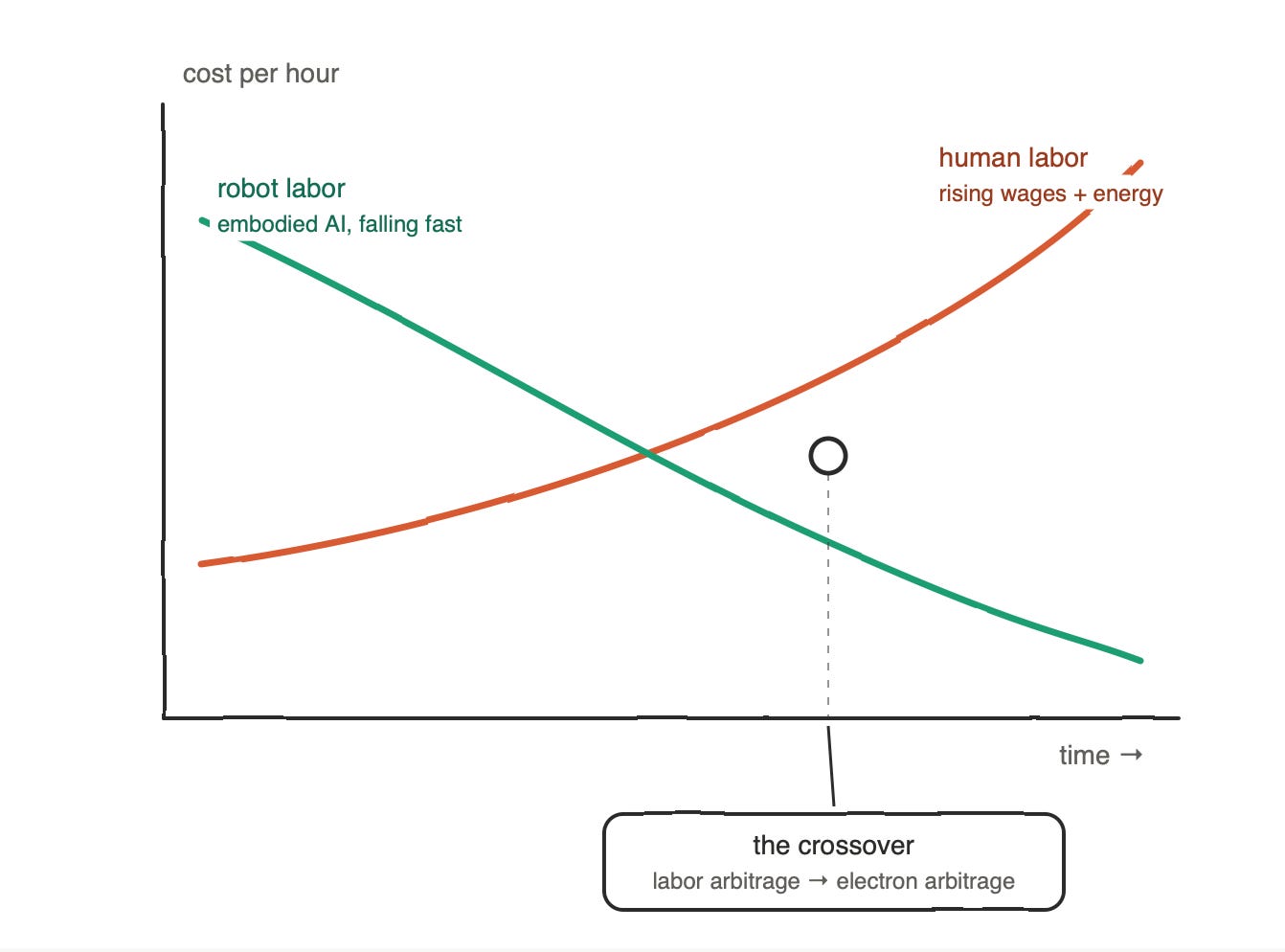
Every structural shift in economic history can be traced, if you look hard enough, to a moment when two cost curves crossed. The story here is no different.
The first curve is the falling cost of what engineers now call embodied intelligence — artificial intelligence that doesn’t merely think, but acts in the physical world through a body. For most of the past decade, a capable humanoid robot was a multi-million-dollar laboratory curiosity. Today, an industrial humanoid like the Unitree G1 sells for somewhere between thirteen and sixteen thousand dollars, and can be leased — Robot-as-a-Service, in the grim argot of the sector — for around five hundred dollars a month. Spread the purchase across a few years of round-the-clock operation, and the effective hourly cost begins to drift toward the low single digits.
Pause on that figure, because it is the hinge on which everything turns. A machine costing two or three dollars an hour does not eat, does not sleep, does not unionize, does not quit for a better offer across town, and does not need to be paid more when the local cost of living rises. It does not require the elaborate, expensive scaffolding that surrounds every human worker: the recruiting, the training, the supervision, the benefits, the turnover, the absences. Strip all of that away and you are left with something that looks less like an employee and more like a utility — a thing you plug in and meter.
Now consider the second curve. As the cost of robotic labor collapses, the cost of the one thing those robots cannot do without — electricity — has been pulling violently apart across the globe. German industry now pays roughly twice what American industry pays for power, and well more than its counterparts in China or India. When labor was the scarce, expensive input, this divergence was a footnote. But remove labor from the equation, and energy is suddenly thrust into the leading role it was always understudying for.
Here, then, is the thesis in a single line, and I would ask you to carry it with you through everything that follows: the world is moving from labor arbitrage to electron arbitrage. For forty years, the decisive question was where can I find the cheapest hands? For the next forty, it will be where can I find the cheapest, most reliable electrons — and how cleverly can I redesign my product so that machines, not people, build it?
But before we follow that thread into three industries, intellectual honesty demands a caution — one that, conveniently, also happens to be a competitive advantage for anyone who heeds it.
A Word on Hype, Before We Continue
The story I am telling you is true. It is also surrounded by a great deal of nonsense, and the two are easily confused.
The internet is presently awash in breathless claims that the robots have already won — that factories are “ninety-two percent automated,” that humanoids are even now “killing the cost of labor” on live production lines. These figures are seductive precisely because they are directional truths dressed up as accomplished facts. The danger, for a serious investor or a serious writer, is that the inflated version is trivially easy to discredit, and when it falls, it takes the real and important trend down with it.
So I have made a deliberate choice in what follows. Every figure I give you, I can stand behind. Where the popular narrative has outrun the evidence, I will tell you exactly where reality sits — not to deflate the thesis, but to armor it. The genuine story is more than dramatic enough. It does not need embellishment. It needs precision. That, after all, is the whole point of a newsletter called Macro Notes.
With that promise made, let us go to the place where this revolution is most visible, and most brutal.
The Automakers: Wolfsburg Against Giga Texas
If you want to watch the old world and the new world collide in real time, watch the automobile industry. Cars have always been the proving ground of automation — the first place welding robots appeared, the first place assembly lines were timed to the second. And yet the deepest part of building a car, the final assembly, has stubbornly remained a human affair: workers threading kilometers of wiring through the body, snapping in trim, crawling inside the moving carcass of the vehicle to fasten what machines could not reach.
Two companies stand at opposite ends of what is about to happen to that work. Their contrast is the clearest illustration of my thesis I know.
Consider first the predicament of Volkswagen. A fully loaded hour of automotive labor in Germany costs in the neighborhood of sixty-two euros — the highest figure in the global industry. Cross into France and it falls to roughly forty-seven; into Italy, around thirty-three. Cross the Mediterranean to Morocco, or east into Serbia and Poland, and you can build an entry-level car for under ten euros an hour. Now you understand, in a single set of numbers, why the geography of European carmaking has been what it is.
Because its plants remain comparatively dependent on human hands, Volkswagen still devotes something like fifteen percent of its global revenue to labor — a crushing burden against leaner rivals. Its own management has conceded that German sites run twenty-five to fifty percent over their planned costs, some of them twice as expensive as the competition. And so, for the first time in its eighty-seven-year history, Volkswagen has done the previously unthinkable: it has begun closing factories on German soil and cutting tens of thousands of jobs.
Stellantis, facing the same arithmetic, reached for the oldest tool in the box. Unable to make small electric cars profitable at French or Italian wages, it simply moved the work — to Kénitra in Morocco, to Serbia, to Poland. This is the reflex of the entire twentieth century distilled to its essence: when your humans become too expensive, find cheaper humans. It is a strategy, and for a long time it was the only strategy. But it is a strategy that assumes the human is irreducible — that someone, somewhere, must always be standing on the line.
Now consider Tesla, and watch the assumption dissolve.
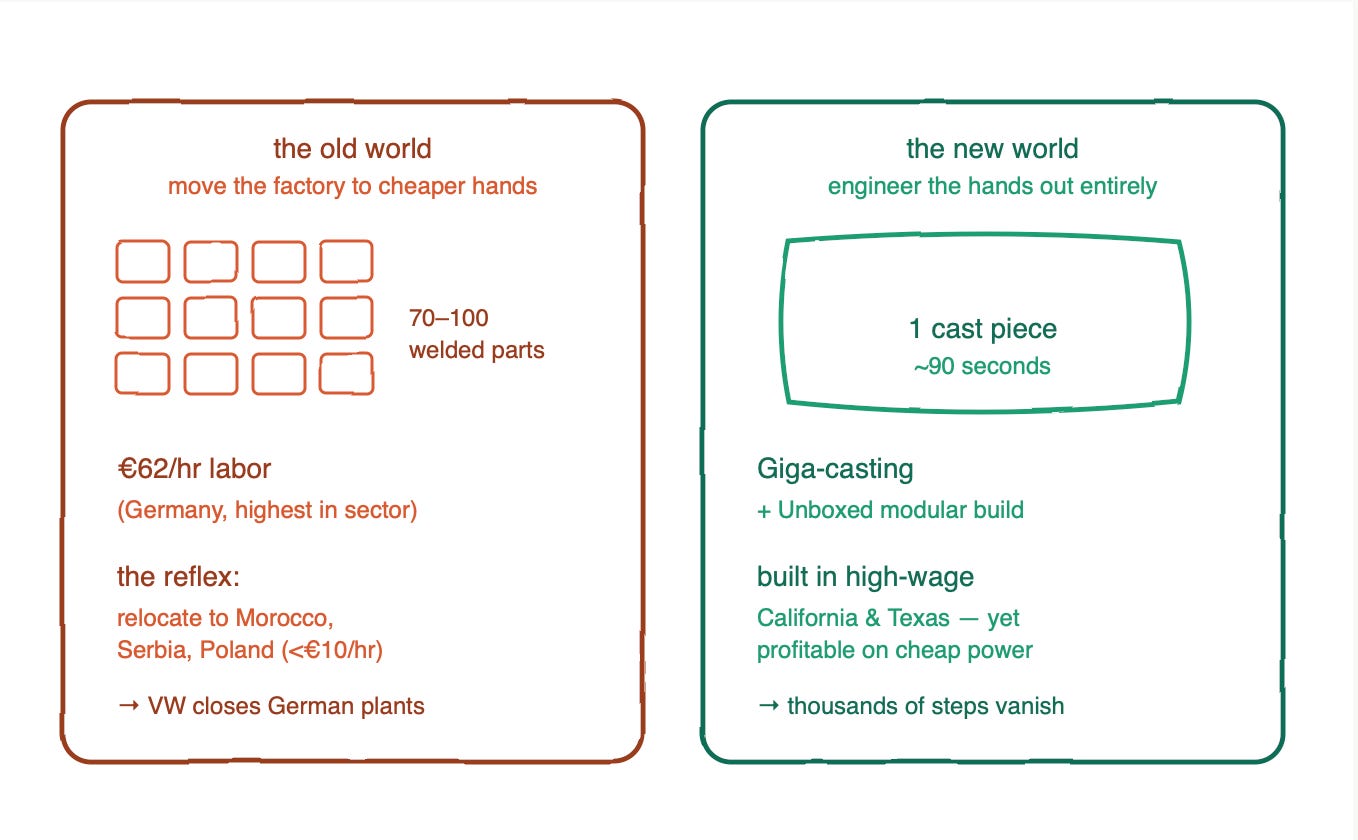
Tesla builds its cars at enormous scale in Fremont, California, and at Giga Texas in Austin — two of the highest-wage environments imaginable. By the old logic, this is madness. How does a company manufacture profitably in California while the Germans hemorrhage money and flee to Morocco? The answer is that Tesla refused to play the game at all. It did not go looking for cheaper hands. It set out to eliminate the need for hands.
The clearest expression of this is a technology called Giga-Casting. In a conventional plant — Wolfsburg, say — the rear underbody of a car is assembled from seventy to a hundred separate pieces of stamped metal, which must then be aligned, welded, and glued together by an army of robots and a crowd of human workers performing quality control. Tesla replaced this entire ballet with a single machine: a colossal press that injects molten aluminum and casts the whole rear structure as one piece in about ninety seconds. In that instant, hundreds of process steps, hundreds of welding robots, and thousands of hours of human labor simply cease to exist. They are not made cheaper. They are abolished.
Tesla went further still, reconceiving the very logic of the assembly line through what it calls the Unboxed Process. Rather than forcing workers to labor inside a half-built shell creeping down a line a kilometer long, the car is built as separate modules — doors, seats, floor — assembled in parallel like the components of a kit, then joined at the very end. The factory itself was treated not as an inherited constraint but as a product to be designed. This is what first-principles engineering actually looks like when applied to a building.
And now Tesla is preparing its most audacious move — though here, precisely, is where I must slow down and separate fact from fable, because this is the part of the story most often exaggerated.
Here is what is genuinely true. Tesla is ending production of the Model S and Model X at Fremont, with the final units rolling off in 2026, and is converting those very lines to manufacture its Optimus humanoid robot — with production slated to begin around late summer. Roughly a thousand Optimus units are already deployed across Fremont and Giga Texas, the largest fleet of humanoid robots ever placed inside factories. The company speaks of a first-generation capacity of a million units a year at Fremont, and a second-generation line at Giga Texas designed, in the long run, for ten million annually.
And here is what is not true, however often it is repeated: that these robots are already replacing workers and crushing labor costs on live production lines. On Tesla’s own Q4 2025 earnings call, Elon Musk said plainly that the units are, for now, primarily learning — collecting data, sorting battery cells, practicing the fine motor tasks of kitting and parts handling — rather than performing meaningful productive work. Tesla also missed its own 2025 deployment target. The robots are apprentices, not yet journeymen.
Why insist on this distinction? Because it is the difference between a credible thesis and a discreditable one. The honest framing is more powerful anyway: Tesla is no longer a carmaker that automates. It is becoming a robot manufacturer that intends to use its own machines to drive the cost of human labor toward zero — and it is building that future right now, in real buildings, on a timeline that runs through 2028 rather than one already concluded in 2025. The legacy automakers, imprisoned in fifty-year-old plant architectures and rigid labor agreements, simply cannot pivot at this speed. That is not a moral failing. It is structural gravity.
Which brings us to Europe’s particular tragedy, and to the deeper logic of the whole essay.
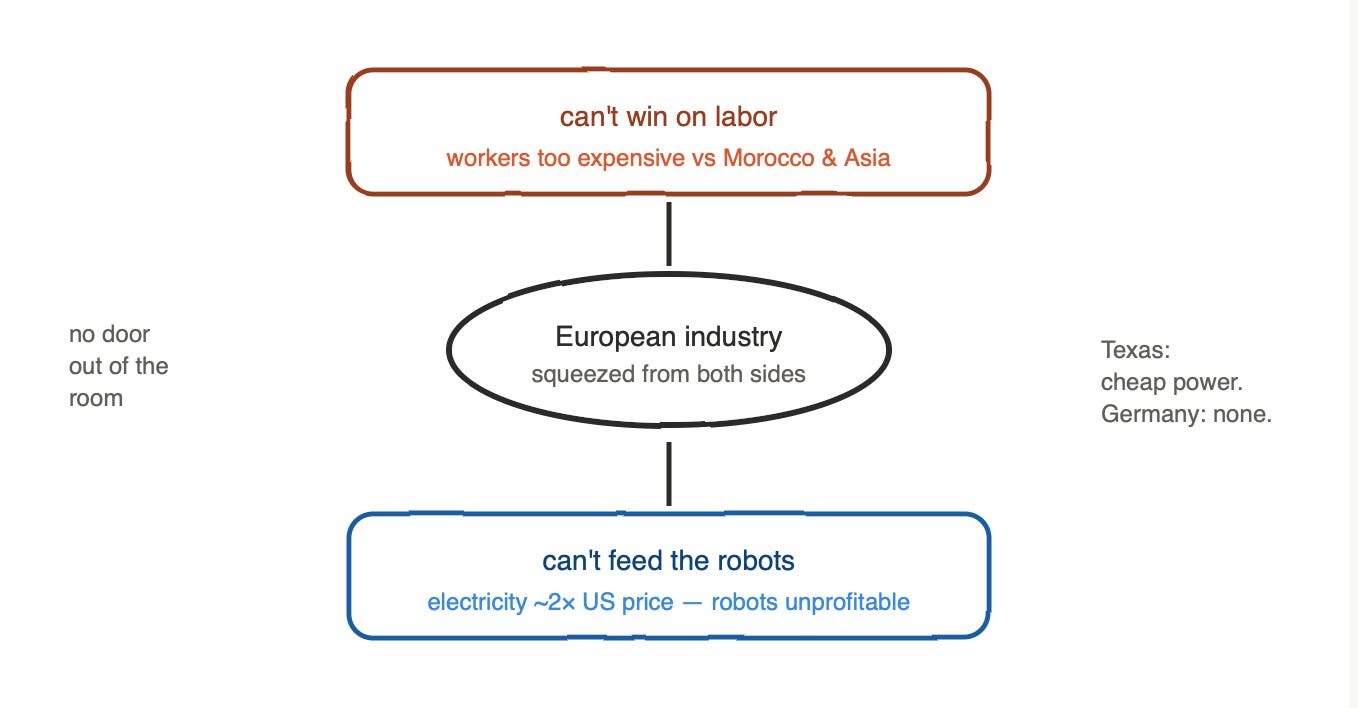
You will recall the two cost curves. Europe is caught, with terrible symmetry, on the wrong side of both. It cannot win the old game of cheap labor against Morocco or Asia — its workers are simply too expensive. But neither can it easily win the new game of hyper-automation, because a Tesla-style gigafactory is an electricity glutton. The giant presses, the AI computation, the robotic fleets, the climate control — all of it devours power around the clock. And European industrial electricity, ever since the rupture with Russian gas, sits among the most expensive in the developed world. Texas offers cheap natural gas, abundant wind, relentless sun. Germany offers none of these.
Sit with the full weight of that for a moment. Europe can neither afford its humans nor economically feed its robots. It is squeezed from both directions at once, and there is no obvious door out of the room. If you wanted a single image of what “electron arbitrage” means in practice — of how the decisive variable has migrated from the cost of hands to the cost of power — you could hardly do better than a German auto executive caught between wages he cannot pay and an electricity bill that makes the alternative impossible.
The automakers were only the first domino. What follows — how the Apple–Foxconn empire is quietly coming apart, why textiles are the next fortress to fall, and the precise map of the regions and sectors where the wealth of the coming decade will actually be made — is for Macro Notes Premium subscribers…