


In the fall of 2024, a French trader operating under the pseudonym “Théo” contacted YouGov — one of the world’s largest polling firms — and commissioned a private study. Three swing states. Pennsylvania, Michigan, Wisconsin. He wanted it done within a week.
The study had one unusual requirement. Instead of asking respondents the standard question — who are you voting for?— Théo wanted them to ask a different one: who do you think your neighbors are voting for?
This is a technique called social circle polling. The academic literature behind it is thin but compelling. In elections where social stigma distorts self-reporting — where a meaningful share of voters are reluctant to name their preferred candidate out loud — the neighbor question bypasses that filter entirely. You’re not asking people to reveal their own choice. You’re asking them to describe the environment around them. And environments are harder to fake.
At the time, every major polling model in the United States — CNN, FiveThirtyEight, RealClearPolitics — was calling the 2024 presidential election a toss-up. Some models gave a slight edge to Kamala Harris. The consensus was clear: too close to call.
Théo had already wagered $30 million on Donald Trump winning. That was before the YouGov results came back. When they did — when the neighbor polling data showed Trump significantly overperforming his public numbers in all three states — Théo did something that, in hindsight, will probably be studied in finance textbooks for the next fifty years.
He liquidated virtually all of his remaining liquid assets and raised his total position to approximately $80 million. He spread the bets across 11 different accounts on Polymarket, the largest decentralized prediction market in the world, executing the trades in increments of $500 to avoid moving the price. The accumulation took weeks. Nobody noticed.
Trump won. Depending on which analysis you follow — Bloomberg’s initial estimate of $48 million based on four known accounts, or Chainalysis’s later figure of roughly $79 million across all eleven — Théo walked away with one of the largest individual trading profits in the history of event-based markets.
The media called it a bet. The crypto world called it a prophecy. I think both descriptions miss the point entirely.
What Théo actually did was produce original research — private, proprietary, methodologically rigorous research — and deploy capital based on an information asymmetry he had created himself. He didn’t have insider information. He didn’t have access to secret data. He commissioned a poll. The tool was available to anyone. The methodology was published in academic papers. The insight was sitting in plain sight.
The only difference between Théo and every professional pollster in America is that Théo had $80 million of his own money on the line. That financial incentive — that skin in the game — is what drove him to go deeper, think harder, and ultimately get closer to the truth than an entire industry of experts who had no personal cost attached to being wrong.
And that, right there, is the core mechanism that makes this story matter far beyond one election and one trader.
I need to be upfront about something before we continue.
I don’t invest in prediction markets. I have no position on Polymarket, Kalshi, or any of these platforms. Betting on election outcomes or Super Bowl results is not part of my strategy, and I’m not going to tell you it should be part of yours. That’s your decision.
But I’ve spent the last several weeks studying this space — not as a potential participant, but as a researcher. Because underneath the headlines about sports betting and election wagers, something structural is taking shape. Something that has very little to do with gambling and everything to do with the way financial information gets produced, priced, and distributed.
The numbers tell a story that most financial media is too distracted to read properly.
In 2024, total prediction market volume was roughly $16 billion. In 2025, it reached $63.5 billion — a fourfold increase in twelve months. As of early 2026, monthly volumes regularly exceed $20 billion, which puts the industry on pace for somewhere between $300 billion and $1.3 trillion in annual volume by year-end, depending on which estimate you trust. Monthly active users went from approximately 4,000 in early 2024 to over 800,000 by February 2026.
Those numbers alone would be interesting. But what makes them remarkable is what happened next.
Kalshi — the first CFTC-regulated prediction market exchange in the United States — went from a $2 billion valuation in June 2025 to $22 billion by March 2026. That’s an 11x revaluation in nine months. Sequoia, Andreessen Horowitz, Paradigm, ARK Invest, and Y Combinator all participated. Robinhood integrated prediction markets into its platform and reported them as the fastest-growing product line in the company’s history, reaching an annualized revenue run rate of $435 million by the fourth quarter of 2025. DraftKings launched a standalone prediction market app in 38 states, including California, Florida, Georgia, and Texas — states where traditional sports betting remains illegal. CME Group, the world’s largest derivatives exchange, is providing the underlying infrastructure.
But the signal that stopped me — the one that made me start building an investment thesis — came in October 2025. Intercontinental Exchange, the company that owns the New York Stock Exchange, invested $2 billion in Polymarket at an $8 billion pre-money valuation. And the stated purpose of the investment was not to build a betting platform.
It was to become the exclusive global distributor of Polymarket’s event-driven data to institutional investors.
Read that carefully. ICE didn’t buy a gambling company. ICE bought a data feed. A real-time, market-priced, financially incentivized signal of how the world’s most informed participants assess the probability of future events — from Fed rate decisions to geopolitical escalations to legislative outcomes. And ICE is integrating that signal into its existing institutional data infrastructure alongside Reddit sentiment data and Dow Jones news analytics as part of a product called Signals and Sentiment.
That single transaction changed the way I think about this entire sector. It reframed the question. The question isn’t whether prediction markets are gambling or finance. The question is: what happens when skin-in-the-game information aggregation becomes a standard input in institutional decision-making?
And the investment thesis that follows from that question is, I believe, one of the most audacious I’ve published on Macro Notes.
Keep reading…
Before continuing, here’s what our partner DataToBrief offers you. As a reminder, you can also sponsor Macro Notes and reach 60,000 investors for a CPM of $100. To discuss this, contact me at sponsorships@altis.news .
DataToBrief - Your Next Analyst Never Sleeps
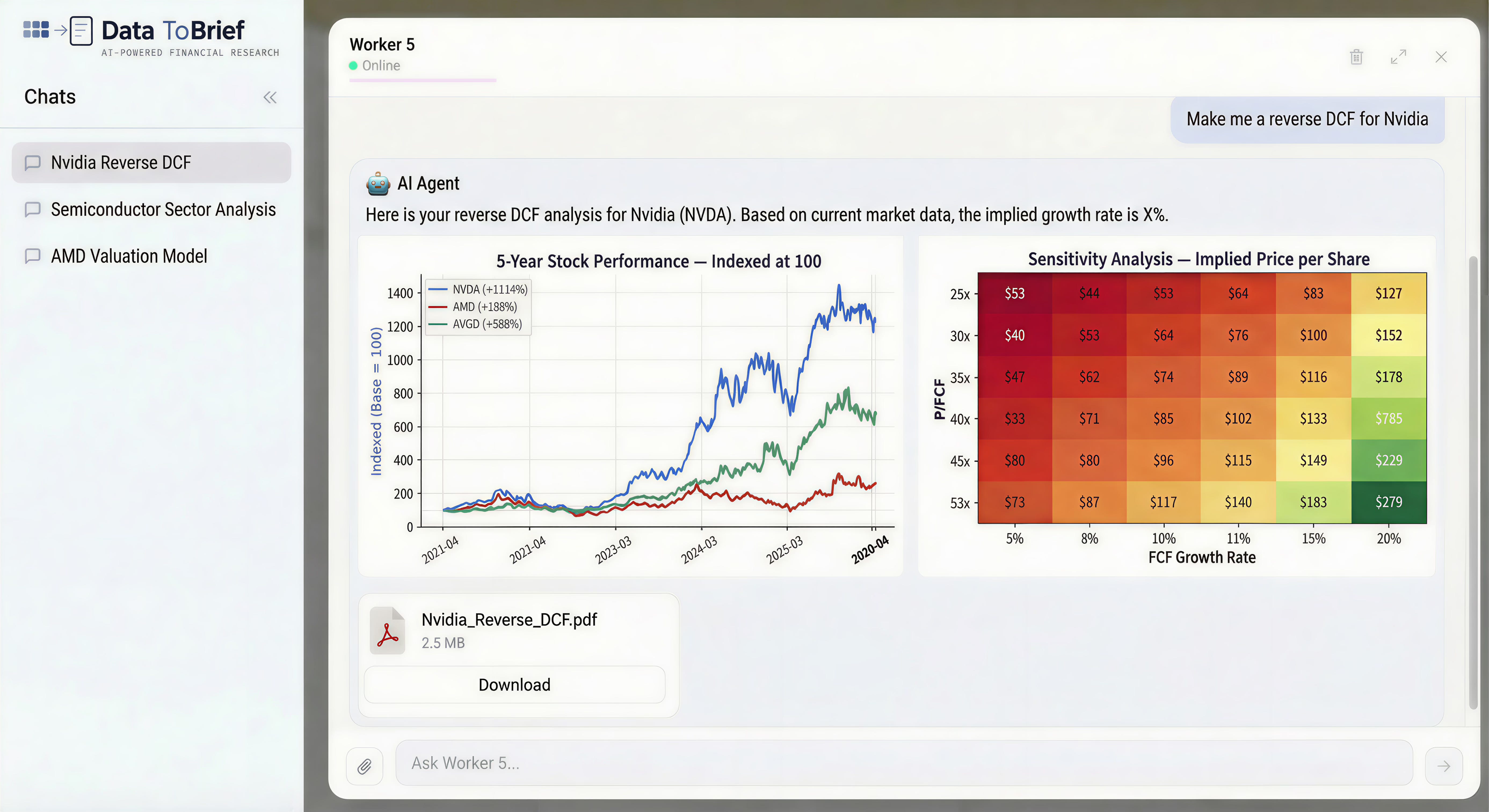
You read Macro Notes because you think in themes. Rate cycles, trade policy, currency regimes. But the real alpha comes from connecting those macro views to the right companies at the right time.
DataToBrief gives you an AI analyst that does exactly that.
Monitors every filing, earnings call, and macro signal. Proactively. Alerts you when something changes in your investment thesis. Generates full research reports on any public company in 15 minutes.Traces every claim back to its original source. No hallucinations.
It watches your theses around the clock. A surprise in ASML’s order book. A shift in guidance from a company you flagged three months ago. A regulatory filing that confirms your bear case. Your AI analyst catches it, analyzes it, and tells you what it means for your position.
Need to go deeper? Ask it to build a complete research report. It pulls from 14+ sources, constructs bull/base/bear scenarios with target prices, and delivers institutional quality output you can act on.
Think of it as the analyst who:
Covers your entire watchlist, not just the five names you had time to update this week.
Connects macro signals to individual company impact before you have to ask.
Works across global equities in 10 languages.
Never misses an earnings call, a 10-K, or a late Friday filing.
The best investment teams don’t just react to macro shifts. They have the coverage to act on them. DataToBrief gives you that coverage without adding headcount.
Early access is open for a limited number of teams.
Get Early Access to Your AI Analyst Link»
There’s a question I’ve been turning over for months that I think most investors aren’t asking yet. It’s a simple question, but the implications run deep.
If artificial intelligence progressively automates human labor — and every serious indicator suggests this is happening, not as a distant scenario but as a measurable, accelerating reality in 2026 — then what, exactly, determines economic value?
The traditional answer is straightforward. Value comes from work. People produce things, companies sell those things, earnings grow, stock prices follow. The entire apparatus of financial analysis — earnings reports, P/E ratios, revenue-per-employee, analyst estimates — was built to measure one fundamental variable: the productivity of human labor.
But that variable is changing. Morgan Stanley published a report earlier this year identifying 2026 as the year corporate budgets structurally shift from headcount to compute. Not experimenting with AI anymore. Reallocating. Battery Ventures calls it “the year of agents — software expanding from making humans more productive to automating work itself.” An MIT study estimates 11.7% of US jobs could already be automated by current AI systems. Bernstein’s research team wrote something I haven’t been able to stop thinking about: “the lines between labor and capital start to blur, and the existing social contracts between labor and capital may need to be rewritten.”
If you accept that this transition is underway — even partially, even slowly — then a second question follows naturally.
In an economy where value increasingly depends not on who works but on where capital gets allocated, what becomes the most important competitive advantage?
The answer is information. Specifically, information about the future. Not what happened last quarter. Not what an analyst thinks based on last quarter. Information about what is likely to happen next — and how confident you should be in that assessment.
This is where I need you to hold two ideas in your head simultaneously.
The first idea is that prediction markets are growing at a rate that has no precedent in modern financial history. Half a billion dollars in total volume in 2022. $63.5 billion in 2025. On pace for somewhere between $300 billion and a trillion dollars in 2026. A 127-fold expansion in three years. Those numbers alone would be worth studying.
The second idea is that the categories growing fastest on these platforms are not sports and politics. They’re economics — Fed rate decisions, inflation prints, jobs reports — up 905% in 2025. Technology and science markets grew over 1,600%. The contracts that look nothing like gambling and everything like a new financial primitive for pricing uncertainty in real time.
Now connect those two ideas to the macro shift I just described.
If the economy is transitioning from labor-driven value to capital-allocation-driven value, then the critical decisions are no longer “how many widgets did we produce” but “will the Fed cut rates,” “will this regulation pass,” “will this geopolitical conflict escalate,” “when will AI agents replace this function.” These are questions of fundamental uncertainty. They’re the variables that move markets. And until very recently, there was no structured, liquid, real-time mechanism for pricing them.
Traditional financial data tells you what already happened. Futures and options give you implied expectations on a narrow set of financial variables. Analyst reports give you one person’s opinion with no skin in the game. Polls give you a static snapshot with no financial incentive for accuracy.
Prediction markets are different on every axis. They’re forward-looking by design. They’re financially incentivized — participants risk real capital, which drives them to seek better information. They update in real time. They’re verifiable. And they cover precisely the category of events that the new economy makes critical: regulatory, political, technological, and geopolitical outcomes that no traditional financial instrument can capture.
I’m going to make an argument in the rest of this article that may sound ambitious, but I believe the evidence supports it fully.
Prediction markets are not a new form of gambling that happens to generate interesting data. They are the native information infrastructure of the capital-allocation economy — the economy that AI is building whether we’re ready for it or not. They are the first mechanism in financial history that converts collective intelligence about non-financial events into a structured, tradeable, continuously updating probability signal. And the institutional financial system is beginning to integrate that signal into its core workflows right now. Not in theory. Not in pilot programs. In production, through products that launched in early 2026.
The reason I started researching this space isn’t because I wanted to understand prediction markets. It’s because I’ve been trying to answer a much larger question — a question that sits at the center of everything I write on Macro Notes: how does the investment infrastructure need to evolve to match an economy that AI is fundamentally reshaping?
Prediction markets, I believe, are one piece of that answer. And the investment thesis I’ve built around that belief connects a specific set of publicly traded companies to a structural shift that most of the market hasn’t priced yet.
In the premium section of this article, I’ll walk through the complete thesis. I’ll explain which company has positioned itself as the monopoly distributor of prediction market data to institutional investors — and why their existing business model makes this a near-frictionless revenue expansion rather than a speculative bet. I’ll show you the specific transaction that signals the inflection point, the financial data that supports the position, and the risk framework I’m using.
I’ll also argue that the traditional sportsbook industry — some of the biggest names in gambling — is structurally locked out of this opportunity, and explain why that creates a window for a category of companies that most investors haven’t connected to prediction markets at all.
This is one of the more ambitious theses I’ve published. But I think the logic is sound, the data is compelling, and the timing is right…