


Every civilization believes its problems can be solved by adding something — a rule, an office, a layer of oversight. None of them notices the moment that instinct stops paying off and starts quietly killing them. An anthropologist named Joseph Tainter spent a career explaining why, and his answer turns out to be the most reliable pattern in economic history — and a test you can run, today, on your own career, your portfolio, and your country.
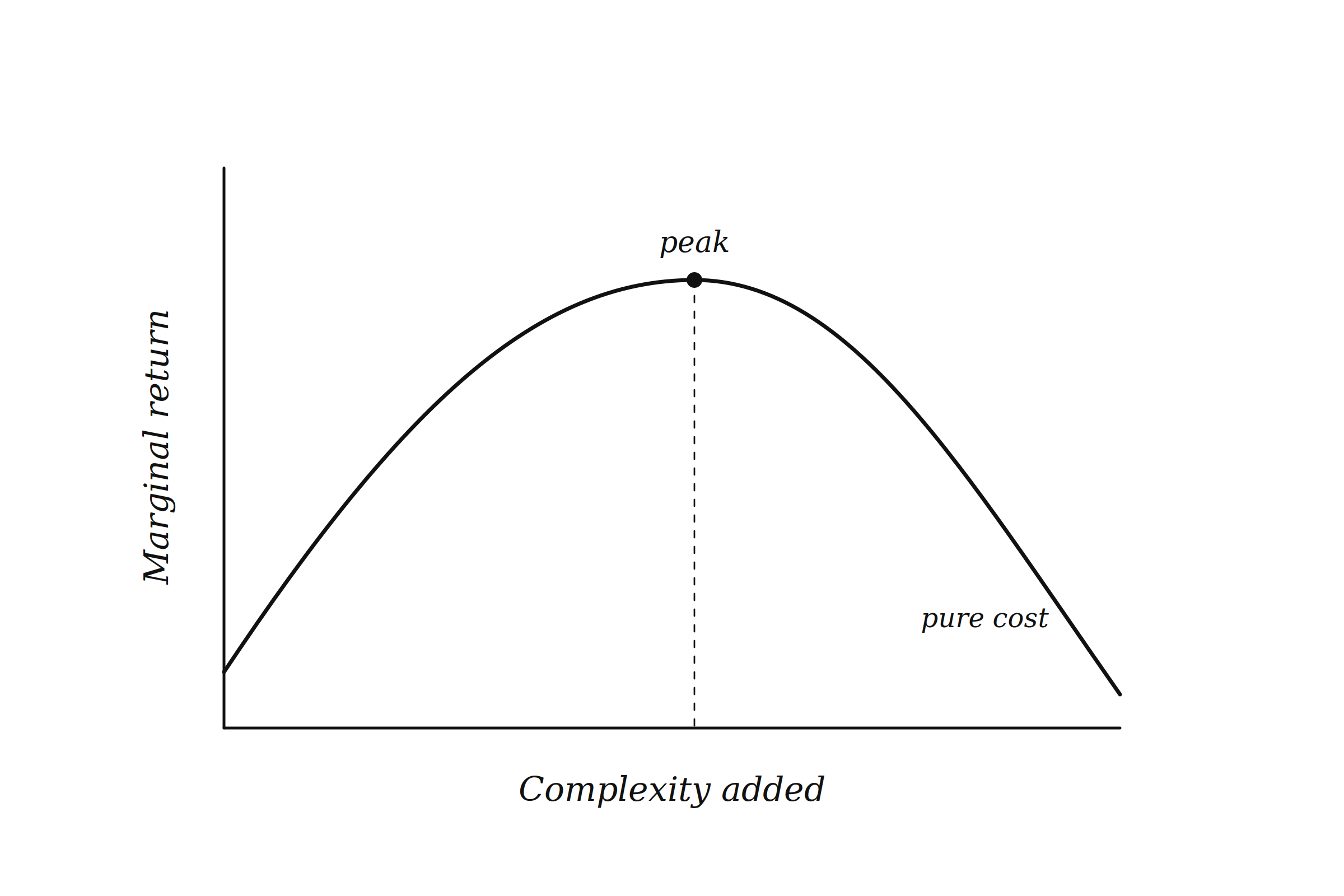
The central idea belongs to Joseph Tainter, an anthropologist who published The Collapse of Complex Societies in 1988, and it is fearsome in its simplicity. Human societies, Tainter argues, are best understood as problem-solving organizations whose sociopolitical systems require energy for their maintenance. Confronted with a problem — an invasion, a famine, a shortfall — a society responds the only way it knows how: by adding complexity. A new layer of bureaucracy. A new tier of hierarchy. A new specialization, a new office, a new rule.
At first this works beautifully. Early on, the marginal value of complexity is positive — each additional increment more than pays for itself in improved output. The first irrigation bureaucracy turns a floodplain into a breadbasket; the first standing army turns a vulnerable frontier into a secure one. Complexity is, for a long time, the smartest investment a society can make.
And then, quietly, the arithmetic inverts. After a certain point, increased investments in complexity fail to yield proportionately increasing returns. Marginal returns decline and marginal costs rise. Complexity as a strategy becomes increasingly costly, and yields decreasing marginal benefits. Over time the law of diminishing returns reduces the marginal value of each new layer until it disappears completely — and past that point, any additional complexity is pure cost. The society does not notice the moment it crosses the line, because each new rule, each new office, still looks locally sensible. It is only in aggregate, and only in retrospect, that the picture resolves: an organization investing ever more heavily in a strategy that returns ever less.
Now comes the genuinely unsettling part, the one most people miss when they reach for Tainter as a story about decline. The collapse, when it comes, is not chosen. When societies fail to respond to reduced circumstances through orderly downsizing, it is not because they do not want to — it is because they cannot. The complexity has become load-bearing. Every layer has a constituency, a budget, a reason for being that made sense the day it was added. So the layers stay, the costs mount, and the society loses the one thing it most needs: the capacity to adapt. Complex societies collapse because, when some stress arrives, they have become too inflexible to respond.
Tainter’s one-sentence version is the one to carry with you: a society’s elite members add one layer of bureaucracy or demand one tribute too many, and they end up extracting all the value it is possible to extract from their environment, and then some — and the “and then some” is what causes the trouble. Collapse itself, in his definition, is not death. It is something more precise and, oddly, more useful to us: the point at which a society rapidly sheds a significant portion of its complexity. Collapse, in other words, is simplification — the violent, involuntary kind, arriving because the orderly kind was never possible.
Hold on to one more concept, because it is the hinge that connects this edition to the last one. Tainter insists that these problem-solving systems run on energy, and that when they start to yield diminishing returns, the clock can be reset if a new “energy subsidy” can be found. A society drowning in the costs of its own complexity can buy itself a new lease — ifsomething arrives that radically lowers the cost of the work the complexity was doing. Coal did this for an exhausted early-modern Europe. The question we will end on is whether artificial intelligence is about to do it again — and who it rescues, and who it does not.
So here is the thesis in a single line, and I would ask you to keep it in view through everything that follows: complexity is the solution that slowly becomes the problem — and the decisive skill of the coming era is no longer how to add it, but how to tell which kind to cut.
Three promises, then, before we descend into the cases. First, I will show you the curve every civilization eventually draws, and how to locate yourself on it. Second, I will show you why simplification is almost impossible to choose voluntarily — and the one force in history that has ever managed it. And third, I will show you which side of the line to stand on: which complexity preserves a future and which devours it, and what that means for where you put your capital, your career, and your conviction.
A caution first, in the spirit of this newsletter. Tainter’s idea attracts prophets of doom the way a flame attracts moths, and the breathless version — civilization is ending, here is the date — is both seductive and trivially easy to discredit. I am not going to sell you that. Where the popular telling outruns the evidence, I will say so plainly, because the real pattern is powerful enough without embellishment. It needs precision. That, after all, is the whole point.
Let us go to the clearest case history we have.
Rome: A Civilization Paid in Diluted Money
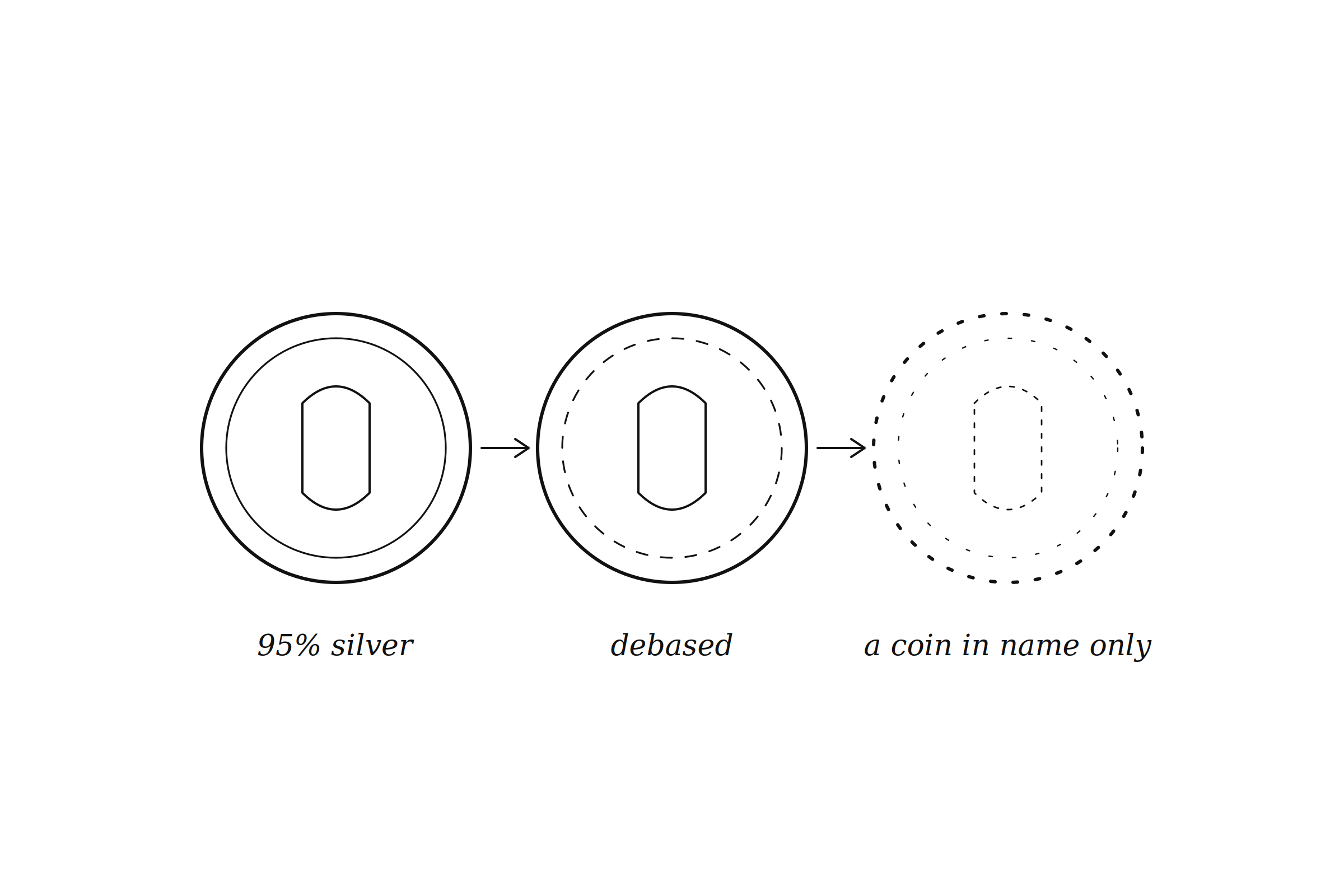
If you want to watch the curve bend in real time, with hard numbers attached, watch what happened to Roman money.
A coin is a beautifully honest instrument, because you can measure exactly how much a state is cheating. Under Augustus, the silver denarius was the real thing: around 95 to 98 percent silver, weighing roughly 3.9 grams, and it held that integrity through the first two centuries of the empire. Then the line begins to bend. The cause was textbook Tainter — the cost of maintaining the apparatus outran the empire’s capacity to pay for it. As territorial overreach, military expense, and administrative cost rose, successive emperors found themselves resorting to debasement to fill the state’s coffers.
By the great Crisis of the Third Century, the cheating had become catastrophic. By the middle of the third century the denarius was essentially a bronze coin with a thin silver coating. The mechanism was a doom loop of pure political short-termism: each short-lived emperor needed money fast to pay the army’s accession bonus, and the easiest way to raise it was to debase the coinage severely with bronze and copper — which produced runaway price rises, so that by the time Diocletian came to power the old coinage had nearly collapsed.
Here is the single detail that should make the hair on your neck stand up, because it is the perfect symptom of complexity gone septic. The Roman state stopped trusting its own money. Diocletian’s enlarged bureaucracy hardly improved the empire’s economic machinery — and one sign of the dysfunction was that taxes came to be paid in bullion rather than in the state’s own debased coin. An institution so complex it could no longer rely on the instruments it had itself created: that is the curve, made tangible.
And the imperial response? More complexity, of course — that is the only move the machine knows. Diocletian’s Edict on Maximum Prices of 301 was a sweeping, empire-wide attempt to legislate the crisis away by fixing the price of everything from wheat to a lion. It is the canonical example of the layer too far. It failed exactly as such layers always fail: the introduction of new coinage did halt the debasement, but prices kept right on rising. Diocletian, in the end, tried to halt the disintegration of the Roman economy with sweeping interventionist policies that solved nothing.
Notice what Rome did not run out of. Not soldiers, not territory, not silver mines, not administrative talent. What it ran out of was return on its own complexity. Every response to the crisis — more offices, more taxes, more rules, more dilution — deepened the very disease it was meant to cure. The empire could not simplify, because every layer had become someone’s livelihood and someone’s power. So it kept paying more to get less, until the simplification it would not choose arrived in the form it could not refuse.
This is not a story about ancient incompetence. The Romans were not fools. They were trapped in a logic — and the logic is still running.
The rest of this edition is for Macro Notes Premium subscribers. Here is what waits on the other side:
The modern proof — we are demonstrably on the curve. The hard numbers: why it now takes eighteen times the researchers to sustain Moore’s Law, why US research inputs rose twenty-three-fold for flat productivity, and the regulatory code that has only ever grown — never shrunk — across every administration since Carter.
Why no society can simplify on purpose — the most unsettling thing Tainter found, and the one force in history that has ever reset the clock.
The distinction that changes everything: complexity is not technicality. Why Bitcoin is fearsomely complex yet antifragile, while a “simpler” bureaucracy is brittle — and the one-line test that tells the two apart.
The energy subsidy arrives — and it cuts in one direction. Why AI dissolves the bad kind of complexity first, and who that spares versus who it exposes.
The test, at three scales — how to read a company, a country, and your own career for negative-return complexity, and which side of the line to stand on.
The payoff: simplicity as an investment philosophy — turning all of it into a usable rule for where you put your capital, and the one caveat that keeps it from becoming ideology.