


Whenever I’m in a developed city — anywhere, doesn’t matter which — I read the storefronts and the billboards the way some people read tea leaves. What a place chooses to sell you, and advertise to you, says more about a society than most of what it says about itself out loud.
A few weeks ago I was driving and got stopped at a red light. Right beside me was a billboard for Lilly — Eli Lilly, the pharma company behind the weight-loss drugs everyone’s suddenly on. And as I sat there waiting for the light, I noticed the rest of the street: a fast-food joint a little further down, and a gym almost directly across from it. Three businesses, one stretch of road. One sells you the problem. One sells you the hard way out. One sells you the shortcut. All three thriving, all at the same time.
The light changed, but the image stuck with me. Because none of it is random. Those three storefronts are the visible surface of a cycle that’s been running for fifty years — one that begins with an injury to the human body and ends, eventually, with fortunes built at every stage of the damage and the repair. I want to trace that cycle from its start, because once you see its shape clearly on the body, you’ll notice it starting to repeat somewhere far less expected: the human brain. But we get there by walking, not jumping. So — the body first.
How the injury happened
The story doesn’t start with fast food. It starts with the office chair.
For almost all of human history, staying alive meant using your body. Then, over the twentieth century, industrialization quietly took that away. Machines did the lifting; work moved indoors, to desks and screens. And here’s the part that’s easy to miss: sitting still all day wasn’t a mistake. It was the prize. We had finally built a world where you no longer had to sweat to earn a living. Productivity went up; physical effort went down.
The trouble is that we kept eating as if we were still in the fields. Worse — the food itself changed. Cheap, engineered, ultra-processed food spread everywhere, and it now makes up somewhere between half and two-thirds of the calories eaten in the rich world. So you had a body that had stopped moving being fed more than ever, by food designed to be overeaten. Calories in went up; calories out went down. That gap — invisible, one meal at a time — is where the whole thing began.
And it built slowly. This is the detail to hold onto, because everything later depends on it. The damage took decades to surface. As recently as 2012, not a single U.S. state reported adult obesity above 35%. Eleven years later, twenty-three states did, and the country now sits near 41.6% — with a bill of roughly $173 billion a year in related disease. Nobody felt the trigger being pulled in the 1970s. The wound just widened, quietly, for two generations.
One aside worth keeping, because it comes back later. Not everyone got hit equally. Most of Europe stayed well below American obesity levels — several countries under 15% — not because Europeans have more willpower, but because of rules: limits on how junk food is marketed, what goes into it, what schools are allowed to serve, plus cities you can actually walk across. Regulation didn’t cancel the injury. It slowed the bleed. File that away.
The first response: a cure that asks everything of you
Now watch what grows out of an injury this widespread.
As bodies stopped moving on their own, a whole industry appeared to sell movement back to us. That’s all a gym really is — physical effort you now have to buy on purpose, because daily life stopped handing it to you for free. And it became enormous: the global fitness market is worth around $278 billion in 2026, and the wider world of movement — equipment, apps, coaching, athletic wear — tops $1.1 trillion.
But look closely at what kind of cure this is, because it matters. It’s slow. It’s hard. It asks you to reorganize your life and stay reorganized for years. And most people can’t — they start, they quit, they start again. Here’s the part that turns a health observation into a business insight: that failure is the engine, not the flaw. A cure that rarely sticks is a cure people pay for again and again. The whole model quietly runs on relapse. Every January, the same customers come back.
So that’s the first response to the injury: an effortful, lifelong, recurring cure. Hold that thought, because a second, very different kind of response was coming — one that would make the effort almost optional.
The second response: the shortcut that skips the effort
For decades, the only way back was that long, sweaty road. Then the road got a bypass.
GLP-1 drugs — Ozempic, Wegovy, and the rest — don’t ask you to become a different person. They reach into the biology of hunger and turn it down. No willpower, no new lifestyle. And the numbers moved accordingly: the weight-loss segment alone runs from about $13.8 billion in 2024 toward $49 billion by 2030, with American users climbing from roughly 5 million in 2023 to a projected 30 million by 2030.
Here’s where you start seeing money move, not just appear — and this is the real lesson of the whole cycle. When the shortcut arrived, it didn’t only create a new market. It began draining the ones around it.
Eli Lilly rode this drug into the trillion-dollar club, with U.S. revenue up 43% in a single quarter. Its rival Novo Nordisk — facing the same booming demand — guided toward a sales decline, because within the shortcut there are already winners and losers. And downstream, the damage spreads: analysts at J.P. Morgan estimate these drugs could pull $30–55 billion a year out of the food industry by the early 2030s, as people simply eat about 21% less. When a shortcut cure appears, the smart question isn’t only “who sells it?” — it’s “whose business was quietly built on the problem staying unsolved?” Packaged food. Snack makers. Even dialysis clinics. A single drug turned them into things investors now describe as structural declines.
Step back — and you can see the shape
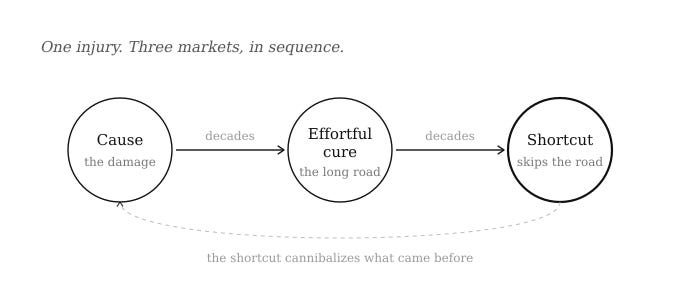
Now pull back from the details, because a pattern has quietly assembled itself, and it’s the thing actually worth owning.
An injury to the human body created not one market but three, in sequence. First, the industries that caused the damage and grew fat on it. Then an industry that sold a long, effortful cure — profitable precisely because the cure is hard to keep. And finally a shortcut that made the effort optional, minting a fortune while quietly gutting the industries built on the original problem.
Cause. Effortful cure. Shortcut. Each phase had its own investment logic — the cause-industries eventually become slow structural shorts; the effort-industry is a compounder that feeds on relapse; the shortcut is the asymmetric bet that stays small for years, then goes vertical and eats everything upstream. This isn’t a story about obesity. It’s a template. And templates are useful only if they repeat.
So here’s the question this whole note has been walking toward: is anything else in modern life injuring us slowly, in the same way — early enough that its cure-markets haven’t fully formed yet?
I think there is. And it’s happening to the organ we can least afford to lose.
In the rest of this edition:
The brain’s injury — and why 2026 is really “1985 for the body.” How the exact same shape is unfolding one floor up, and the timing call that tells you how early we still are.
The one number that decides everything — and why the science being unproven doesn’t matter for your money. The uncomfortable truth about causation, and why cure-markets form anyway.
Phase two of the brain, already forming. Why reading is the “gym” of the mind, the early-adoption signal hiding in a French university study, and the response markets compounding right now.
The collision with AI — the one macro force with no historical precedent. Two curves crossing this decade, and where the long-term thesis actually lives.
The brain’s shortcut — its version of the weight-loss drug. What it is, why it’s a “watch, don’t bet” for the next two decades, and the single place this entire analogy finally breaks — into something we don’t yet have a word for.
📊 The Investment Playbook. The technical section: sectors to fade and sectors to build into, market-size projections and timelines phase by phase, and named public equities on each — with a blunt verdict on which are too early, too late, or in the window right now.