


When we think about AI, we think about ChatGPT, Claude, AI agents in CRMs, and all kinds of applications serving the virtual world. We might also think about film production, content creation, and so on.
Today, let’s look at AI in the real world, because this is a macro trend that is booming right now, and the deployment of AI in robotics and autonomous systems is accelerating.
Amazon celebrated its millionth robot in 2025. The IFR also recorded 542,000 industrial robot installations in 2024, more than double the number ten years earlier.
Industrial robotics has been growing for a long time, but it hasn’t been particularly visible. Now we have applications that are much easier to see: autonomous cars, delivery robots.
The difference with virtual AI applications is that we don’t get the same rapid deployment. ChatGPT reached an estimated 100 million users in a few months. In a virtual environment, deploying an application has fewer physical constraints.
Those constraints mainly come down to compute and data centers, which is why demand for all kinds of infrastructure components has exploded alongside AI adoption.
But for AI applications in the real world, demand goes beyond data centers. It also means complex factories to produce these robots, including the large factories Tesla plans to use to build Optimus robots and autonomous cars at scale.
So when we invest in robotics, it is usually a long-term investment by nature. We expect deployment to be gradual, and demand to grow progressively.
But AI is starting to change this. The more autonomous industrial production becomes, the closer we could get to bringing the kind of mass adoption we already know in the virtual world into the real world.
A startup could invent a physical product and potentially reach hundreds of millions of users by outsourcing its production to a fully autonomous, highly efficient production line. Digital instructions could translate into real-world actions with far fewer steps in between.
This won’t remove every physical constraint, but it could make the process much faster.
And that is why I think we are heading toward a paradigm shift, and why investing in robotics now is probably a good idea over the long term.
On altis.finance, we share ten portfolios tracking different theses around autonomy and robotics. Here are the ten, along with their current returns:
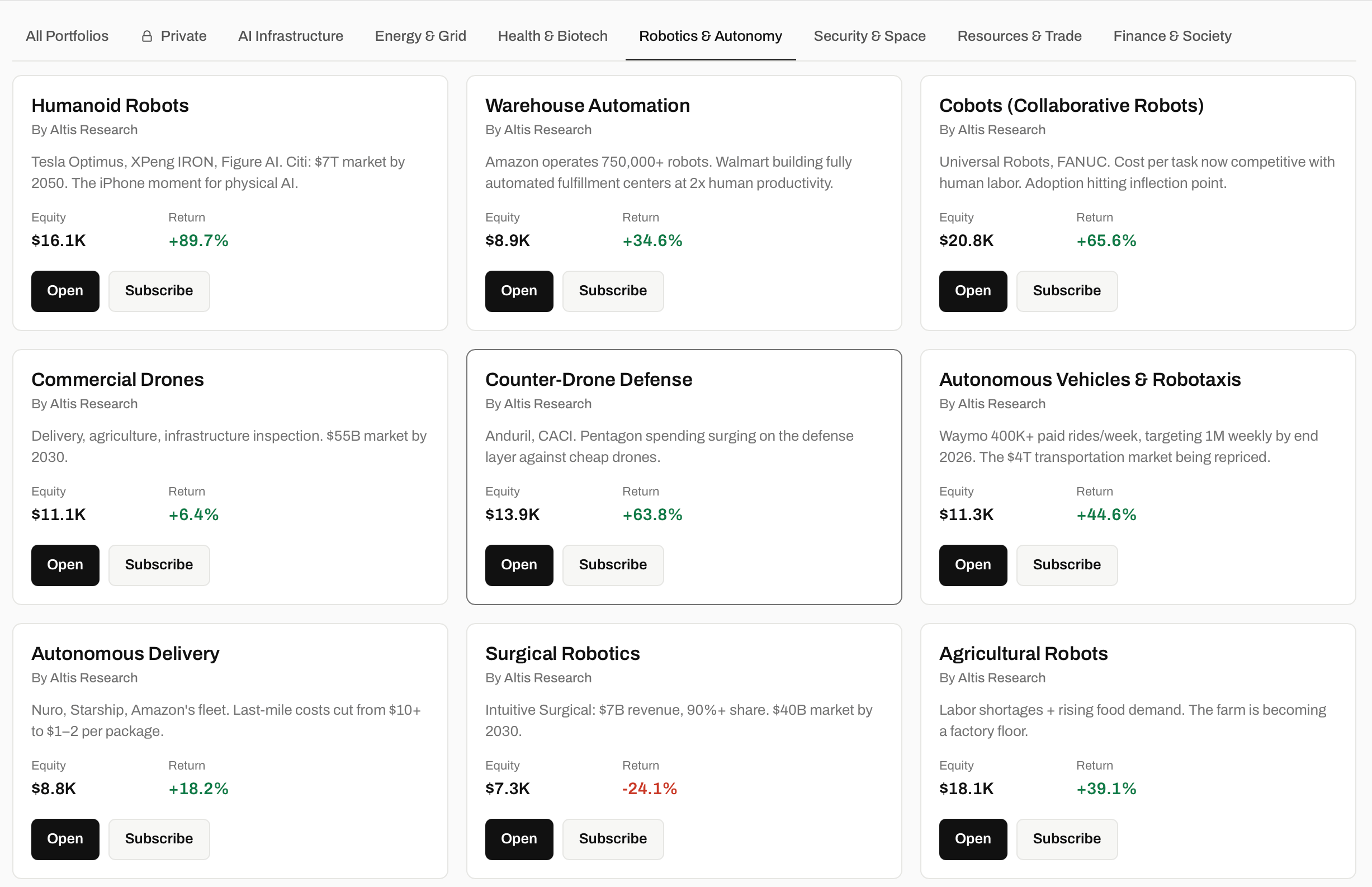
The only thesis that hasn’t really worked out for us so far is surgical robotics. I will write a dedicated edition explaining why the constraints on robotics in surgery are different from those in other sectors, and what we will change in the portfolio to address this.
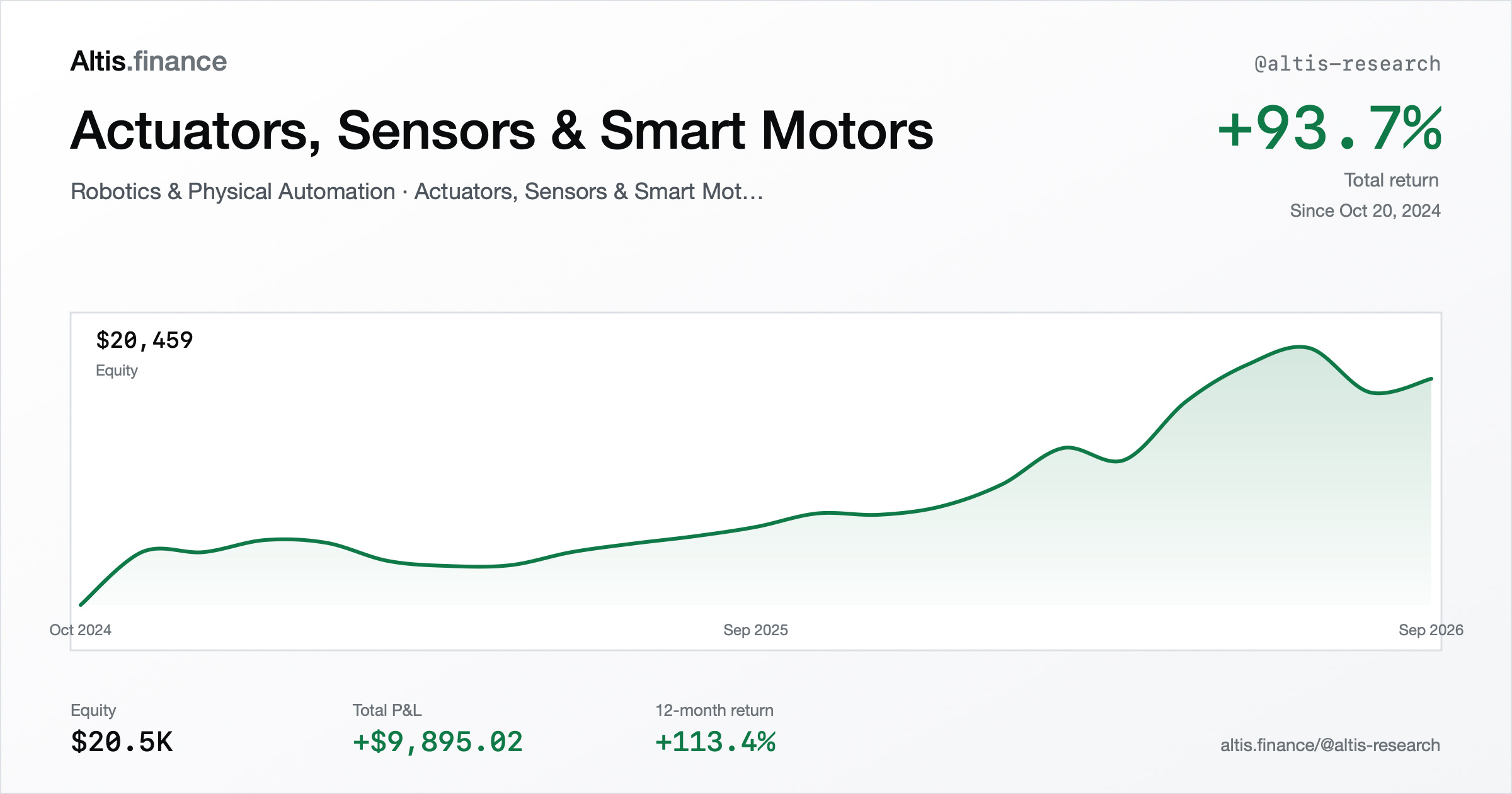
The best-performing one, on the other hand, is Actuators, Sensors & Smart Motors, up +93.7%. It focuses on the components behind robotics: allowing machines to sense, move, and interact with the physical world.
All the portfolios deserve a dedicated edition too. There is a lot to say about each one.
We now share more than 120 portfolios on altis.finance, published by Macro Notes and more than 15 other contributors.
If you’d like to become a contributor and share your own investment theses, visit altis.finance/contributors or contact me at pierre@altis.finance to learn more.
The idea is to make altis.finance an open platform where everyone can share portfolios and investment theses, and where you can follow their evolution in real time. A platform that goes beyond just the ideas we publish through Macro Notes.
You can see the thesis behind each portfolio and the reasoning behind each trade. Every purchase and sale is documented.
Access to all portfolios published by Macro Notes and Altis Research is included in Macro Notes Premium.
If you’re a Macro Notes Premium subscriber, you don’t need to pay for a separate altis.finance subscription, which normally costs $499 per year. That subscription is for people who discover the platform without being Macro Notes Premium members.
Subscribe today to unlock all our research and newsletter editions, plus access to altis.finance.
Subscribe to Macro Notes Premium for $300/year
1. The next challenge: turning intelligence into movement
To understand this trend, let’s take something simple: picking up an object and placing it on a shelf.
For us, this is almost automatic. But a robot has to identify the object, understand where it is, determine how to grasp it, apply enough force to hold it without damaging it, then adjust its movement if the object slips or encounters an obstacle.
And the constraints change depending on whether it is handling a cardboard box, a piece of clothing, or a piece of fruit.
This is a fundamental difference from digital AI applications. In the physical world, understanding an instruction is not enough. You have to execute it, with all the constraints of weight, friction, precision, and safety that come with it.
Amazon provides a concrete example with Vulcan, introduced in May 2025. This robot uses force sensors to detect contact and adjust its movements when storing or retrieving products. According to Amazon, it can handle around 75% of the types of items in its fulfillment centers. Situations it cannot handle are passed on to employees.
What interests me here is that we don’t need to wait for a robot that can do everything before we start seeing economic benefits.
A machine that reliably performs some tasks can already be useful, as long as integrating and supervising it does not cost more than the value it creates.
AI could gradually expand that range of tasks: recognizing more objects, adapting to more situations, and learning new tasks with less specialized programming.
But this requires several layers of technology.
Nvidia, for example, describes its approach to robotics around three functions: training the models, simulating the situations in which robots will operate, and then running those models on the machines themselves. Simulation allows developers to test behaviors before putting them into practice, although it does not replace testing in the real world.
This extends our thesis around AI infrastructure. Developing robotics still requires compute, but it also creates demand for everything needed to turn a digital decision into a physical action.
You need sensors to measure. Motors and actuators to move. Control systems to coordinate those movements.
The more complex the tasks we want to automate, the more important the quality of this entire chain becomes.
And this is the idea behind our components thesis, which I introduced earlier as the best-performing robotics and autonomy thesis among the portfolios you can follow on altis.finance.
At the time of writing, the portfolio is up around 93%.
2. Components: exposure to several areas of robotics
When we think about the winners in robotics, we naturally think about the companies making the machines we see: Tesla, Figure, industrial robot manufacturers, or companies developing autonomous vehicles.
It is similar with LLMs. You think about Claude and OpenAI. But when we look deeper, we see that some of the biggest beneficiaries so far have been the infrastructure suppliers that make this AI possible, receiving a substantial share of the investment behind its deployment.
Our theses around fiber optics and memory have covered this extensively.
And in robotics, there is a similar idea. That is what sits behind our Actuators, Sensors & Smart Motors portfolio.
We are talking about the components inside robots, and here is why they matter.
An actuator turns a command into movement. Depending on its design, it can integrate a motor, a transmission mechanism, and measurement or control components. A gearbox adjusts the motor’s speed and torque to suit the task. Sensors tell the system about its position, the force being applied, or what is happening around it.
These elements may look less impressive than a humanoid robot. Yet they determine a large part of what the machine can actually do.
Harmonic Drive provides an example of this industrial specialization. The company offers precision gears and actuators combining components such as gears, motors, and encoders. Its technologies are used in industrial and collaborative robots.
The investment thesis is quite simple: some suppliers could benefit from the growth of several manufacturers and applications, without depending on the success of a single robot model.
But we need to be precise. A drone, a surgical robot, and a humanoid do not all use the same components. Their requirements for weight, power, precision, and cost are different. We therefore need to identify the markets each supplier is actually exposed to.
And above all, an increase in the number of robots does not guarantee higher profits for every supplier.
Let’s take a purely illustrative example. If a manufacturer sells twice as many components, but its average selling price falls by 30%, its revenue increases by 40%, not 100%. And if production costs do not fall sufficiently, profitability can disappoint despite a growing market.
This is an important tension within the thesis: for robots to be adopted more widely, their cost often needs to come down. Suppliers may be asked to absorb part of that reduction.
So the question becomes: which components are difficult to replace? Which manufacturers offer precision, reliability, or durability that customers are willing to pay for?
In the premium section of today’s edition, we’ll explore:
The components thesis in more depth: where demand could grow, which suppliers could retain pricing power, and what could weaken the investment case.
The portfolio and its positions: the companies we have selected, what they supply, and how each one fits into the thesis.
The trade history: when we added or reduced positions, the reasoning behind those decisions, and how the portfolio has evolved.
What we are watching next: the developments that could strengthen our conviction or lead us to adjust our positions.
Your Macro Notes Premium subscription also includes access to this portfolio on altis.finance, where you can follow its evolution in real time and see the reasoning behind each recorded trade.
That access extends to all the other portfolios published by Macro Notes and Altis Research, including the robotics and autonomy portfolios introduced earlier.