

At Macro Notes, we invest with a global macro approach.
That means we start from the macroeconomy to identify interesting market movements, then we build investment theses. Only then do we pick the companies exposed to those theses.
It’s a top-down approach to stock picking. We don’t ask “does this company have interesting potential?” We study the economy at the macro level first, and then we ask whether a company exposed to the thesis we’ve built has interesting potential.
For example, instead of asking “does GE Vernova have interesting potential?” and analyzing the company, we reason (to simplify) like this: AI needs massive infrastructure, but it also needs energy. Which energy companies will be exposed to this trend? GE Vernova. We look at its contracts, its commitments, whether its order book is concentrated on AI data centers. We identify its competitors. And only at that stage do we analyze the companies one by one, looking at things like the size and quality of the backlog, the pricing on new orders versus old ones, the capacity to actually deliver, customer concentration, the balance sheet, and above all how much of the story is already in the price.
This way of investing works. But of course, only when it’s applied with an enormous amount of rigor.
The reasoning I just walked you through is global macro, but it’s oversimplified. It’s not rigorous. The conclusion is right, but it’s biased.
Here’s what’s missing. We jumped from “AI needs energy” straight to the most famous name in the sector. A rigorous approach would have mapped the entire chain first, from power generation to the grid to the data center itself, and asked one question: where is the bottleneck? Because the bottleneck is where the pricing power sits. And if it turns out that the binding constraint is getting power through the grid rather than generating it, then the best exposure to the thesis might not be the turbine maker at all, but the companies making transformers and grid equipment. The company everyone already knows isn’t necessarily the one that captures the most value.
And that’s just one gap. We’d still need to ask how long the trend lasts, what could break it, and what the market has already priced in.
That’s why a thesis can’t be told in a few lines.
Today, I’m sharing 5 theses we’re working on, the ones we’re most optimistic about right now. For each thesis, we’ll do a deeper, more rigorous analysis that you can read on Macro Notes Premium, to access our final conclusions and understand how we’ll invest in each one, or why we won’t.
Thesis #1: The Refining Crunch
Most people are watching the price of crude. We’re watching what happens after the crude.
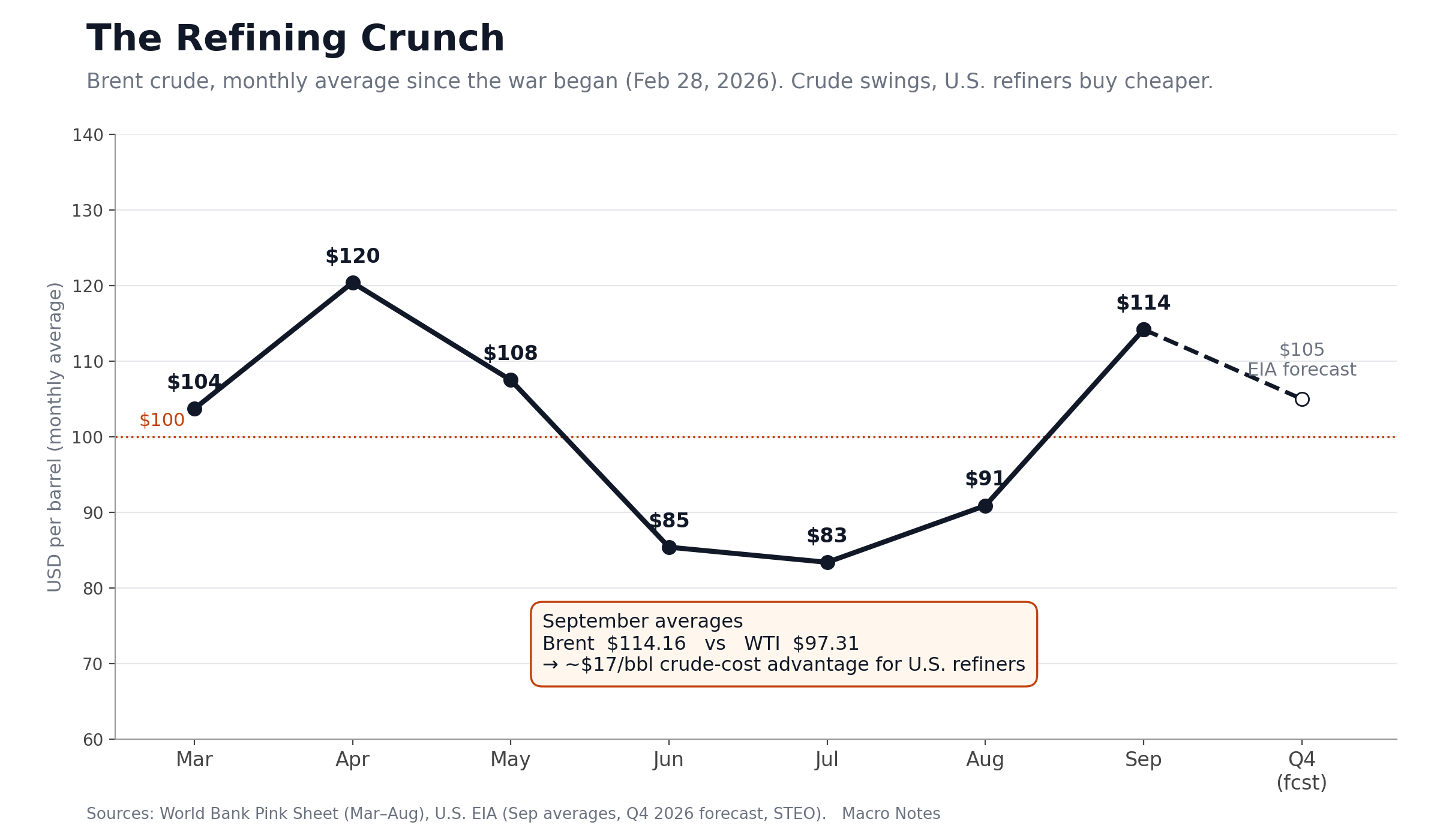
Since the war with Iran began on February 28, oil has been the headline of the year. Brent peaked above $126 a barrel at the end of April, fell back, and has been trading above $100 again since early September. Every time it moves, the financial press writes the same story: oil is up, inflation is coming, buy energy.
But here’s what that story misses. Nobody fills their tank with crude oil. Consumers buy gasoline, diesel and jet fuel. And for most of this year, they’ve been paying the equivalent of more than $100 a barrel for those fuels, even when crude itself was trading well below that level.
Why? Because the conflict didn’t just disrupt oil supply. It created a global refining crunch. Refining capacity in and around the Gulf has been impaired, shipping routes have become dangerous, and the world is short of finished products, not just of crude. When that happens, the margin between what a refiner pays for crude and what it sells fuel for widens. That margin is where the money is.
This is where the top-down approach matters. If you start from “oil is going up,” you buy oil producers and you’re exposed to every headline about a ceasefire. If you start from “the world is short of refined products,” you look for the companies that own the bottleneck: the refiners.
And the best positioned are not in the Middle East. They’re in the United States. American refiners like Valero, Marathon Petroleum and Phillips 66 buy crude priced on WTI, which has been trading several dollars below Brent, and they sell their products at global prices. They’re paid for the crisis without being located in it.
What would make us wrong? A durable ceasefire that reopens Gulf flows quickly would compress margins fast. That’s the risk we’re watching most closely. The other one is demand: at these fuel prices, consumers eventually drive less and airlines fly less. The question is whether that happens before or after the supply side normalizes.
Thesis #2: The Gold Paradox
Here’s a question we’ve been asking ourselves for weeks: there’s a war in the Middle East. Oil is above $100. Inflation is running hot. This is exactly the environment where gold is supposed to shine.
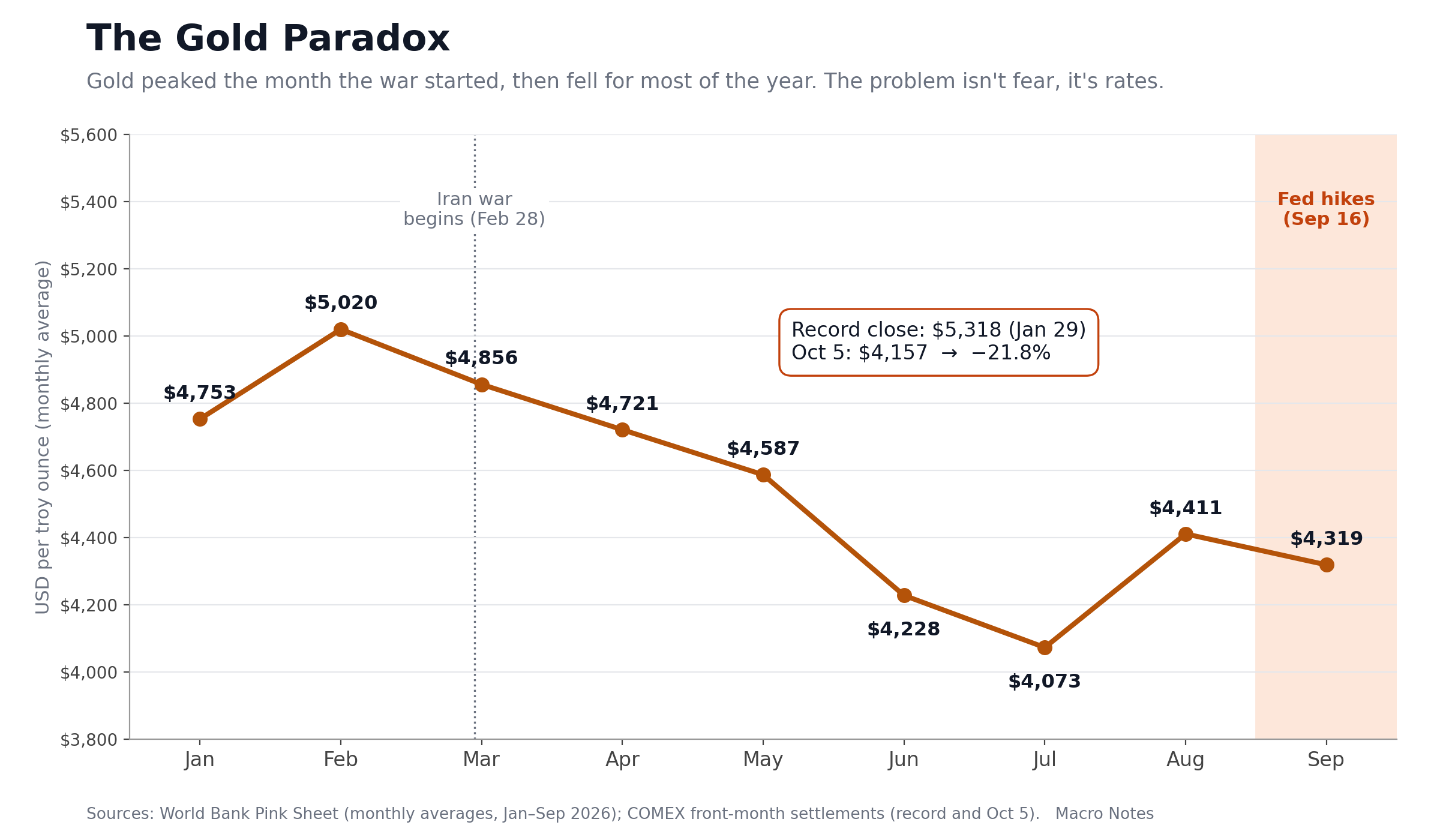
And yet gold is down more than 20% from its January record.
On October 5, gold settled at $4,157 an ounce. Its record close was $5,318, on January 29. It lost another 7% in the last month alone.
GOLD — 2026
Record close (Jan 29)      $5,318
Close (Oct 5)              $4,157
From record                -21.8%
Last month                  -7.1%
If you only look at gold itself, this makes no sense. If you look at the macro, it makes perfect sense.
Gold doesn’t pay any yield. Its biggest competitor isn’t fear, it’s interest rates. And right now, the Federal Reserve is hiking again. It raised rates in September to 3.75–4.00%, and long-term Treasury yields are above 5%. When you can earn more than 5% on a government bond, holding a metal that pays nothing has a real cost. That’s what has been crushing gold. Not a lack of fear, but the price of waiting.
So the real question isn’t “is gold a good hedge?” The real question is: when does the Fed stop?
And this is where it gets interesting. Earlier this month, markets were pricing a real chance of another hike on October 28. Then Fed Chair Kevin Warsh declined to send a hawkish signal, and the odds of an October hike dropped to around 15%. The market is starting to price a pause.
A Fed pause doesn’t mean gold goes straight back to its record. But it removes the main force that has been pushing it down. And if that happens, the most interesting exposure might not be gold itself, but the miners. At $4,100 an ounce, the large producers are still extracting gold far below its selling price. Their margins are enormous, and the market is valuing them as if the metal were in a downtrend.
What would make us wrong? A Fed that hikes in October and again in December. That’s the scenario where real rates keep rising and gold stays under pressure. That’s why the next two Fed meetings are the catalysts we’re tracking for this thesis.
The next three theses
These first two theses have something in common: they’re about the war, and how it’s reshaping energy and monetary policy. The next three go further, and they’re the ones we’re the most convinced about.
The third thesis is about a number that hasn’t existed in this market for a long time: 5%. For the first time in years, a risk-free government bond is a real competitor to stocks. Most investors are treating this as noise. We think it’s a regime change, and that it changes which part of the equity market you should own. The S&P 500 is near its highs, but only a quarter of its stocks are above their 50-day moving average. We’ll explain where we think the opportunity is hiding.
The fourth thesis is about AI. The market has spent the year panicking about AI capex and the threat to software. We think the panic is pointing at the wrong place. There is a part of the AI chain that nobody can route around, and it’s not where most people are looking.
The fifth thesis is about what the war has consumed. Eight months of conflict, drones and strikes on shipping have drained stockpiles that take years to rebuild. The replenishment cycle hasn’t been priced yet, and we’ll show you which companies sit at the bottleneck.
For each of these three theses, and for the two above, the premium section goes through the full analysis: the catalysts, the risks, the companies we’re looking at, and our final conclusion on how we’re investing, or why we’re not.
And as always, every thesis we publish is tracked live in Altis Terminal, included at no extra cost with your subscription. You can see our positions, our trades and how each thesis is validating or invalidating against the market, in real time.