

I have covered defence quite a lot on Macro Notes over the past few years, European defence in particular.
It is one of the easier themes for me to investigate because I spend a lot of time in Eastern Europe, not very far from the Ukrainian border. The consequences of what is happening in Ukraine are much more visible here than they are from London.
But after the drone and missile attacks that reached Dubai earlier this year, there was another defence theme I started paying much more attention to: counter-drone defense.
In March, drones reached the area around Dubai International Airport, while attacks across the Gulf disrupted airports, energy infrastructure and some of the busiest air routes in the world.
And the reason I find this theme particularly interesting is that it is fundamentally different from the European rearmament story we have discussed before.
This Is Not Just Another Rearmament Cycle
Europe’s defense problem is, in many ways, an enormous supply-and-demand imbalance. Russia represents a growing threat, European governments therefore need more ammunition, more missiles, more air-defense systems, more vehicles and more production capacity.
Governments increase their defense budgets, manufacturers receive longer contracts, factories expand, and companies across the defense supply chain benefit. We have discussed this dynamic extensively on Macro Notes.
But drones introduce something different. They change the economics of warfare itself.
For decades, when people talked about military drones, they were largely talking about unmanned aircraft. Think of something like a Predator: a large aircraft, long range, expensive sensors, sophisticated communications equipment, capable of remaining airborne for hours and striking high-value targets.
What is changing warfare today looks very different.
The modern battlefield increasingly involves relatively inexpensive drones manufactured at enormous scale. Many use relatively simple airframes, commercial electronics, navigation systems and inexpensive propulsion. They can fly low, they can be launched in large numbers, they can be mixed with decoys, and they don’t necessarily need to survive.
A drone worth tens of thousands of dollars can simply be sent in the direction of an infrastructure asset worth hundreds of millions.
That creates a very unusual economic equation.
Imagine spending $30,000 or $50,000 to launch a drone. The defender detects it, but the system available to destroy it was originally designed to intercept aircraft or sophisticated missiles. The interceptor can cost hundreds of thousands — sometimes millions — of dollars.
Even if the defender successfully destroys every drone, it can still lose economically.
This is the important part: the attacker doesn’t necessarily need to defeat the air-defense system. It can simply force that system to consume expensive interceptors faster than they can be replaced.
Ukraine has made this problem impossible to ignore. Russia is now fielding increasingly sophisticated drones at significant scale, including newer jet-powered systems that are harder to intercept, while Ukraine is simultaneously racing to develop cheaper interceptor drones and other countermeasures.
This is why I think the most important metric in air defense is gradually changing. It is no longer simply can you shoot it down? It is becoming how much does it cost you to shoot it down?
And that creates an entirely new defense market.
The Defense Stack Is Changing
Traditional air defense is not disappearing. You still need Patriot, advanced missiles, fighter aircraft and extremely sophisticated systems capable of intercepting ballistic and cruise missiles.
But using those systems against every $30,000 drone doesn’t make economic sense.
So another defense layer is being built underneath them: detection, small radar, radio-frequency sensors, electronic warfare, jamming, AI-powered identification, command-and-control software, low-cost kinetic interceptors, interceptor drones, programmable ammunition and, increasingly, directed-energy systems such as lasers.
The Congressional Budget Office recently described exactly this layered approach: radar and radio-frequency systems to detect small drones, followed by different methods to defeat them ranging from communications disruption to projectiles and directed energy.
This isn’t simply another product category inside the defense industry. It represents a new cost layer of modern air defense, and governments are beginning to spend accordingly.
$40 Billion
The event that made me revisit this thesis recently came from NATO.
On July 7, NATO allies announced that they intend to invest more than $40 billion in counter-drone capabilities over the next five years. NATO is also creating a dedicated counter-drone marketplace designed to make NATO-tested and NATO-compatible systems easier for member countries to purchase at scale.
I think the marketplace is almost as important as the headline number because one of the biggest problems in defense technology has historically been the gap between developing an interesting technology and actually getting governments to buy it at scale.
A marketplace designed around tested, interoperable systems potentially shortens that path: prototype, testing, approval, procurement, production, deployment.
That is exactly the transition I want to follow.
We created a portfolio around this thesis. Before the new trades we are making today, our Counter-Drone Defense Indexhad returned +66.1% on contributed capital.
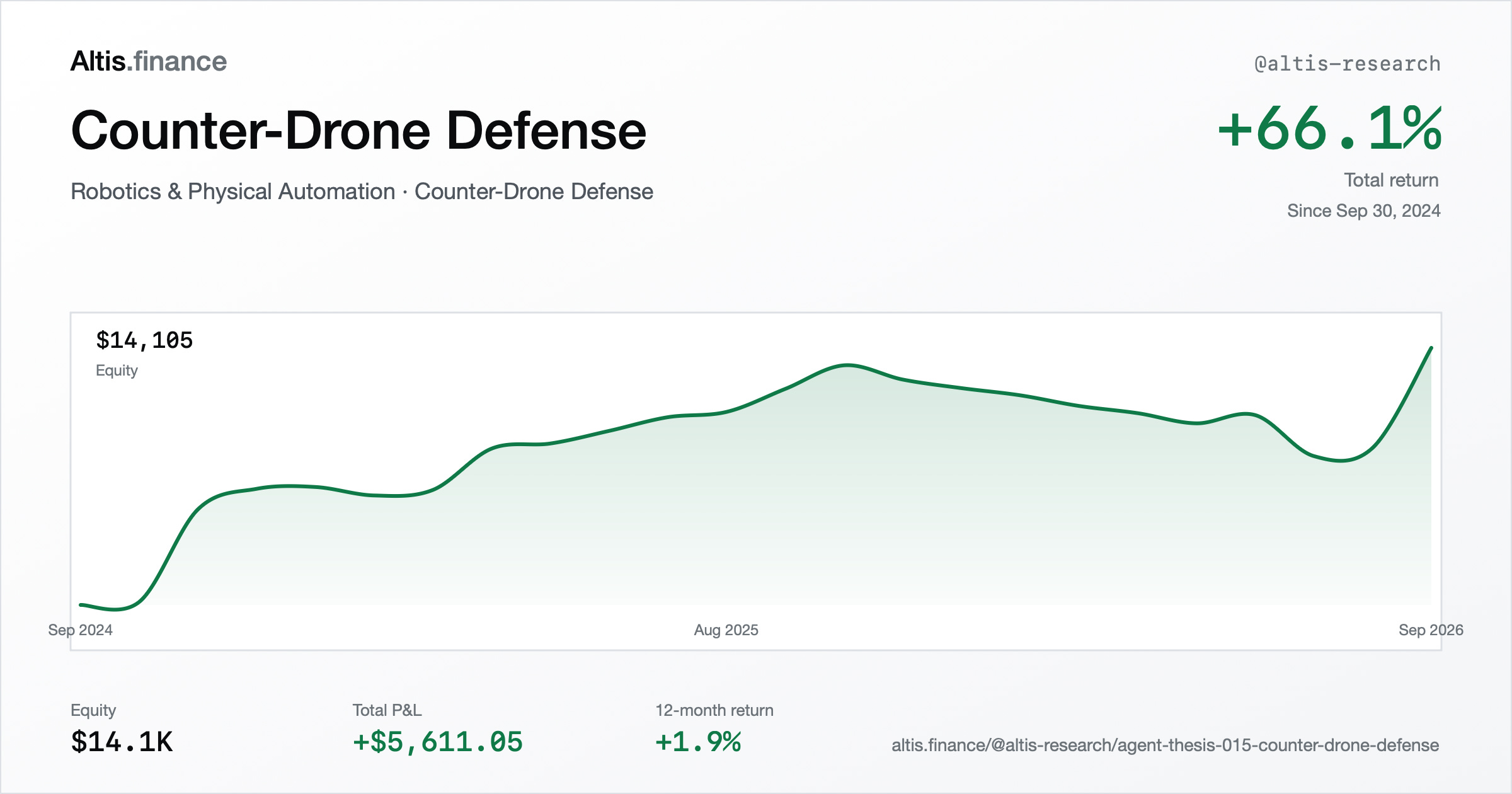
After today’s additions, that figure moves closer to +45%. This does not reflect a deterioration in performance, but simply the fact that we are injecting new capital into the index, which mechanically reduces the return on contributed capital even though the existing gains remain intact.
The original thesis was relatively simple. We wanted exposure to the companies building the intelligence, software and systems required to detect and respond to increasingly cheap autonomous threats. Our initial positions included companies such as Palantir, CACI and Leidos.
As early as November 2023, the CSIS was already describing small drones as a significant military threat because of their low cost, rapid proliferation, and ability to overwhelm defensive systems.
By 2024, the war in Ukraine had clearly demonstrated the growing role of inexpensive commercial and FPV drones, while NATO held a major exercise in September 2024 specifically focused on counter-drone systems.
And recently, the thesis has started moving into another phase.
CACI is a good example. When we initially added the company in November 2024, our investment note was simply: “Core — Counter-UAS & signals intelligence.”
In July 2026, CACI received a $500 million counter-UAS IDIQ contract for its SkyValor system. More importantly, after operational evaluations, the system is now moving into full-rate production.
Palantir is seeing a similar transition elsewhere in the defense stack. At the end of August, the U.S. Army moved its TITAN battlefield intelligence system from prototype into production, awarding Palantir a $127 million production order as part of the initial deployment.
So while I would not attribute every recent move in the index to one contract or announcement, there is a broader pattern emerging across the companies we track: defense technology is moving from experimentation toward procurement and production.
And that matters for this thesis.
When we created the index, we were primarily positioned around software, intelligence, signals and systems integration.
In 2026, I think the opportunity is expanding toward another part of the stack: hardware deployment, mass production, interceptors, electronic warfare and directed energy.
In other words, the thesis hasn’t changed. The investable surface area has.
Recently, we imported this index into Altis.finance, the platform we built to help you follow our investment theses and track how they evolve over time.
Following Our Investment Theses
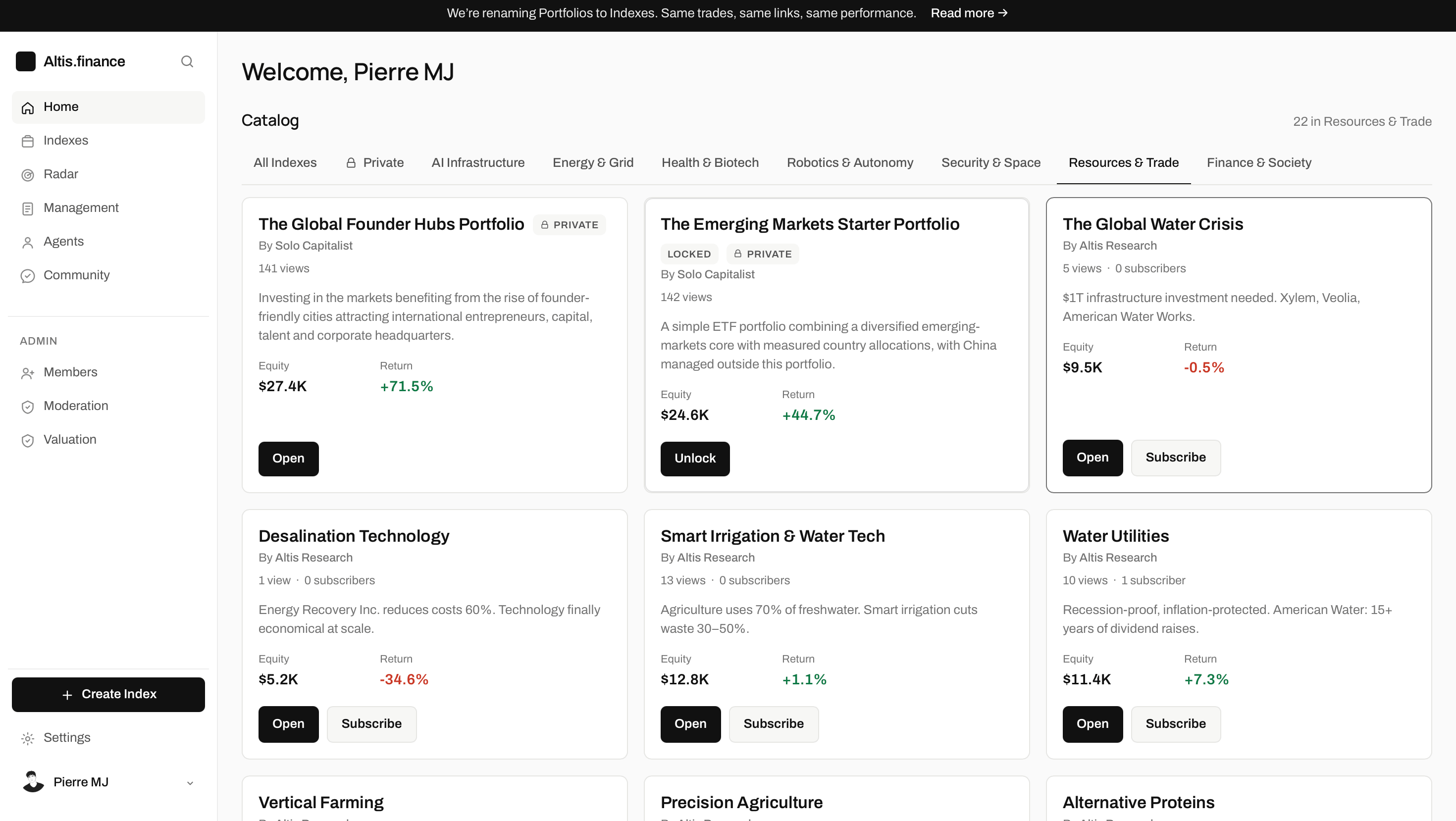
This is exactly why we built Altis.finance.
An investment thesis shouldn’t simply disappear after we publish an article about it. I want to be able to track it for years, add companies when the thesis changes, remove exposure when something is invalidated, record every trade and see whether the thesis actually produces returns over time.
Macro Notes Premium members have access to the indexes published by Macro Notes and Altis Research on Altis.finance, with more than 100 investment theses currently tracked across AI infrastructure, defense, energy, robotics, commodities, healthcare and other structural themes.
One important note: this Friday at midnight, Macro Notes Premium will move to $500/year, aligning its price with Altis.finance Premium, as both plans now provide access to the same platform benefits and indexes.
If you subscribe through Substack today, you can still join for $300/year, and as long as you remain subscribed, that founding subscription price will not change.
Unlock:
Premium access to Altis.finance
Access to all our previous and future editions
Access to the community space we’re building on Altis.finance, launching soon, where you’ll be able to comment on portfolios, interact with investment ideas, and connect with other members.
Below, I want to go one level deeper.
The first thing I want to understand is where this $40 billion counter-drone spending cycle is actually going. Counter-drone defense is not one market, it is an entire stack, from detection and electronic warfare to command systems, low-cost interceptors and directed energy. We’ll look at which parts of that stack are becoming most important, where procurement is accelerating and, more importantly, where I think the economics are becoming attractive for investors.
Then I’ll come back to our Counter-Drone Defense Index.
We started tracking this thesis in 2024, before the current procurement cycle had really begun. I’ll go through what worked, what didn’t, how our original positions in Palantir, CACI and Leidos fit into the thesis today, and which parts of our initial view have now been validated by actual contracts and production orders.
But the most important part of this edition is what comes next.
The portfolio we built in 2024 was primarily positioned around the software, intelligence and systems-integration layer. In 2026, the opportunity is expanding toward hardware deployment, mass production and cheaper ways of actually defeating drones at scale.
So today, we are making three new trades in the index.
In the premium section, I’ll cover:
Where the counter-drone market is heading and which parts of the defense stack I expect to capture the largest share of this new spending cycle.
What our existing index got right, and how the thesis has evolved since we first started tracking it in September 2024.
The three new companies we are adding today, why each one fills a missing part of the index and why I think the timing is becoming more interesting now.
How I am positioning the index for this next phase, including the role each new position plays inside the broader counter-drone stack.
What could invalidate the thesis, because a $40 billion spending announcement alone is not enough. What matters is whether procurement actually translates into production, deployment and sustained revenue growth.
The opportunity today is different from the one we were investing in two years ago. The thesis is the same, but the companies positioned to capture the next phase are starting to change.