


Bitcoin is one of the most liquid assets in crypto.
It trades around the clock, seven days a week. As I write this, its market capitalization sits at roughly $1.57 trillion, with tens of billions of dollars changing hands on active trading days.
Yet for most of Bitcoin’s history, a holder who needed liquidity faced a strangely simple choice:
Sell Bitcoin.
Need capital to fund a business?
Sell Bitcoin.
Need cash for a large purchase?
Sell Bitcoin.
Want to redeploy capital into another opportunity?
Sell Bitcoin.
And every sale solves the immediate liquidity problem by creating another one: you give up part of your exposure to the asset.
For a trader, that may not matter.
But for someone who owns Bitcoin because they expect to hold it for five, ten or twenty years, it is a structural mismatch. You are financing a short-term cash requirement by liquidating a long-duration position.
This is especially relevant to Bitcoin because the long-term investment thesis has always been built around scarcity and continued financial adoption. Bitcoin’s protocol caps supply at 21 million coins, while its integration into traditional financial infrastructure has continued to expand. In January 2024, for example, the SEC approved the listing and trading of multiple spot Bitcoin exchange-traded products in the United States.
Whether that thesis ultimately proves right or wrong isn’t really the point here.
The point is that if you believe Bitcoin will be worth more ten years from now, selling it because you need liquidity today is an inefficient way to manage the position.
And this isn’t how large pools of wealth generally operate elsewhere.
A founder doesn’t necessarily liquidate his company shares every time he needs capital.
A real-estate owner can borrow against property rather than selling the building.
Investors can borrow against securities portfolios. Schwab, for example, explicitly offers a pledged-asset credit line designed to give investors liquidity without liquidating their investments.
Even assets we normally think of as highly illiquid can become collateral. Bank of America and J.P. Morgan offer financing against fine-art collections so wealthy clients can access liquidity without selling the underlying works.
The asset remains on the balance sheet.
The liquidity comes from somewhere else.
And Bitcoin is beginning to make the same transition.
That is what I want to explore today.
A Quick Note Before We Go Further
For this edition, we partnered with CoinRabbit, a crypto-backed lending and digital-asset management platform.
This is a sponsored edition, but CoinRabbit’s involvement went considerably further than a normal sponsorship placement. Their team gave us access to several pieces of research and proprietary data that helped shape the thesis you are reading.
Specifically, they provided four resources:
CoinRabbit × CryptoQuant — Buying the Bear, an August 2026 study of whale and institutional-scale positioning across Bitcoin, Ethereum and XRP.
CoinRabbit × GoMining — The Bitcoin Mining Playbook 2026, examining how post-halving mining economics are pushing operators toward more sophisticated treasury and balance-sheet management.
CoinRabbit × ChangeNOW — Financial Privacy in the Digital Age, focused on the implications of putting increasingly large amounts of private wealth onto publicly observable blockchains.
CoinRabbit’s proprietary borrower data, covering the last four months of borrowing activity and breaking down repeat borrowing and collateral preferences between retail and high-net-worth users.
CoinRabbit explicitly gave us freedom to use the metrics, research and insights wherever they fit our analysis.
The sponsorship made access to those materials possible. The interpretation and conclusions below are mine.
And together, these datasets point toward a much broader change than simply the growth of another crypto-lending product.
Bitcoin Is Changing Function
Bitcoin’s financial history can be simplified into something like this:
Buy → Hold → Sell
You acquired Bitcoin.
You held Bitcoin.
Eventually, if you wanted to extract economic value from your position, you sold some of it.
That model is now expanding into something more interesting:
Reserve → Collateral → Liquidity
Bitcoin isn’t just something that can sit on a balance sheet.
Increasingly, it can be used to finance the balance sheet itself.
That distinction may sound technical, but I think it matters.
There is a major difference between owning $1 million of an asset and owning $1 million of an asset that can support credit.
In the first case, accessing $200,000 means selling part of the asset.
In the second, the asset can potentially remain economically exposed while supporting a separate source of liquidity.
Traditional finance already works this way at enormous scale.
Real estate supports mortgages.
Treasuries support repo markets.
Equity portfolios support securities-backed credit lines.
Fine art can support specialty lending.
And we are now beginning to see Bitcoin inserted into similar structures.
In March, Better Home & Finance and Coinbase launched a structure allowing qualified U.S. homebuyers to pledge Bitcoin or USDC against a separate loan used to fund the down payment on a conventional mortgage. The primary mortgage itself remains a standard conforming loan eligible for Fannie Mae backing.
That may look like a niche product today.
But conceptually, it represents something much larger.
Bitcoin is starting to move from:
an asset you can own
to:
an asset you can finance against.
And if that continues, the next stage of Bitcoin’s institutionalization may not only be about who buys it.
It may increasingly be about what holders can do with it once they own it.
The First Signal: Large Holders Are Accumulating
Before thinking about credit, we first need to understand what the holders with the most capital are actually doing.
This is where the research CoinRabbit produced with CryptoQuant becomes useful.
Their August report tracks large-holder behavior across Bitcoin, Ethereum and XRP using wallet balances, order flow and realized-price data.
The Bitcoin data is particularly interesting.
According to CryptoQuant, whale balances — excluding exchanges and mining pools — bottomed at roughly 2.87 million BTC in December 2025.
By the time of the report, those holdings had climbed to around 3.06 million BTC.
More importantly, accumulation accelerated when Bitcoin fell below $60,000 during the June selloff.
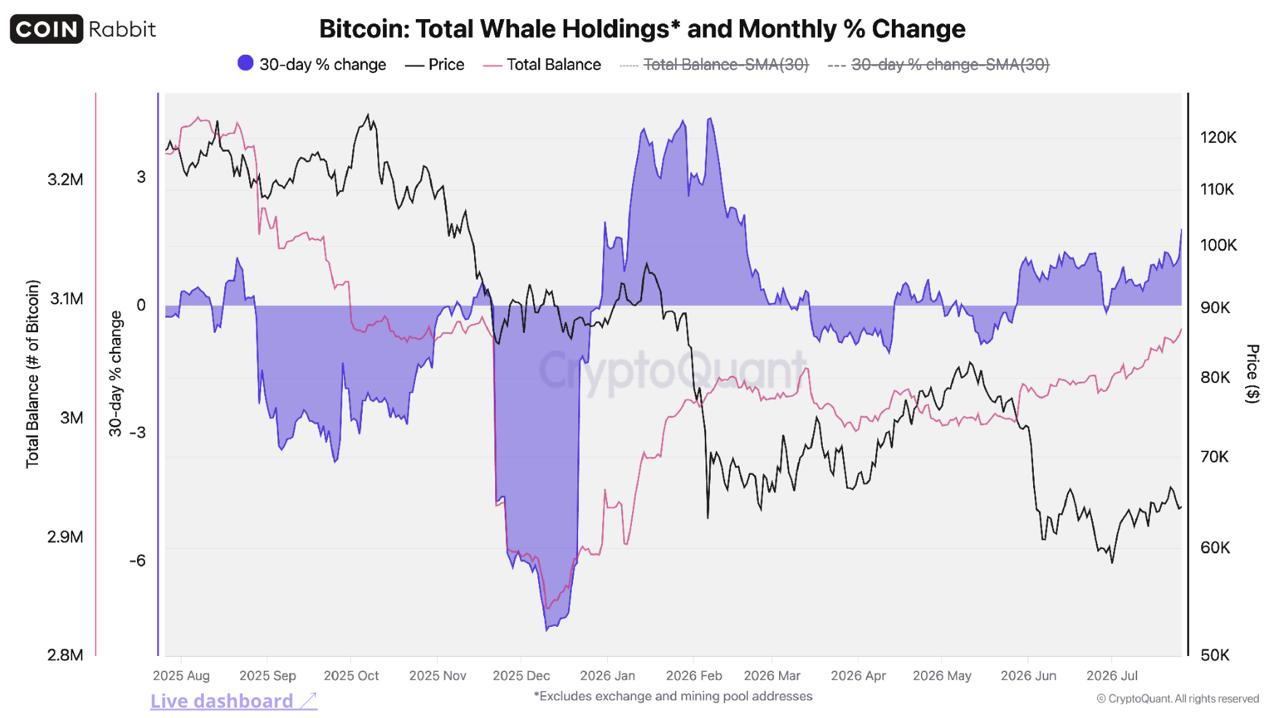
Now, there is an important timing distinction here.
Bitcoin is no longer below $60,000. As of August 30, it has recovered toward roughly $78,000. So this isn’t a claim that whales are currently buying BTC below $60K; it is evidence of how they behaved when the market gave them that opportunity earlier this summer.
And that behavior is exactly what we would expect from investors with a longer time horizon.
They weren’t simply surviving the drawdown.
They were using it to increase exposure.
Ethereum shows an even more striking divergence.
CryptoQuant found that wallets holding between 1,000 and 10,000 ETH had reduced their aggregate holdings from roughly 15.6 million ETH in January to about 12.9 million.
But the larger 10,000–100,000 ETH cohort moved in the opposite direction, increasing from around 14 million ETH in mid-2025 to approximately 19.6 million ETH by the time of the report.
The 100,000+ ETH cohort added roughly 1.8 million ETH from mid-2025, according to the same research.
This doesn’t guarantee that the bottom is in. CryptoQuant itself explicitly cautions that further downside remains possible.
But I don’t think “whales are bullish” is actually the most interesting conclusion from this data.
The more interesting question is what happens after they accumulate.
Because as an investor’s exposure increases, another problem becomes increasingly important:
How do you access capital without selling the assets you have deliberately spent a bear market accumulating?
And that is where the collateral layer begins to matter.
Separating Liquidity From Liquidation
Historically, the two were almost the same thing in crypto.
Need liquidity?
Sell crypto.
But collateralized lending separates those decisions.
The old equation was:
Need liquidity → Sell Bitcoin
The emerging equation is:
Need liquidity → Sell Bitcoin OR Borrow Against Bitcoin
The mechanics are relatively straightforward.
A holder places Bitcoin as collateral.
A lender advances capital against a portion of its value.
The borrower can use that liquidity for another purpose.
Interest accrues.
When the loan is repaid, the collateral is released according to the lender’s terms.
The CoinRabbit × GoMining research describes essentially this flow: deposit crypto as collateral, receive liquidity, use the borrowed funds, pay interest, repay principal and receive the collateral back.
This obviously isn’t free money.
Selling eliminates part of your exposure.
Borrowing preserves the economic thesis but introduces debt.
That means interest expense, counterparty risk, collateral risk and potentially liquidation.
The important change isn’t that one option is universally better.
It’s that holders now have two different tools for two different problems.
And when I looked through the proprietary CoinRabbit data, one number made me think this behavior is already becoming much more routine than I expected.
For readers who want to see the mechanics of a Bitcoin-backed loan directly, CoinRabbit explains its current BTC lending structure here. Explore Bitcoin-backed loans on CoinRabbit
65% Come Back
CoinRabbit shared a dataset covering its last four months of borrower activity.
It divides users into two groups: retail clients holding less than $500,000 on the platform and high-net-worth clients above $500,000.
The number that jumped out at me was this:
65.1% of borrowers in the dataset were repeat borrowers.
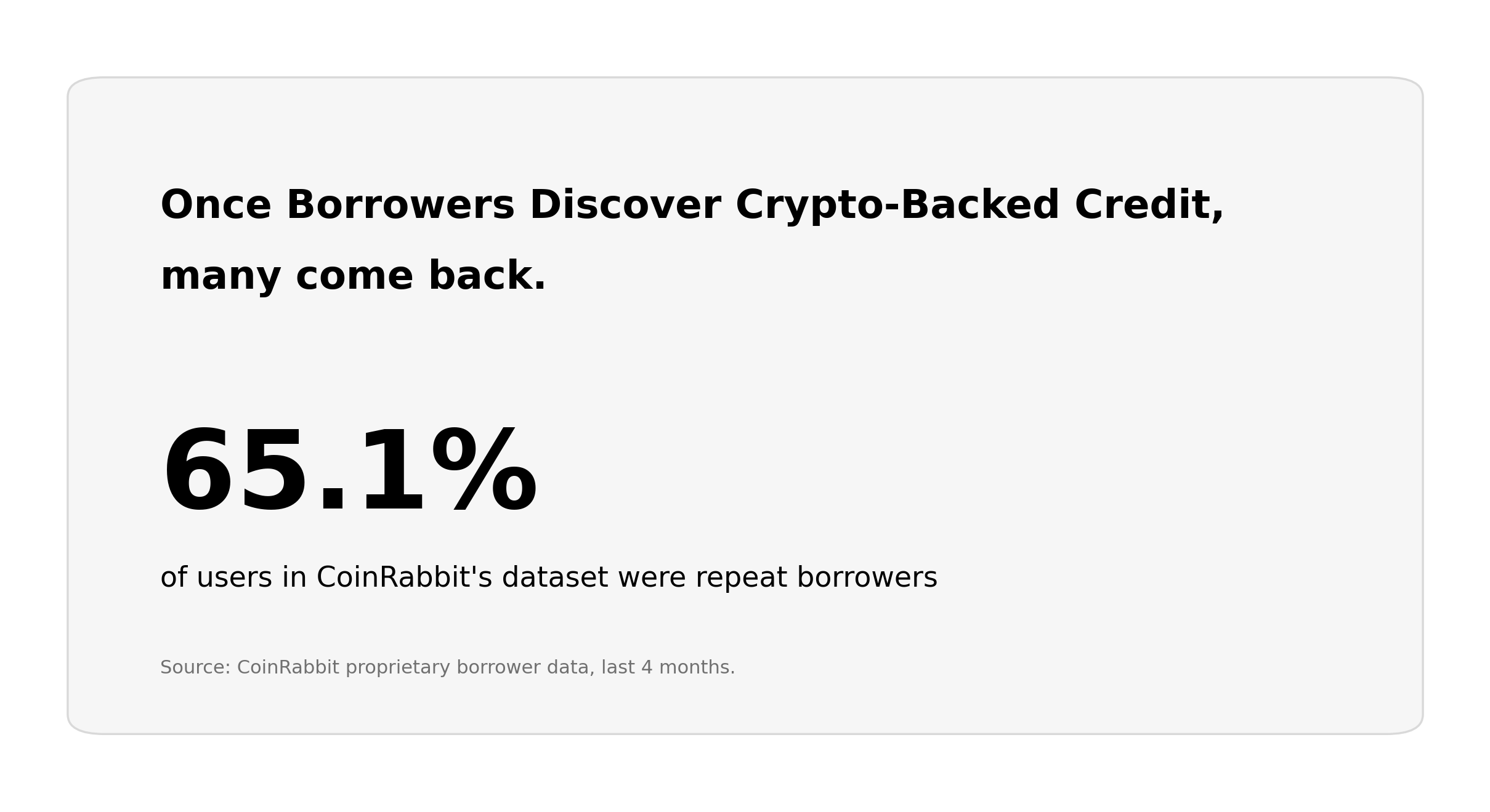
I think that’s more revealing than simply knowing how many loans were originated.
If collateralized borrowing were primarily an emergency mechanism — something people discovered once when they desperately needed liquidity — you might expect usage to be mostly transactional.
Borrow once.
Solve the problem.
Leave.
Instead, a large proportion return.
That suggests that for at least part of CoinRabbit’s customer base, borrowing against crypto is starting to behave more like a liquidity-management tool than a one-off financial event.
The collateral mix is also interesting.
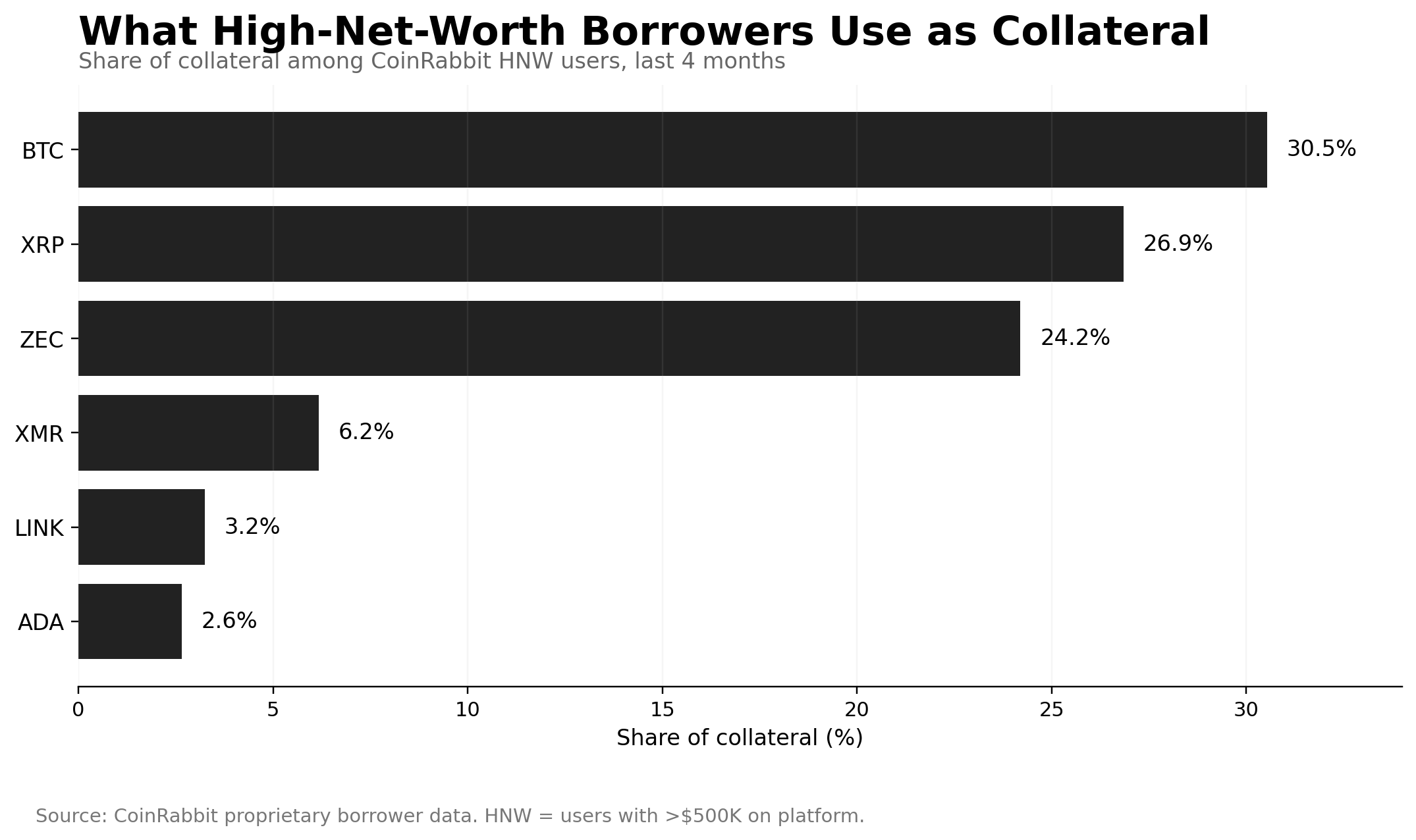
Among the HNW segment in the internal dataset, CoinRabbit reports BTC at 30.53% of the collateral mix, followed by XRP at 26.85%, ZEC at 24.20%, and XMR at 6.17%.
Retail customers look different: XRP represents 35.19%, Bitcoin 30.22%, while ETH is much further behind at 3.19%.
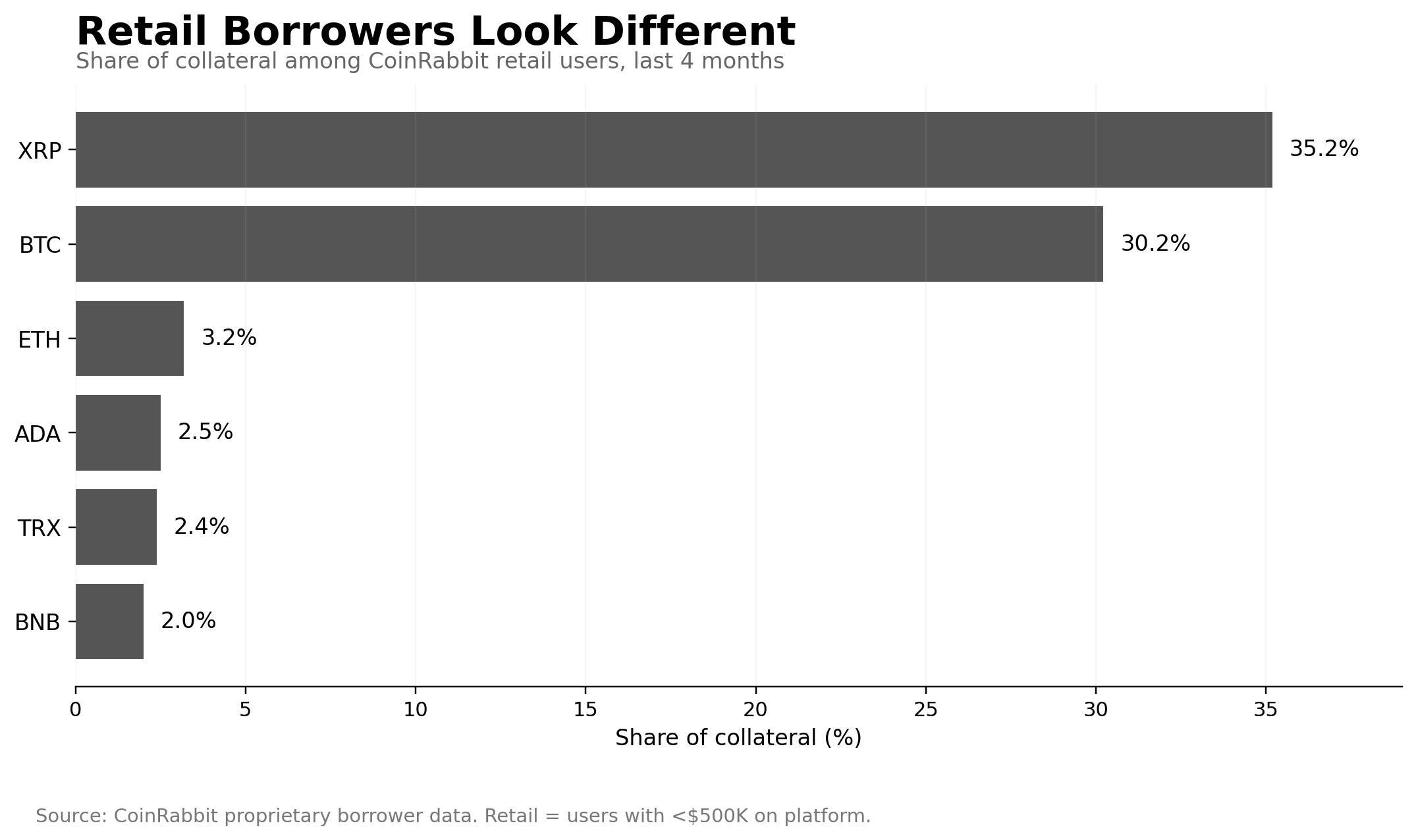
Retail borrowers show a noticeably different mix.
I would not extrapolate these percentages to the entire crypto market.
This is a CoinRabbit-specific dataset covering four months, not a representative survey of every crypto holder.
But that’s precisely why I find the repeat-borrowing figure useful.
We’re not looking at what investors say they might do with crypto-backed credit.
We’re looking at a group of actual borrowers and seeing that once some of them use their assets this way, they tend to use the mechanism again.
And there is another part of the Bitcoin economy where this problem is even more obvious.
Miners.
Bitcoin Miners Have the Perfect Liquidity Problem
I think miners are one of the best laboratories for understanding what could eventually happen to Bitcoin holders more broadly.
Their business creates an unusually clean mismatch.
They produce Bitcoin.
But almost everything required to produce it is paid for in fiat currency.
Electricity. Employees. Hosting. ASICs. Cooling. Land. Debt service. Infrastructure.
For years, the obvious solution was:
Mine BTC → Sell BTC → Pay OpexThat worked reasonably well when mining margins were wide.
Then came the April 2024 halving.
The network’s block subsidy fell from 6.25 BTC to 3.125 BTC, cutting the primary block reward in half.
At the same time, network competition continued increasing.
CoinShares estimated that the weighted average cash cost to produce one Bitcoin among publicly listed miners had reached approximately $79,995 in Q4 2025, while hashprice fell as low as roughly $29 per PH/s/day during Q1 2026.
The result was predictable.
Public Bitcoin miners sold more than 32,000 BTC during Q1 2026, according to data analyzed by TheEnergyMag — more than their net sales during all of 2025 and a new quarterly record.
Think about what is happening here.
These companies exist to produce Bitcoin.
Many presumably have a long-term positive view on the asset.
Yet their operating model can force them to sell precisely when mining economics deteriorate and Bitcoin is weak.
They are long Bitcoin strategically but short liquidity operationally.
That is exactly the problem collateralized credit is designed to solve.
From Mining Bitcoin to Managing Bitcoin
This is the central argument in the CoinRabbit × GoMining report.
The mining industry is gradually moving from a pure production mindset toward a balance-sheet mindset.
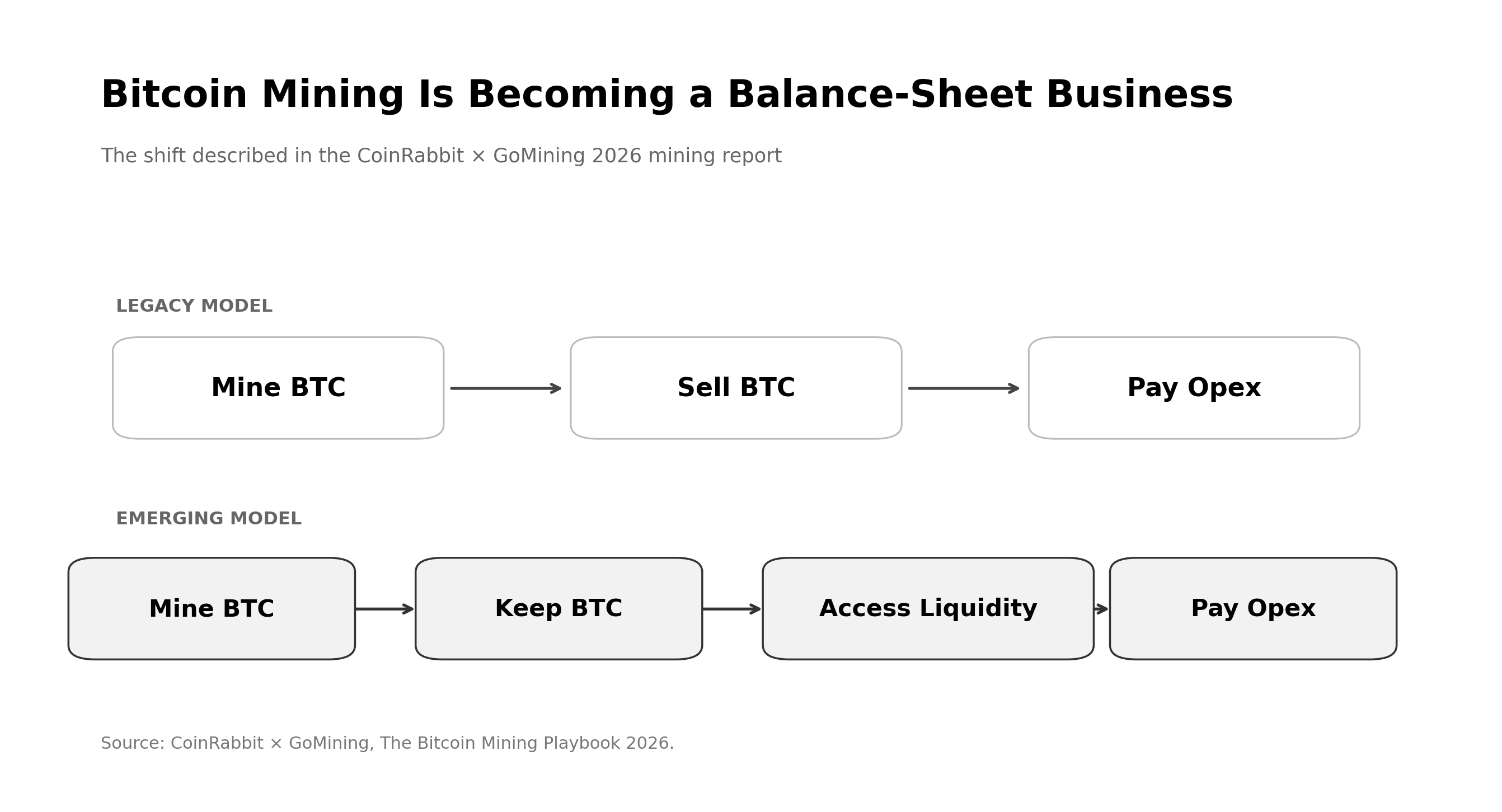
The mining industry is gradually moving from a pure production mindset toward a balance-sheet mindset.
The report describes the historical model as:
Mine → Sell BTC → Pay Opexand the more capital-efficient alternative as:
Mine → Keep BTC → Access Liquidity → Pay OpexThat seems like a small adjustment.
It isn’t.
It changes what the mined Bitcoin is.
Under the first model, Bitcoin is inventory.
Under the second, Bitcoin starts to become a reserve asset and financing asset.
The report’s broader finding is that mining competitiveness is no longer solely determined by how efficiently an operator produces Bitcoin. Low-cost electricity and efficient ASICs remain essential, but financial engineering and treasury management increasingly determine who survives difficult parts of the cycle.
This is especially relevant because miners now have another competitor for their most valuable input: electricity.
AI and high-performance-computing operators are competing aggressively for power infrastructure, while some miners are simply turning their sites into AI data centers.
Hut 8, for example, signed a $9.8 billion, 15-year AI data-center lease in July covering hundreds of megawatts at its Texas campus.
A megawatt now has multiple competing uses.
That raises the cost of making poor capital-allocation decisions.
And it makes the BTC sitting on a miner’s balance sheet increasingly important.
The Miner May Be Showing Us What Comes Next
CoinRabbit’s own mining cohort provides another useful data point.
According to the company’s 2026 research, approximately 33% of CoinRabbit Private Program clients in its mining cohort use Bitcoin collateral to support short-term operational needs.
That means some miners are already using BTC as working-capital infrastructure.
Bitcoin is no longer simply their output.
It is becoming part of their financing stack.
The same research found significant demand for something even closer to traditional corporate revolving credit: more than 90% of miners interviewed said they would try an open-ended credit structure backed by a single collateral pool if CoinRabbit offered it.
That is particularly interesting to me.
Because once you move from individual loans toward a continuously accessible credit line, you are no longer talking about a crypto-native novelty.
You’re starting to recreate familiar corporate treasury infrastructure around a new kind of collateral.
And I suspect miners may simply be adopting it earlier because their need is more obvious.
An entrepreneur holding BTC has the same basic problem.
So does a family office.
So does a company with Bitcoin on its balance sheet.
So does an individual sitting on a concentrated position acquired years ago.
They may want liquidity.
They may not want to sell.
Bitcoin Is Becoming a Balance-Sheet Asset
We’ve already watched Bitcoin move through several stages of financialization.
First, exchanges made it liquid.
Then institutional custodians made it easier to hold at scale.
Derivatives made it possible to hedge and express more complex views.
Spot ETFs made Bitcoin accessible from a conventional brokerage account.
Now we’re starting to build the credit layer.
And this is generally what happens as an asset class matures.
The value of real estate isn’t simply that property can appreciate.
It also supports an enormous credit system.
A stock portfolio isn’t merely a collection of investments.
It can support portfolio-backed lending.
Treasury bonds aren’t valuable only because governments repay them.
Their collateral properties make them foundational to global financial markets.
The more credible and financeable an asset becomes, the more things can be built around ownership of that asset.
Bitcoin appears to be moving in that direction.
And we now even have examples outside crypto-native lending platforms.
The Better/Coinbase mortgage structure is a good illustration: Bitcoin collateral supports a separate loan that funds a home down payment, while the borrower avoids having to sell the Bitcoin simply to generate the cash.
This doesn’t mean Bitcoin suddenly behaves like Treasuries.
It clearly doesn’t.
Its volatility alone creates radically different collateral requirements.
But the direction of travel is worth paying attention to.
What Happens to Bitcoin’s Sell-Side?
This is where the macro implications become more interesting.
Suppose a long-term holder needs $100,000.
Historically:
Need $100K → Sell $100K of BTC
That creates $100,000 of potential spot supply.
Now add a functioning collateral market:
Need $100K → Sell BTC OR Borrow Against BTC
Some holders will still sell.
Some absolutely should sell rather than add leverage.
But the second option means that a liquidity requirement no longer automatically creates a liquidation requirement.
Over time, that could reduce one category of discretionary selling.
Miners make this obvious.
If a miner needs $5 million for electricity and has no financing, the BTC treasury becomes the financing source.
Sell the Bitcoin.
If the same miner can obtain appropriately structured secured financing instead, the operating expense doesn’t necessarily create immediate BTC supply.
I would be careful about taking this too far.
Crypto-backed lending is not mechanically bullish for Bitcoin.
In fact, leverage can make markets substantially more violent.
The interesting trade-off is this:
Collateralized credit can reduce voluntary selling during normal conditions while creating additional forced selling riskduring extreme conditions.
That brings us to the biggest problem with the entire thesis.
The Ghost of 2022
You can’t discuss crypto lending seriously without discussing 2022.
Celsius. BlockFi. Genesis.
The failure of centralized crypto lenders made one thing painfully obvious:
The collateral itself is only one part of the risk.
What happens after you hand it to someone matters just as much.
One of the concepts that moved to the center of the conversation after 2022 is rehypothecation.
At its simplest, rehypothecation means collateral pledged by a borrower can itself be reused by the lender for another purpose.
Your BTC backs your loan.
The lender then lends or pledges that collateral somewhere else.
That creates another counterparty.
Potentially another loan.
Potentially another source of leverage.
Potentially another point of failure.
The CoinRabbit × GoMining research argues that post-2022 due diligence has increasingly shifted away from simply optimizing interest rates toward minimizing counterparty and collateral-management risk.
I think this distinction is essential.
The lesson from 2022 shouldn’t be reduced to:
“Crypto lending doesn’t work.”
Traditional credit markets fail too.
The more useful question is:
What does the collateral architecture actually look like?
This is also where CoinRabbit’s product design becomes relevant to the story rather than just appearing as a sponsor.
Its current terms explicitly state that CoinRabbit does not re-lend, rehypothecate or otherwise reuse collateral. Its Bitcoin loan page says pledged collateral is kept in cold wallets with multisig access rather than lent out to generate interest.
That doesn’t remove every risk associated with using a centralized lender.
But it removes one specific layer of risk that became impossible to ignore after 2022.
CoinRabbit has a more detailed explanation of its no-rehypothecation framework here. Read CoinRabbit’s rehypothecation research
There Is No Free Liquidity
The second risk is simpler.
Bitcoin is volatile.
Debt is not impressed by your long-term thesis.
If you place $100,000 of BTC against a $50,000 loan, Bitcoin can decline substantially before the collateral value approaches the loan value.
If you place the same $100,000 against $90,000 of debt, your margin for error becomes dramatically smaller.
That is Loan-to-Value, or LTV.
Higher LTV:
More liquidity today.
But also:
Less protection against a drawdown tomorrow.
CoinRabbit currently offers LTV configurations between 50% and 90%, and its own product page explicitly warns that higher LTV means receiving more loan funds but facing a higher margin-call risk.
Interestingly, its research with miners found demand for LTV as high as 95%.
CoinRabbit says it currently caps maximum LTV at 90%, because a 95% structure would leave only a 5% collateral buffer before reaching margin thresholds.
I find that data point fascinating because it captures the basic tension of financial engineering perfectly:
Capital efficiency and financial fragility often increase together.
The more of an asset’s value you extract today, the less volatility you can tolerate tomorrow.
So the correct conclusion isn’t that holders should always borrow instead of selling.
Sometimes selling is the right answer.
The more important conclusion is that Bitcoin holders increasingly have access to the same decision framework wealthy investors already use with other assets:
What should I sell?
What should I continue holding?
What should I finance against?
And what level of leverage can my balance sheet actually tolerate?
Crypto Wealth Is Starting to Look More Like Private Banking
There is one final part of CoinRabbit’s research that initially seemed separate from this story but actually fits surprisingly well.
Their report with ChangeNOW looks at financial privacy.
As crypto wealth becomes larger, simply owning the assets creates problems that smaller holders rarely have to think about.
Public blockchains are transparent.
Once an address can be associated with an identifiable person or entity, transaction history, counterparties, balances and transaction patterns can potentially become visible to outside observers.
That is very different from private banking.
Your neighbors cannot open a website and inspect your brokerage account.
They cannot see your bank balance.
They cannot follow every wire transfer your company makes.
With public blockchains, the underlying financial infrastructure was designed around verifiability rather than discretion.
And as the amount of wealth stored on-chain grows, that trade-off becomes more important.
CoinRabbit’s internal HNW research found that roughly 50% of surveyed high-value holders had experienced at least one targeted scam or social-engineering attempt during the previous three years. More than 70% said they distribute assets across multiple wallets or custody providers.
Independent security data suggests the physical risk is also becoming harder to dismiss.
CertiK documented 52 verified physical “wrench attacks” in the first half of 2026, with approximately $124.1 million in recorded financial exposure. Europe accounted for 39 of the 52 cases, while France alone accounted for 33.
This is why I think the evolution we’re watching is ultimately larger than crypto lending.
As digital wealth matures, the infrastructure around it starts recreating some of the functions private banking has provided wealthy clients for decades:
Liquidity.
Collateral management.
Custody.
Risk management.
Discretion.
CoinRabbit’s Private Program is explicitly aimed at clients with $500,000+ in capital and combines customized lending terms with private-manager support and other wealth-management services.
For readers managing larger digital-asset positions, you can learn more about CoinRabbit’s Private Program here.Explore CoinRabbit Private
The Next Question for Bitcoin
For most of Bitcoin’s history, the question was simple:
Should I buy Bitcoin?
Then it became:
How much Bitcoin should I hold?
I think the next question is increasingly going to be:
What can I do with Bitcoin once I own it?
That is a much more mature question.
And the infrastructure is beginning to answer it.
ETFs allow Bitcoin to sit inside traditional investment portfolios.
Institutional custody allows larger pools of capital to hold it.
Mortgage products are beginning to recognize it as collateral.
Miners are experimenting with using BTC reserves to finance operating expenses.
Platforms like CoinRabbit are building dedicated credit infrastructure around it.
And actual borrower behavior suggests that once some crypto holders begin using their assets as collateral, many return to the mechanism again.
None of this eliminates Bitcoin’s volatility.
It doesn’t eliminate liquidation risk.
It doesn’t eliminate lender risk.
And it certainly doesn’t turn borrowing into free money.
But it changes something fundamental.
For a long time, Bitcoin wealth had one obvious exit valve:
sell the Bitcoin.
Now another financial layer is being built.
Hold the asset.
Use it as collateral.
Access liquidity elsewhere.
That is how many mature assets already function.
And if Bitcoin is going to continue evolving from a speculative asset into a genuine reserve asset for individuals, companies and institutions, its ability to support credit may ultimately be almost as important as its ability to support ownership.
The next stage of Bitcoin’s institutionalization may therefore have less to do with who is buying it...
...and much more to do with what they can do with it once they refuse to sell.
This edition was produced in partnership with CoinRabbit. CoinRabbit provided proprietary data and research used throughout this analysis. Editorial conclusions and opinions are those of Macro Notes.
Crypto-backed borrowing involves material risks, including collateral volatility, liquidation, counterparty and custody risk. This edition is for educational purposes only and does not constitute investment, tax or financial advice.
Go deeper with Macro Notes Premium
Macro Notes Premium gives you access to all of our premium research — but it now includes much more than the newsletter itself.
Your subscription also includes Altis Terminal, our investment research platform where you can explore 100+ live portfolios published by Macro Notes, Public Markets, and 10+ other contributors.
Track positions, trade history, performance, and the evolution of each investment thesis over time.
Altis Terminal normally costs $499/year as a standalone subscription. It is currently included with Macro Notes Premium at no additional cost.
Subscribe to Macro Notes Premium to unlock the full edition and access Altis Terminal.