

When you’re trying to enter a highly competitive market, where companies are constantly fighting over prices, the first question I like to ask is a very simple one:
Where does the cost actually come from?
Because if you understand where the cost comes from, you might find a way to compete without having to play the same game as everyone else.
And the parcel delivery industry in Poland provides a particularly interesting example.
Poland was already an extremely competitive logistics market, dominated by international players such as DHL, UPS, FedEx, and DPD. Prices were low, service quality was high, and competing directly against these established companies would have required enormous resources.
Yet this is precisely the market that InPost decided to enter.
The company was founded by Rafał Brzoska, who had a very different idea about how to compete.
Rather than trying to offer the same service at a lower price, he started by examining the economics of parcel delivery.
And he discovered something particularly interesting.
According to Brzoska, in an interview I listened to while preparing this edition, approximately 70% of parcel delivery costs were associated with the last mile.
In other words, the most expensive part of delivering a package wasn’t necessarily transporting it between cities or sorting it inside a warehouse.
It was bringing that package to the customer’s individual address.
Think about what this means.
You can optimize your warehouses, negotiate better fuel prices, improve your routes, and invest in more efficient vehicles.
But you are still operating within the same economic model as your competitors.
What happens if, instead of optimizing the most expensive part of the business, you fundamentally change how that part of the service works?
That is what InPost decided to do.
Instead of delivering every parcel directly to the customer’s door, the company introduced a new category of delivery service built around automated parcel lockers.
These lockers could be installed in residential neighborhoods, near supermarkets, shopping centers, transportation hubs, and other locations people regularly visit.
Customers could collect their packages themselves, at a time that suited them, using a self-service system that eventually became accessible directly through their smartphones.
The economic difference is significant.
A traditional courier has to travel between individual addresses, stop, locate the recipient, and sometimes attempt delivery multiple times.
With parcel lockers, a courier can deliver dozens or even hundreds of packages to a smaller number of locations.
The last-mile delivery cost doesn’t disappear entirely, of course. But the cost of delivering each individual parcel can be reduced dramatically.
And here is another important detail.
The customer is now completing the final part of the delivery.
But that doesn’t necessarily mean sacrificing convenience.
People already move around throughout the day.
They commute to work, stop at supermarkets, visit shopping centers, go out on weekends, and walk through their neighborhoods.
If the locker is conveniently located along one of those routes, collecting a parcel can become part of an activity the customer was already going to perform.
InPost was not simply making an existing delivery service cheaper.
It was creating a different way of delivering parcels.
And that distinction is extremely important.
In a highly competitive market, where traditional operators were fighting over prices, InPost had identified a way to change the underlying cost structure.
That is how a new company can potentially build a highly profitable business in what initially appears to be a red ocean.
But there is another part of this story that I find even more interesting from an investment perspective.
The early financial reality looked very different from the long-term economic opportunity.
InPost began deploying its automated parcel lockers in Poland in 2009.
According to Brzoska, the company invested approximately €30 million in its first few hundred machines during the early deployment period.
And at one point, those machines were generating only around €500 in monthly revenue, not €500,000, just €500.
The situation was particularly interesting because InPost’s parent company, Integer.pl, was already publicly listed on the Warsaw Stock Exchange.
In 2009, Integer.pl reported approximately PLN 135.9 million in consolidated revenue and PLN 10.3 million in net profit.
The group was profitable, but its financial statements also showed PLN 53.5 million in net investing cash outflows.
These figures reflected the entire group, not just the parcel locker business, which was still in its infancy.
And that is precisely the distinction I want to make.
The consolidated results could tell you how the existing businesses were performing.
But they could not, by themselves, tell you what the economics of this new delivery infrastructure might look like five or ten years later.
You needed to understand what management was trying to build, why the economics could be fundamentally different, and what would have to happen for that model to work.
Of course, an ambitious project is not automatically a good investment.
Many companies invest heavily in infrastructure that never becomes profitable.
The real question is whether the future economics justify the current investment, and whether there is sufficient evidence that those economics can eventually materialize.
This is something I spend a considerable amount of time investigating when I research an investment opportunity.
I don’t just want to understand a company’s current business model.
I want to understand what its business model could become, what its management is trying to achieve, and which economic forces could make that transformation possible.
Sometimes the most valuable information isn’t in the latest quarterly earnings report.
It might be in an interview with the founder, a technical conference, an industry presentation, or a podcast with the CEO of a company manufacturing highly specialized aircraft components that has only 300 views on YouTube.
These are the kinds of sources I particularly enjoy studying.
Because occasionally, buried inside an hour-long conversation, someone explains exactly how an industry works, what its biggest constraints are, or what could fundamentally change its economics.
And that information can help you develop an investment thesis that is very different from what you would arrive at by simply reading financial statements.
This is why I have never wanted Macro Notes to be just another financial newsletter focused on earnings, price targets, and quarterly performance.
Our objective is to understand how the economy is changing, identify the industries that could benefit from those changes, and then find the companies best positioned to capture the value being created.
We generally start with the bigger picture and gradually work our way down to individual businesses.
But we also spend considerable time understanding the businesses themselves, their economics, their supply chains, their competitive advantages, and the people running them.
Today, I want to explain in detail how we build investment theses at Macro Notes.
I’ll walk you through the different stages of our research process, from identifying a structural economic change to understanding its potential impact on individual companies.
I’ll also explain why we sometimes spend weeks investigating an industry before considering any investment opportunity, and why an interesting company doesn’t necessarily make an attractive investment.
Some of this process is relatively straightforward.
Other parts require considerably more research, proprietary data, financial modeling, and continuous monitoring.
I’ll share the foundations of our approach with everyone, while reserving the more advanced parts of our research methodology for Premium subscribers and some of our most detailed research work for Founding members.
The objective is not simply to show you which investment theses we develop.
It is to help you understand how we arrive at them, what could make them valuable, and how we determine whether our original assumptions are actually playing out over time.
Introducing the Macro Notes Premium & Founding Library

Before we continue, I want to introduce something new we’ve recently added for our Premium and Founding members.
We’re starting to use Substack’s Perks feature to build a dedicated library of additional research, resources, and investment tools available to our paying subscribers.
We’ve already introduced our first resources:
The Global Macro Investing Masterclass — A structured introduction to our approach to macro investing, from understanding major economic trends to identifying investment opportunities.
Macro Notes Terminal — Our investment research platform, where you can explore and track macro investment theses, follow their evolution, and access our thematic indexes.
And this is just the beginning.
Over the coming weeks and months, we’ll be adding many more resources, with different access levels depending on your subscription.
Some will be available to all paying members, others exclusively to annual Premium subscribers, and our most advanced research will be reserved for Founding members.
For Founding members in particular, we’re introducing a new monthly research publication.
Each month, we’ll publish a complete thematic research package covering an industry or investment opportunity we’ve investigated in depth.
Our first research package will be released on November 30, focusing on the space industry.
This is a particularly ambitious project, involving extensive industry research, company and supplier mapping, financial models, and detailed analysis of where economic value could be created and captured across the space economy.
The objective is to go considerably further than a traditional newsletter edition and provide the kind of research depth that can give investors a meaningful informational and analytical edge.
We’ll share more details as we approach publication.
In the meantime, I encourage all Premium and Founding members to visit the library regularly, as we’ll continue expanding it with new research, datasets, models, and other resources.
You can access the library here:
Explore the Macro Notes Premium & Founding Library
Now, let’s get back to how we actually build our investment theses.
1. Start With Structural Change
The first step in our research process is generally not to look for a company.
It’s to identify something that is changing in the economy.
This could be a technological transition, a demographic shift, a geopolitical development, a change in regulation, or a transformation in how an industry operates.
And importantly, we are not necessarily looking for something that is already growing rapidly.
We are looking for changes that could become considerably more important over the next five or ten years.
Consider the electric vehicle industry.
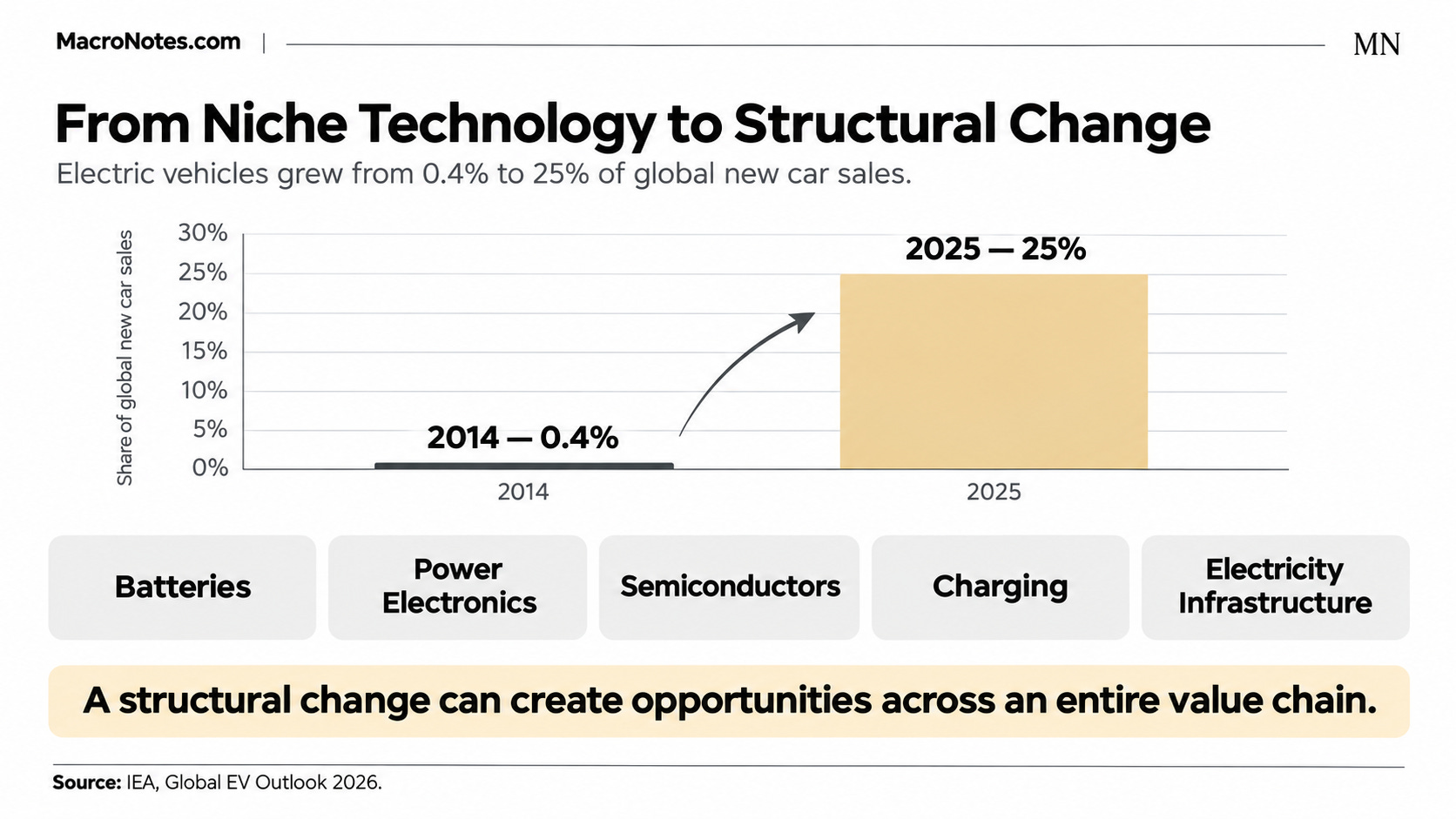
In 2014, electric cars represented just 0.4% of global new car sales.
At the time, Tesla was still a relatively small manufacturer, and electric vehicles were largely considered a niche market.
But the interesting investment question wasn’t simply how many vehicles Tesla would sell in the next quarter.
It was whether the economics of electric vehicles could eventually become competitive enough to support mass adoption.
If battery costs declined, manufacturing scaled, charging infrastructure expanded, and the technology improved, the entire automotive industry could change.
And that transformation would create opportunities extending far beyond Tesla.
Battery manufacturers, power electronics suppliers, charging infrastructure companies, semiconductor producers, and even parts of the electricity industry could benefit.
By 2025, electric vehicles represented approximately 25% of global new car sales, according to the International Energy Agency.
A market that accounted for less than 1% of sales in 2014 had become a major part of the global automotive industry.
Of course, identifying the transition was not enough to know which companies would make attractive investments. Some businesses would succeed, others would fail, and competition could destroy the economics of initially promising opportunities.
But this is generally where our research begins.
We first try to understand what could change in the economy, before asking which companies could benefit from that change.
2. Understand the Industry Before the Company
Once we’ve identified a structural change, the next step is to understand the industry it affects.
And this is where we spend a considerable amount of time.
Because a growing industry doesn’t necessarily mean that every company operating within it will become more profitable.
What matters is understanding how the industry works, where the economic constraints are, and which businesses are positioned to capture the value being created.
A good example comes from our recent research into Vietnam’s economy and electricity infrastructure.
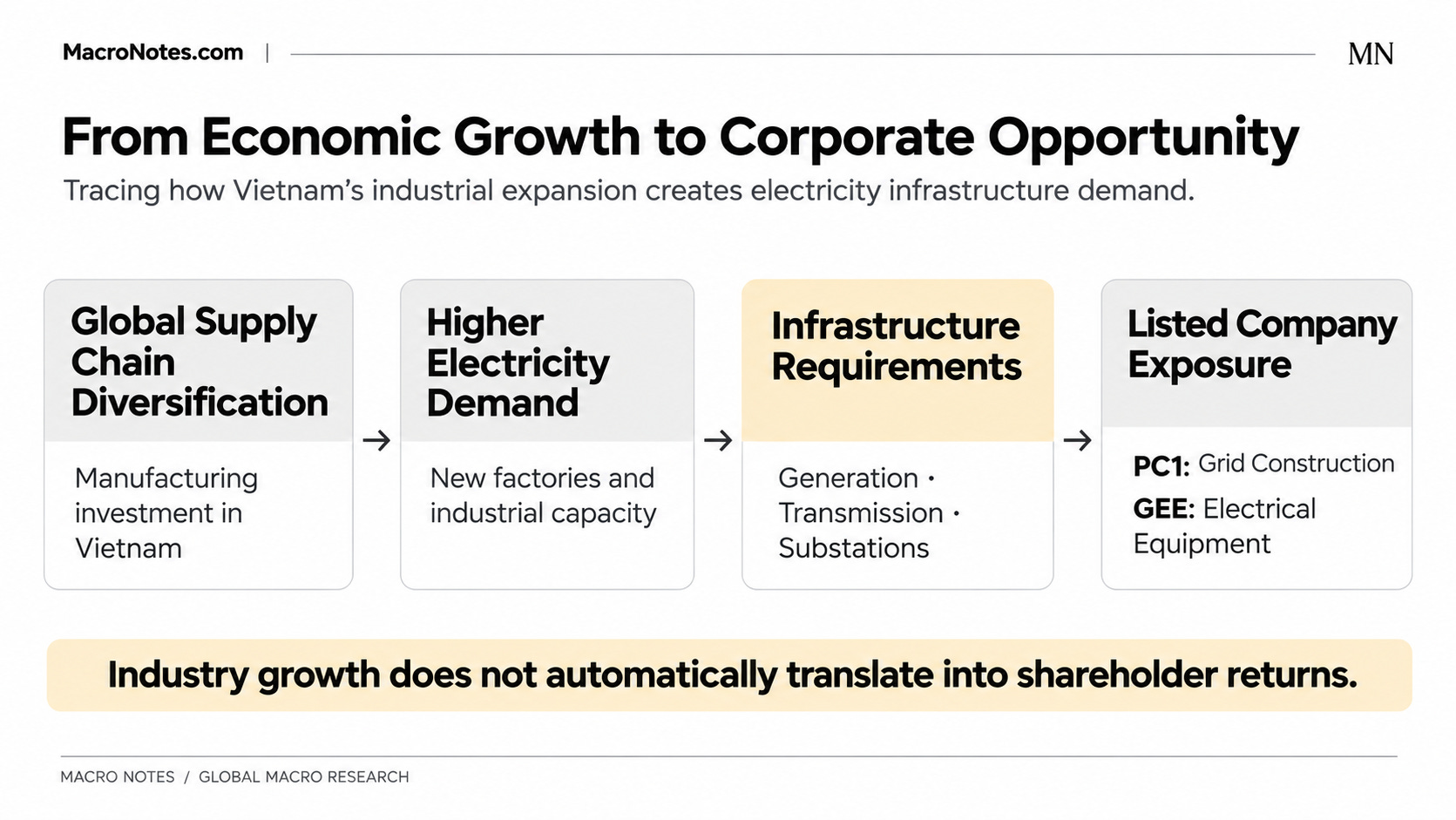
Vietnam has become an increasingly important manufacturing hub as companies diversify their global supply chains.
But building new factories requires much more than industrial land and labor.
Those factories also need reliable electricity.
Vietnam’s revised national power development plan estimates approximately $136.3 billion in electricity infrastructure investment requirements between 2026 and 2030, including $118.2 billion for generation and $18.1 billion for transmission infrastructure.
Now, we could simply identify Vietnam’s electricity producers and conclude that they should benefit from increasing demand.
But that would overlook an important part of the opportunity.
Generating more electricity is only useful if that electricity can reach the places where it is needed.
And this is why transmission infrastructure, substations, transformers, and electrical equipment become particularly interesting to investigate.
Companies such as PC1, which operates in power infrastructure construction, and GELEX Electric, which manufactures electrical equipment, offer different forms of exposure to this investment cycle.
The questions then become more specific.
Which projects will actually receive funding? Which companies can win the contracts? What margins can they earn? And how much additional capital will they need to support growth?
We are no longer simply studying Vietnam’s economic expansion. We are studying how that expansion could translate into revenue, profits, and potentially attractive investment opportunities for individual businesses.
This distinction is central to our approach.
3. Understand What Management Is Building
Understanding an industry is important, but understanding what a company’s management is actually trying to build can be just as valuable.
This is why I spend considerable time listening to management interviews, earnings calls, investor presentations, and sometimes very technical discussions that attract relatively little attention.
I want to understand not only what a company is doing today, but what its management believes the business could become.
Consider Corning, a company we’ve studied in the context of our research on fiber optics and AI infrastructure.
Most investors associate the AI investment cycle with GPUs and semiconductor companies.
But as AI data centers become larger, connecting thousands of processors efficiently becomes an increasingly important engineering challenge.
This creates demand for advanced optical connectivity.
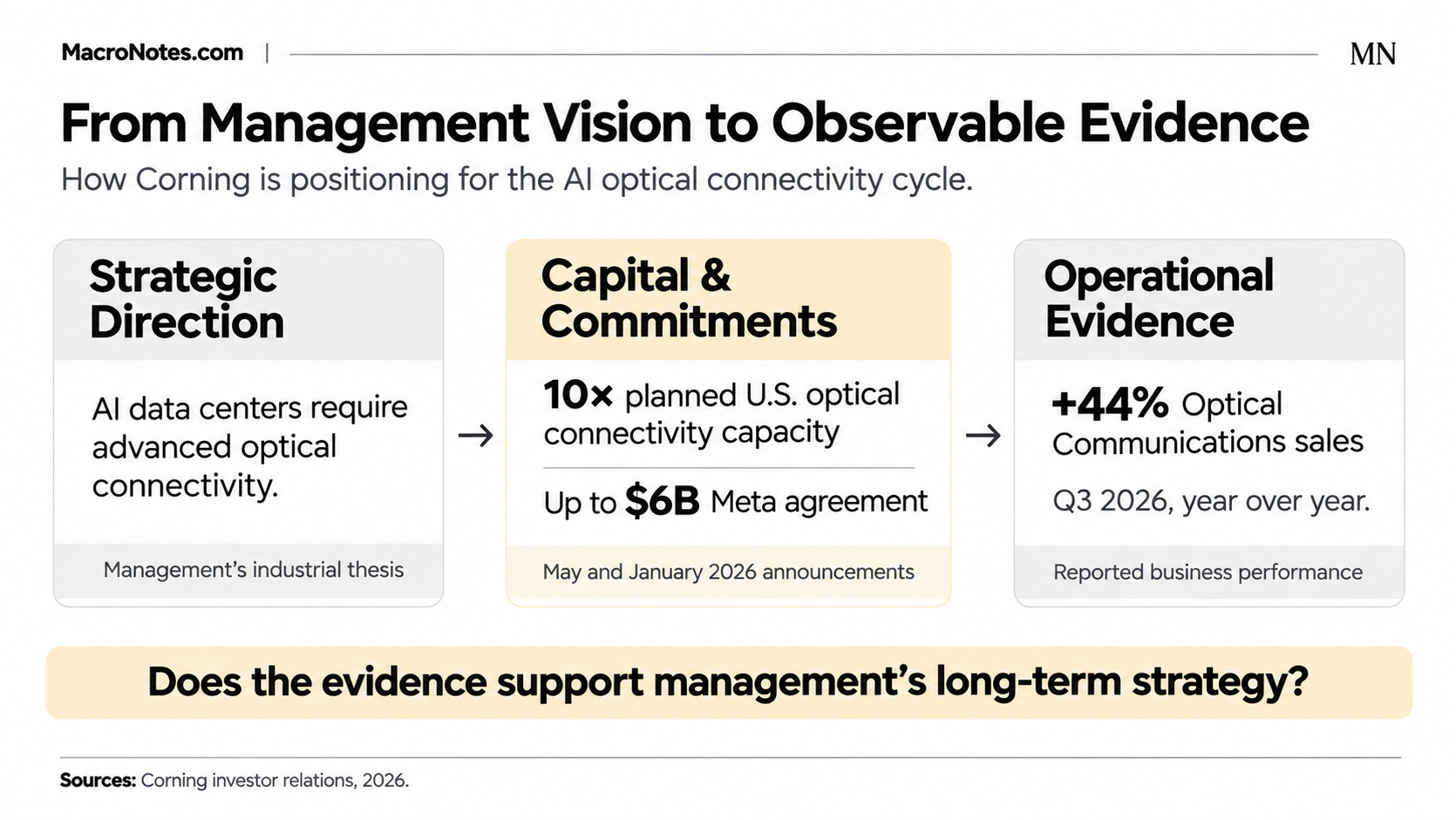
And Corning’s management has been positioning the company around this opportunity.
In January 2026, Corning announced a multiyear agreement worth up to $6 billion with Meta to supply optical fiber, cables, and connectivity solutions.
In May, the company announced another partnership with NVIDIA, including plans to expand its U.S. optical connectivity manufacturing capacity tenfold and increase domestic fiber production capacity by more than 50%.
These announcements tell us something that quarterly earnings alone cannot fully explain.
Management is making significant industrial commitments around what it expects to become a much larger market.
And we can begin testing that thesis against observable results.
In the third quarter of 2026, Corning’s Optical Communications revenue increased 44% year over year, while its Enterprise Networks business grew 84%.
Of course, those results do not guarantee that every planned investment will generate attractive returns.
But they provide evidence that the market opportunity management has been describing is already translating into business growth.
This is what I try to understand when studying a company’s management: not simply what executives say they want to achieve, but whether their investments, partnerships, and operating results support the future they are describing.
Because sometimes, understanding where a company is going matters considerably more than understanding where it has been.
From an Economic Observation to an Investment Thesis
These three steps are generally where our research begins.
We identify a structural change, understand the industries it could transform, and investigate the companies and management teams positioned to benefit.
But there is an important distinction I want to make.
You can correctly predict the future of an industry and still lose money investing in it.
The electric vehicle industry is a good example. Even though the market expanded dramatically, not every manufacturer, battery supplier, or charging company became a successful investment.
And understanding that Corning could benefit from AI infrastructure growth doesn’t automatically tell us whether its shares are attractively valued.
This is where the next part of our research process becomes particularly important.
How do we estimate the future economics of an opportunity? How do we identify which companies are likely to capture the most value? And how do we determine whether that opportunity is already reflected in the stock price?
These are the questions that turn an interesting economic observation into an actual investment thesis.
In the Premium section, I’ll explain the four remaining stages of our research process, including how we evaluate potential beneficiaries, develop financial scenarios, assess valuations, and continuously monitor our theses through Macro Notes Terminal.