

Quick note: the price of Macro Notes Premium will increase soon. Lock in the $150 first-year rate now before it changes, and unlock access to all our archives and future editions.
I like running completely opposite strategies for different parts of my portfolio. Not slightly different — completely different.
Different logic, different research, different time horizons.
To keep it simple: 20% goes into companies that are already highly valued but have an extremely strong vision.
Think Tesla. We’re not buying a car company — we’re betting on new markets. Humanoid robots, autonomous vehicles, energy storage.
These are expensive stocks by every traditional metric, but we’re paying for what doesn’t exist yet.
60% goes into small caps that nobody talks about. Highly profitable companies with monopolies or strategic positions that allow them to stay profitable for years.
These are my safe positions. They give stability to the whole portfolio and let me take risks elsewhere.
And 20% goes into companies valued between $10 billion and $100 billion that have the potential to become the next trillion-dollar leaders.
Today we’re looking at that last bucket — and specifically at my research method for identifying these companies. These are riskier positions, but they’re also the ones with the most growth potential.
The difference with small caps is that here I’m not trying to build a steady income stream by buying undervalued companies and collecting dividends. Here I’m trying to position myself on bets — companies sitting on fast-growing markets. Tech. Innovation. AI. Biotech. Space. Much harder to predict, and requiring a very different research approach.
There’s one more thing that makes this bucket fundamentally different from the rest of my portfolio: the leadership team matters more than anything else.
With small caps, the CEO isn’t that important — what matters is the strategic position of the business. A company that controls a chokepoint in a supply chain will be profitable no matter who runs it.
But with future trillion-dollar companies, it’s the exact opposite. The founder’s vision, the team’s ability to execute on something that doesn’t exist yet — that’s what makes or breaks everything.
The proof: every trillion-dollar company was once a mid-cap
This isn’t theory. Every single company that has crossed the $1 trillion mark was, at some point, valued between $10 billion and $100 billion.
Most investors at the time thought they were too expensive, too risky, or too unprofitable.
Look at the actual numbers:
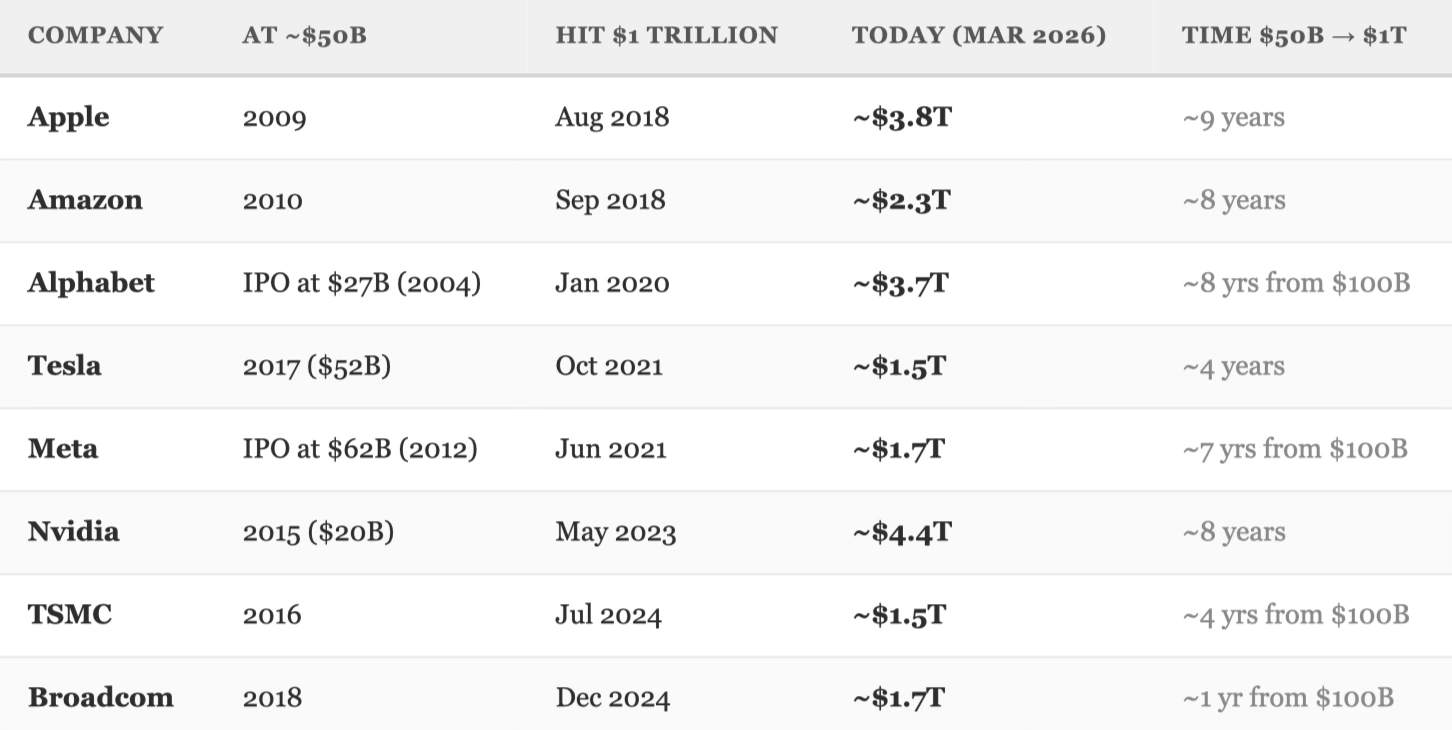
Tesla went from $52 billion in 2017 to over a trillion four years later. That’s roughly 20x. Nvidia went from $20 billion to $4.4 trillion — a 220x in a decade.
These aren’t normal returns. These are the kind of returns that change everything for a portfolio.
And every single one came from a company that, at the time, most people thought was “too expensive.”
What did they look like before the trillion-dollar moment?
This is the part I find fascinating. When you go back and look at what these companies actually looked like when they were still in the $20–50 billion range, you start seeing patterns.
Nvidia at $20 billion, in 2015. At that point it was just a graphics chip company for gamers. That’s how the market saw it.
But Jensen Huang had been CEO since he co-founded the company in 1993. He’d been building CUDA — a parallel computing platform — since 2006, quietly creating an ecosystem that would lock in every AI researcher in the world.
By the time everyone realized AI needed GPUs, Nvidia already owned the infrastructure. Nobody else was close. $20 billion to $4.4 trillion.
Tesla at $34 billion, in 2016. The most shorted stock on Wall Street. A “money-losing car company that will never scale.”
But Musk wasn’t building a car company — he was building a vertically integrated platform. Own batteries, own charging, own software, own factories.
While every legacy automaker was still debating whether EVs were viable, Tesla was building the entire stack from scratch. $34 billion to $1.5 trillion.
Amazon at $54 billion, in 2010. Bezos was getting mocked every quarter for having no profits. But he was reinvesting everything into AWS — a cloud computing business that didn’t even have its own line item in Amazon’s financials yet. Nobody could see it in the numbers.
Today AWS alone does over $107 billion in annual revenue. $54 billion to $2.3 trillion.
Google at $27 billion, at its IPO in 2004. Analysts called it a one-trick pony — just search ads. But Page and Brin were building something much bigger.
They expanded into mobile with Android, video with YouTube, cloud, autonomous vehicles with Waymo, and eventually AI. $27 billion to $3.7 trillion.
The pattern
When you study all of these trajectories, the same DNA shows up. Not sometimes — every time.
A founder-type leader who thinks in decades. A market that’s either exploding or that the company is creating from scratch. A platform that creates lock-in and gets stronger with every user. Revenue growth that’s accelerating, not slowing down. And a massive structural tailwind that makes the whole thing feel inevitable.
That’s the pattern. And I’ve turned it into a systematic framework — 7 specific criteria that I check before adding any company to this bucket.
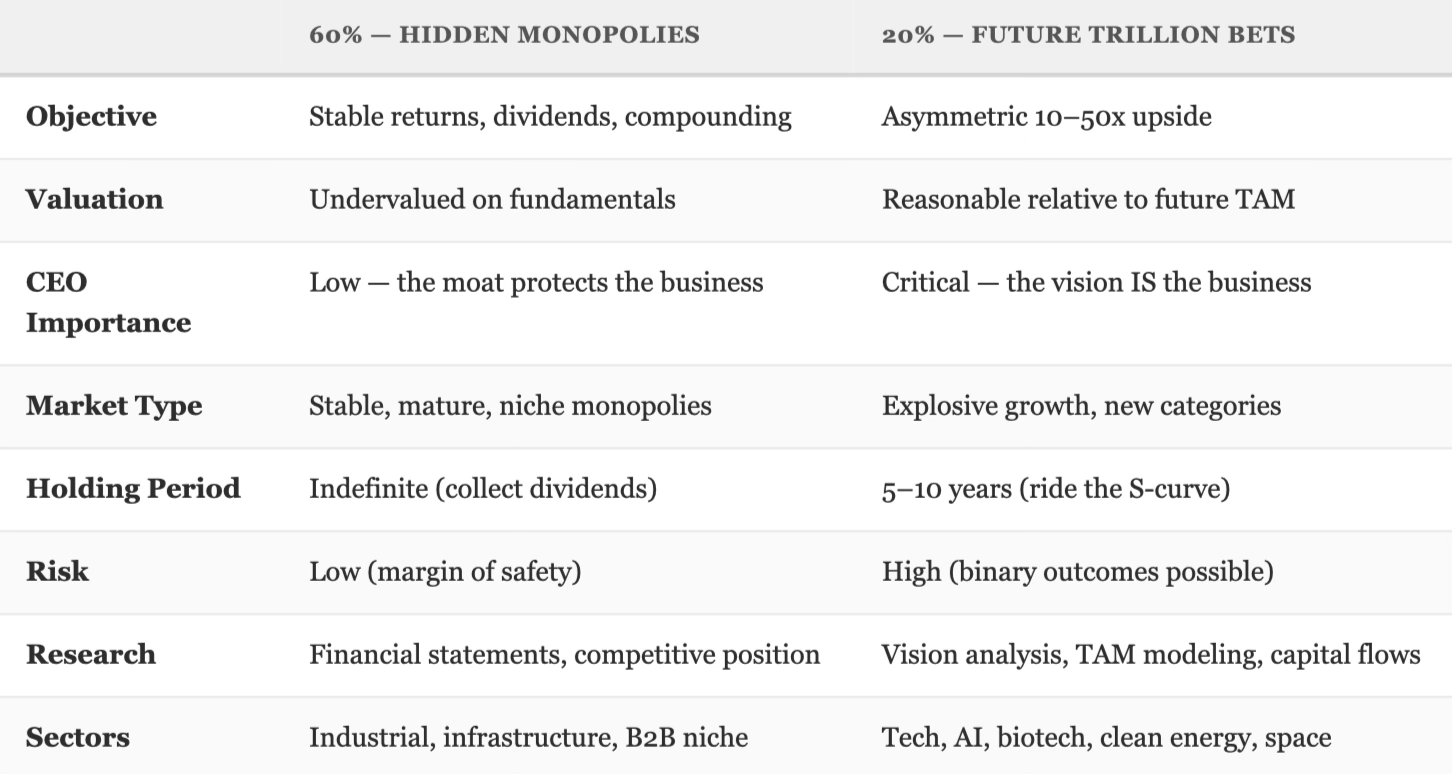
These two strategies are designed to be completely uncorrelated. When growth stocks sell off, my hidden monopolies hold steady. When the market rewards innovation, my trillion-dollar bets generate outsized returns. That’s the whole point of running them in parallel.
What’s in today’s premium edition
Today I’m sharing my complete research framework for the first time — the 7 criteria I use to evaluate any high-growth company, the step-by-step process I follow to find candidates, and my 10 current positions in this bucket.
These are the companies I believe have the potential to become the next generation of trillion-dollar leaders. For each one I’ll share the thesis, the catalyst, and the key risk.
You can use this framework for your own research — it works for any company you’re evaluating in high-growth markets. The goal is to replace gut feeling with a repeatable system.
Let’s get into it.
Why go premium?
Every week I spend 40+ hours digging through earnings calls, filings, and supply chain data so you don’t have to.
Two new deep-dive editions per week.
Full investment theses with entry points, weightings, and exit scenarios. No fluff — just the kind of research that actually moves the needle on your portfolio.
As you’ve probably noticed, the price of Macro Notes Premium has been evolving regularly, increasing from $100 to $300 per year in just three months (with a 50% discount for the first year, you can still access it for only $150).
We reward those who get in early.
Most fast-growing finance newsletters like Macro Notes are priced between $800 and $1,000 per year, and that’s likely where we’re heading by the end of 2026.
If you subscribe now, your price is locked in — it will only increase for future subscribers.
Subscribe today to secure this rate before it changes and the price moves to $500 per year or more.