

I’ve had a hunch for a long time that China will win the AI race.
But it’s a hunch, and it’s probably biased. Most of what I read comes from Western media, where fear of China is good for clicks. A headline saying China is about to overtake the United States, or already has, gets people to read.
So today I want to put that intuition to the test. Can I turn it into a conviction by looking closely at the evidence? Or am I underestimating the American lead and how hard it will be for China to close it?
Getting this right could be one of the biggest edges an investor can have right now. The United States and China can both build large AI markets of their own. The question for investors is which companies will capture the spending as those markets grow, and where suppliers from one side can start winning customers on the other.
By the end of this analysis, we’ll have a map of the monopolies and dominant suppliers most exposed to competition, the Chinese challengers that could gain market share at home and abroad, and the infrastructure companies whose valuations depend on advantages they may struggle to defend. Some Chinese suppliers may have room to grow well beyond what investors expect if they can match their American or European peers on performance, cost, and reliability.
The AI race is still being decided. The past few years have been an intense race to build the infrastructure needed to train and run AI at scale. The next phase also depends on which applications people adopt, how often they use them, and who controls distribution. Those are harder to predict, and they can change which parts of the infrastructure are most in demand.
Take a coding agent working across a large codebase. It may read dozens of files, run tests, and return to the same context as it works through a problem. Keeping that context available between steps puts pressure on high-bandwidth GPU memory. At scale, providers can also move some of that cached data into cheaper memory or storage. The rise of coding agents can therefore change what data centers buy, right down to the mix of GPU memory, server memory, and storage.
AI use cases are changing quickly. That’s one reason I’m particularly interested in China’s push into robotics. Its factories give it a large market in which to deploy and test robots. The question is whether that advantage carries over to robots that can learn new tasks, work reliably on their own, and do enough useful work that customers come back to buy more.
What Would It Mean for China to Win the AI Race?

I started by asking myself what I meant by win. If a Chinese lab releases the best model in the world for a few months, what has China won? If that same model becomes the cheapest reliable way for businesses to process documents, write code, or run customer support, I care much more. Now there’s a customer deciding where to spend a budget.
There are three questions I want to answer. Can China build the infrastructure it needs at scale? Can its companies get people and businesses to use what they build? Can they win enough customers abroad to affect the profits of companies investors already own?
A Chinese supplier can build a substantial business by replacing imports at home. A model developer can reach customers abroad while an American cloud provider sells the computing power behind every request. An American company can train a leading model while relying on a Taiwanese foundry and Dutch lithography equipment. Following the purchase orders makes it easier to see who benefits.
The American Lead Is Most Visible in the Hardware
One number made me take the American lead more seriously. Epoch AI estimates that the United States received 72% of the AI computing capacity delivered worldwide between 2022 and June 2026, measured in H100 equivalents. China received about 10%, including domestically produced chips. The US received 78% of new capacity in the first half of 2026 alone. Epoch measures capacity delivered. Actual utilization and access vary.
The US advantage depends on several countries. Nvidia designs accelerators and has built a software ecosystem around them. TSMC in Taiwan fabricates much of the leading hardware. ASML in the Netherlands makes the EUV lithography machines that help TSMC manufacture advanced chips, with critical optics from Germany’s Zeiss. South Korea’s SK Hynix and Samsung, alongside America’s Micron, supply the high-bandwidth memory those accelerators need. This is one of the strongest arguments for a durable American lead. Several of the hardest capabilities to replicate are already operating together at industrial scale.
China is making progress in chip fabrication and lithography. TechInsights found that SMIC’s N+3 process improves on its earlier 7 nm-class technology using deep ultraviolet lithography, or DUV. Its analysis of a Huawei phone chip also found that the process remained less dense than leading commercial 5 nm processes. In July 2026, Reuters reported that Shanghai Aishengna had begun producing immersion DUV machines. The machines still needed further testing. Reuters separately reported that a Chinese EUV prototype could generate extreme ultraviolet light. The prototype had yet to produce a functioning chip at the time of the report. For a fab, the milestones that matter are a machine it can qualify, a production yield that makes the economics work, and a second order once the machine has proved itself.
A Chinese accelerator can take share while the US lead in advanced computing power widens. IDC data reviewed by Reuters put Huawei at 28% of Chinese accelerator shipments in the first half of 2026, within six percentage points of Nvidia. That’s a share of units shipped, in a market shaped by US export controls and Beijing’s support for domestic suppliers. Huawei is already winning orders. Sustaining those gains will depend in part on whether customers can run their workloads economically on its systems.
A Chinese Model Can Win the Workload. An American Company Can Send the Bill.
The gap looks different when I move from hardware to models. Stanford’s AI Index counted 50 notable US models and 30 Chinese models in 2025. On the Arena benchmark, DeepSeek-R1 briefly matched the leading US model in early 2025. The talent pool spans both countries. In MacroPolo’s study of leading AI researchers based on NeurIPS 2022, 47% had earned their undergraduate degree in China. The United States was the most common country of employment in that sample.
The US has a visible distribution advantage. OpenAI reported in October that ChatGPT reached 1.2 billion people each week worldwide. In China, QuestMobile estimated that ByteDance’s Doubao had 419 million monthly active users in September. The figures use different definitions of active users and cover different markets. They do show that both companies can put new features in front of hundreds of millions of people. Kling gives us a measure of what customers pay for a different kind of product. Kuaishou reported more than RMB 850 million in second-quarter 2026 revenuefrom its video generator.
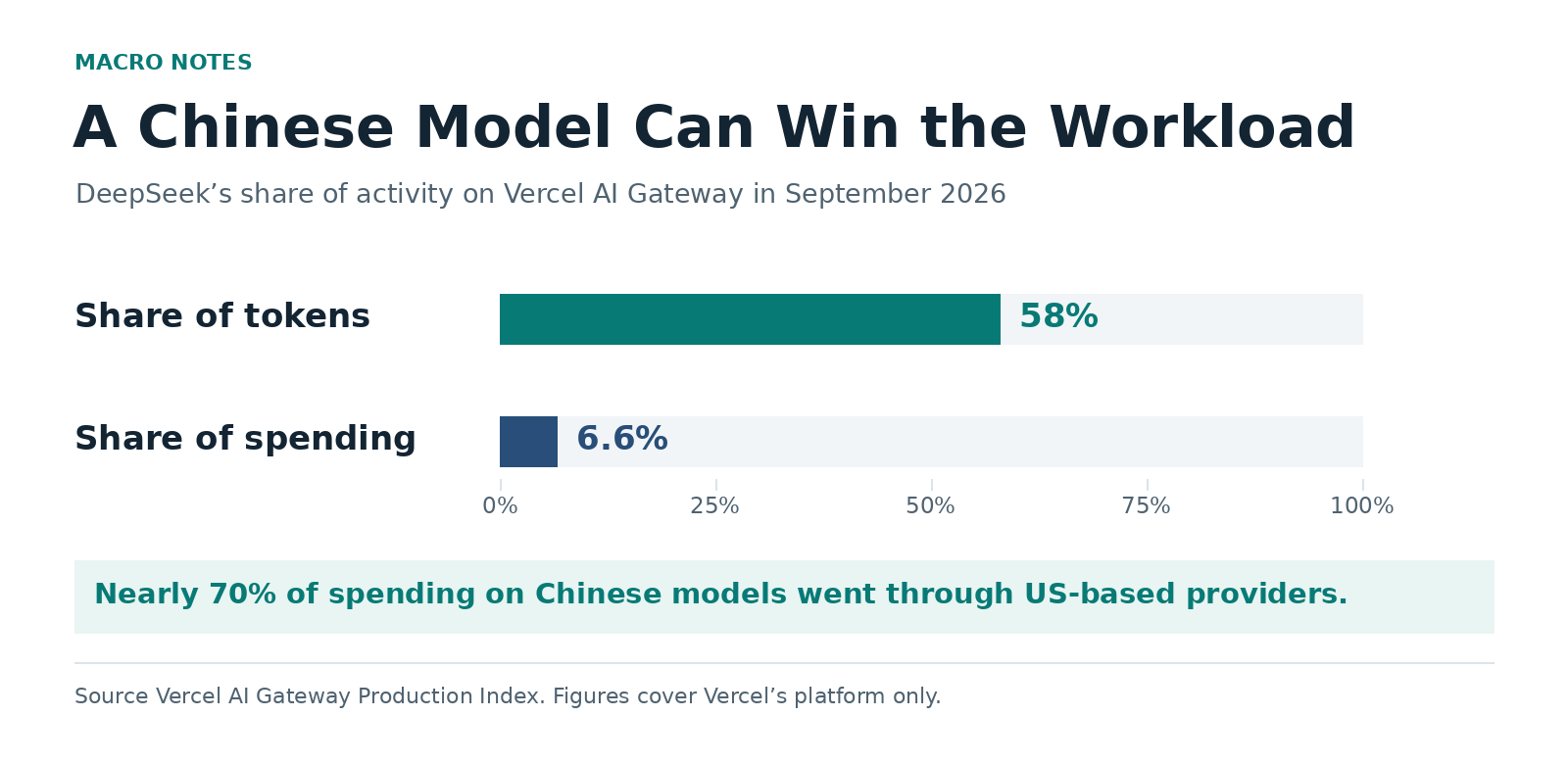
The most revealing data point I found came from Vercel. On its AI Gateway in September, DeepSeek models processed 58% of tokens and accounted for 6.6% of spending. Nearly 70% of the spending on Chinese models across that gateway went through US-based providers. AWS already offers managed access to DeepSeek, Qwen and Kimi, among others. It’s easy to imagine an American software company moving a high-volume workload to a Chinese model and continuing to pay an American cloud provider for it. If the model costs less per completed task and customers keep paying the same subscription price, some of the savings can show up in the software company’s gross margin.
Robotics Is Where China’s Domestic Market Could Matter Most
China installed 354,000 industrial robots in 2025, accounting for 59% of global installations, according to the International Federation of Robotics. Chinese suppliers took 55% of their home market. Further upstream, the International Energy Agency estimates China produced 94% of the world’s sintered permanent magnets in 2024. These magnets are used in motors that drive robotic joints. For robotics companies, that industrial base means access to component suppliers, integrators, and factories that can test a robot on real work.
Omdia estimates that AgiBot and Unitree together shipped about 9,400 humanoid robots in 2025. I want to know what those machines do once they’re deployed. BMW’s Spartanburg pilot gives us a more concrete measure of the work a robot can do. The company says a Figure 02 robot positioned sheet metal parts for welding and helped produce more than 30,000 BMW X3s over ten months. The evidence I’d look for across suppliers is hours of autonomous operation, interventions per shift, and whether the customer orders more robots after the first trial.
Robotaxis offer a clearer view of adoption at scale. Baidu reported 3.2 million fully driverless Apollo Go rides in the first quarter of 2026. In September, Waymo said it was serving more than 500,000 paid trips a week in the US. The figures cover different periods and types of trips, but both businesses have reached a scale where we can ask how much each ride costs to deliver and whether adding a city makes the service more profitable.
I came into this thinking primarily about who would build the best AI. I now think China’s strongest case may be its ability to get useful AI into more products and factories at a price customers will pay. How far that advantage can travel is still an open question. Zhongji InnoLight’s financial statements offer one answer. The company reported almost 95% of its first-half 2026 revenue outside mainland China, as foreign cloud customers bought more high-speed optical modules. In this case, the largest gains for a Chinese supplier are already coming from abroad. The interesting question is which other suppliers could follow it, and how much of that growth investors are already paying for.
What I’ll Cover in the Premium Analysis
The investment question I’m left with is how much revenue and profit can actually change hands. The size of that opportunity depends on the market each company can actually serve, the prices it can charge, and the margins it can keep.
I’ll work through five questions in the rest of the edition.
The first market a Chinese lithography supplier can realistically take from ASML. I’ll use ASML’s China sales to size the opportunity, work through what different levels of market share could mean in revenue, and explain why immersion DUV and EUV have very different commercial timelines.
What Huawei’s and Cambricon’s gains mean for Nvidia. I’ll put numbers on a gain of ten percentage points in China and look at what a foreign cloud provider would need to see before choosing Chinese accelerators for a production workload.
Who keeps the savings when a business switches to a cheaper Chinese model. I’ll model how a lower cost per task flows through to the application’s margins, how much usage would have to grow to offset lower prices, and what AWS and Alibaba can each capture.
The Chinese stocks I’d study first. I’ll compare InnoLight with Eoptolink, AMEC with Naura, and Alibaba with Kuaishou. I’ll look at how reported profits translate into cash and use Cambricon to show how much growth investors may already be paying for.
The evidence that would change my mind. I’ll identify the orders, deployments and spending data I’d track to see where Chinese suppliers are winning business beyond their home market.