


We regularly invite guest contributors to share their work on Macro Notes. Our goal is not only to share our own research, but also to introduce you to new investment ideas, independent research, and different perspectives.
Today’s edition is written by Vitaly Kurdyumov, a former rocket engineer who later worked at GE and DDB (Omnicom). He studied Strategic Management at Cornell and Financial Markets at Yale. Explore his newsletter here.
If you’d also like to introduce your newsletter or product to our audience of 72,000 subscribers, we publish one guest edition per week on Macro Notes. Reserve your guest post by contacting us at partnerships@macronotes.com
An analysis of the US market for investors | November 17, 2026
An economy with too many borrowers and too little cheap capital
Washington needs money. Silicon Valley needs money. Corporate America needs money. And none of them is getting it cheaply.
At first glance, the war involving Iran, the extraordinary investment boom in artificial intelligence and America’s mounting federal debt appear to be separate stories. One is unfolding in the Middle East, another in the data centers of Silicon Valley, and the third in the Treasury Department’s borrowing calendar.
For investors, however, they are increasingly part of the same story: a growing competition for capital at a time when capital is becoming more expensive.
The federal government must borrow trillions of dollars to finance its budget deficit and refinance maturing debt. The largest technology companies are committing hundreds of billions to AI infrastructure, betting that future demand for computing power will justify the expense, and they have begun borrowing to do it. The rest of corporate America still needs financing for operations, investment and debt service. Households, meanwhile, are competing for the same pool of capital through mortgages, auto loans and credit cards.
These borrowers are not operating in separate financial systems. They are drawing on the same pool of savings and investment capital. When demand for financing grows faster than the supply of available funds, its price tends to rise.
The problem is not simply that money has become expensive. It is that America is creating more reasons for money to remain expensive.
The Iran conflict adds another complication. Higher oil prices have prolonged inflation, and the Federal Reserve is now expected to raise rates again in December rather than ease. Meanwhile, the economy’s capacity to absorb another round of financial tightening is far from unlimited. Consumer purchasing power is under pressure, housing remains constrained by borrowing costs, and a substantial share of corporate investment momentum is concentrated in one enormous technology cycle.
The market has already delivered a first warning. On November 5, the Nasdaq 100 fell 6.4% in a single session, its worst day since March 2020, as investors questioned how long the pace of data-center construction can be sustained. The S&P 500 lost 4.4% that day and, as of November 16, stood more than 5% below its October record.
The result is an increasingly uncomfortable paradox: the US economy needs cheaper money to sustain growth, while its own borrowing and investment ambitions are helping make that money more expensive.
For equity investors, that may prove more consequential than any single Fed decision or geopolitical headline.
The first competitor for capital is the US government
Discussions about the cost of money in America typically begin with the Federal Reserve. That is understandable, but incomplete.
The Fed controls its policy rate and exerts considerable influence over financial conditions. It does not, however, set the entire cost of capital. Long-term Treasury yields also reflect inflation expectations, the supply of government debt, investor demand and the term premium investors require for holding longer-dated securities.
On that front, the US fiscal position is becoming increasingly difficult to ignore.
The federal deficit reached roughly $2 trillion in fiscal 2026. Government debt exceeded $40 trillion, while annual interest expenses climbed above $1 trillion. Servicing the national debt is no longer a secondary budgetary consideration. It has become one of the government’s largest financial commitments.
The more immediate concern is the government’s persistent need to refinance and borrow.
The Treasury must issue new securities to cover the deficit and replace bonds coming due. Even after netting out those maturities, its own estimates put privately held net marketable borrowing at $618 billion in the fourth quarter of 2026 and another $800 billion in the first quarter of 2027, the latter including a $150 billion increase in its cash balance.
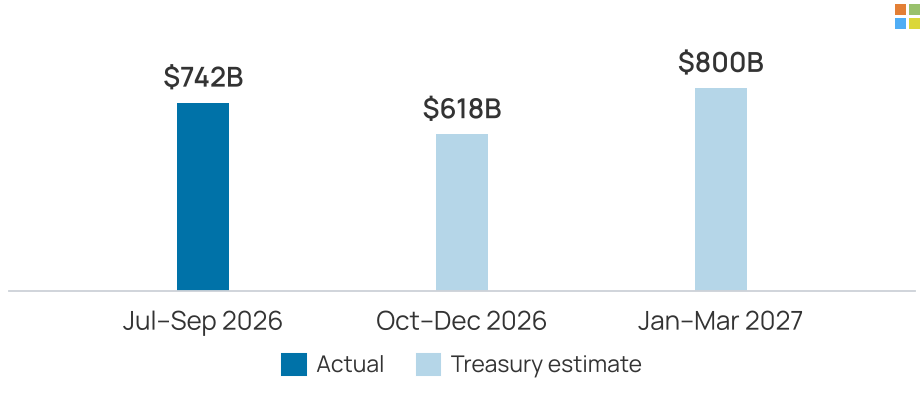
Chart 1. U.S. Treasury privately-held net marketable borrowing by quarter, billions of dollars.
Source: U.S. Treasury, November 2, 2026.
That makes the federal government one of the largest and most persistent borrowers in the capital markets, regardless of what happens to private-sector investment.
The mechanism is straightforward. As the supply of government securities increases, investors may demand higher yields to absorb additional issuance, particularly when inflation uncertainty and concerns about the long-term fiscal outlook are also rising.
This is not an automatic one-for-one relationship. Treasury yields are influenced by banks, pension funds, foreign investors, insurers and other buyers. But research from the Federal Reserve Bank of Kansas City has shown that increased government bond supply can push yields higher through the term premium and crowd out private investment.
The November refunding auctions offered a live illustration. The $42 billion sale of 10-year notes on November 10 drew weaker-than-average demand and cleared about one basis point above the market yield at the time of the auction. Two days later, the $25 billion sale of 30-year bonds cleared at 5.441%, again above the pre-auction level, with a bid-to-cover ratio of 2.36, down from 2.54 a month earlier. Neither auction failed. But investors required a concession to absorb the supply, and long-term yields rose afterward.
In other words, American businesses are competing for capital not only with one another, but with their own government.
There is a further complication. Higher interest rates make refinancing existing government debt more expensive. As older securities mature and are replaced with higher-yielding debt, interest expenses rise, potentially requiring additional borrowing.
That creates a feedback loop: higher financing costs increase the budget burden, which in turn contributes to the government’s future borrowing requirements.
For markets, the implication is important. Even when the Fed eventually stops raising short-term rates, long-term borrowing costs may not fall significantly. If investors continue demanding elevated yields on Treasuries, mortgage rates and corporate financing costs can remain stubbornly high.
The Fed sets the price of short-term money. It cannot eliminate the competition for capital created by America’s fiscal position.
The second competitor is artificial intelligence
If Washington borrows to finance deficits and existing obligations, technology companies are spending to secure what they believe will be the next major engine of economic growth.
The scale of that spending is becoming difficult to compare with a conventional corporate investment cycle.
In the third quarter of 2026, Amazon, Alphabet, Meta and Microsoft collectively spent approximately $202.9 billion on capital expenditures. Their combined operating cash flow was about $175.5 billion.
Capital spending therefore amounted to roughly 116% of operating cash flow.
The differences between companies are significant. Microsoft generated $58 billion in operating cash flow against $39.4 billion in capital expenditures. Amazon spent $77.3 billion while generating $42.4 billion. Alphabet recorded $51.4 billion in capex against $42.3 billion in operating cash flow, while Meta spent $34.9 billion against $32.8 billion.
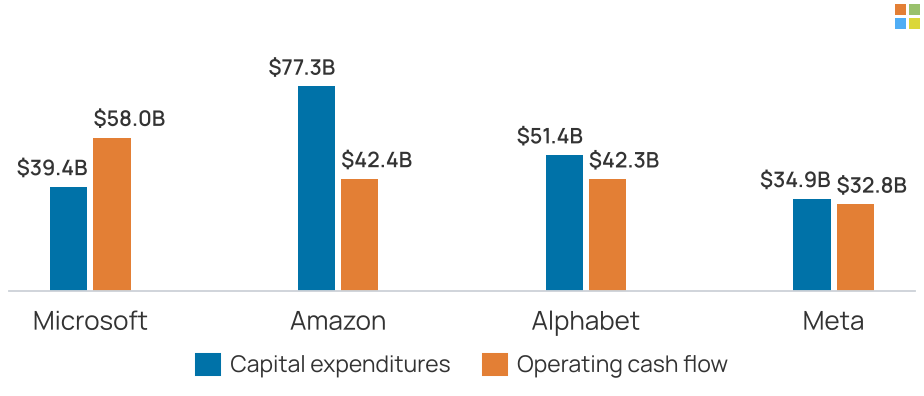
Chart 2. Capital expenditures and operating cash flow, third quarter of 2026, billions of dollars. Meta’s capital expenditures include principal payments on finance leases.
Source: company financial reports for the quarter ended September 30, 2026.
These figures include all corporate capital expenditures, not just AI-related investment. But the construction of AI infrastructure has become one of the principal drivers of the spending acceleration. And the plans keep growing: Microsoft told investors it expects to spend more than $50 billion in the current quarter and about $170 billion in calendar 2027.
The issue is not that companies are investing. Investment in transformative technologies can create enormous economic value. The issue is the widening gap between when the money goes out and when the returns are expected to arrive.
Data centers must be built today. Servers, networking equipment, cooling systems and electricity infrastructure must be paid for now. The financial payoff depends on how quickly companies can sell computing capacity, monetize AI models and turn new services into recurring revenue.
That payoff has yet to become visible on a scale comparable to the investment.
A Reuters analysis of five major players in the infrastructure race — Microsoft, Alphabet, Amazon, Meta and Oracle — found that they generated a record $542.9 billion in operating cash flow during the first nine months of 2026, but spent $556.9 billion on capital expenditures.
Their combined free cash flow swung from a surplus of $143.5 billion a year earlier to a deficit of roughly $14 billion.
This is not a liquidity crisis. These companies still have substantial cash reserves, profitable legacy businesses and access to capital markets. But the way they allocate capital is changing.
Until recently, the technology giants could invest aggressively while simultaneously buying back shares, paying dividends and accumulating cash. Increasingly, a larger share of their resources is being committed to infrastructure.
And the financing has now visibly moved beyond internally generated cash. Between October 29 and November 4, four of the largest AI spenders came to the bond market within a single week. Microsoft sold $25 billion of bonds in ten tranches, its first US bond deal since 2017, with fixed coupons ranging from 4.85% to 6.35%. Oracle sold $10 billion of notes alongside a $10 billion stock offering. Alphabet raised 6 billion euros in Europe. Meta placed $15 billion in dollars and another 9 billion euros. According to LSEG data cited by Reuters, US investment-grade bond issuance had reached a record $1.88 trillion by November 4, and the five hyperscalers alone accounted for more than $370 billion of it, about a fifth of the total.
Equity capital is being called on as well. Anthropic, the AI developer behind Claude, is expected to price its initial public offering on November 18 and begin trading on the Nasdaq the following day. The company and some of its shareholders aim to raise up to $64.4 billion, at a valuation of up to $1.4 trillion, with another $26 billion coming from a private placement to chip and cloud partners. By itself, that is the second-largest IPO in history, and it draws on the same pool of investor capital as everything else described in this article.
S&P Global Ratings estimates that capital expenditures by six major hyperscalers could exceed $1.3 trillion by 2027. The agency expects the group to generate negative free operating cash flow in both 2026 and 2027, with a recovery not arriving until 2029.
This is where the AI investment cycle begins to collide directly with America’s debt problem.
The government is issuing more bonds. Corporations are issuing more bonds. Investors must allocate their capital among a growing number of borrowers.
Technology companies may be able to absorb higher financing costs because of their strong balance sheets, liquidity and growth prospects. Most other businesses have considerably less room to maneuver.
The market’s patience is also thinner than it was. Nvidia’s market capitalization has fallen from about $5.8 trillion in early October to roughly $4 trillion in mid-November, a slide that deepened in the week its chief executive, Jensen Huang, stepped down on November 12 and the chief financial officer, Colette Kress, took over on an interim basis. The company reports quarterly results on November 17, and the investors who have spent two years treating its numbers as proof that the AI build-out pays for itself will be reading them with less confidence than before.
The economy is growing. But what is driving it?
The headline numbers suggest that the US economy is holding up reasonably well.
The Bureau of Economic Analysis’ preliminary estimate showed annualized real GDP growth of 3.4% in the third quarter of 2026, up from 2.2% in the second quarter.
But the composition of that growth deserves more attention than the headline itself.
Consumer spending increased by 3.8%, while investment in equipment surged 20.9%. Purchases associated with AI infrastructure played a significant role in the investment acceleration. Spending on information processing equipment, software and research also contributed to the expansion.
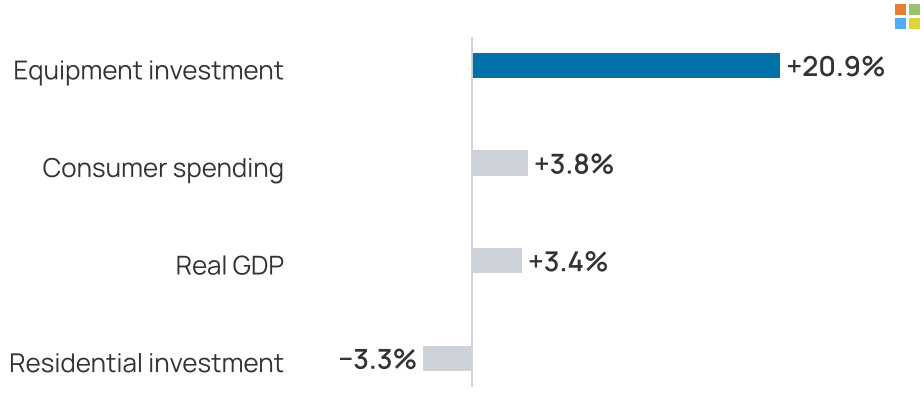
Chart 3. Real growth in the third quarter of 2026, annualized percent change from the previous quarter, advance estimate.
Source: Bureau of Economic Analysis, October 29, 2026.
That raises an uncomfortable question: how durable will economic growth prove to be if the AI investment cycle slows?
This does not mean the entire US economy is dependent on data centers. Consumer spending remains its largest engine of economic activity. But the investment boom has become sufficiently large that a slowdown could have a meaningful impact on GDP, corporate revenues and earnings across multiple industries.
There is also the condition of the American consumer to consider.
The labor market delivered a better October than expected: nonfarm payrolls rose by 165,000, the unemployment rate edged down to 4.1%, and average hourly earnings were up 3.1% from a year earlier. Beneath the headline, the picture is less comfortable. The number of people working part-time because they could not find full-time work rose by 339,000 to 4.8 million, and the average spell of unemployment reached 27 weeks, the longest outside the pandemic in a decade.
Inflation, meanwhile, is not retreating. The consumer price index rose 0.4% in October after 0.6% in September, and core prices rose 0.3% for the third month in a row. The Bureau of Labor Statistics could not publish a year-over-year rate because last year’s government shutdown left a gap in the data, but economists’ interpolations put headline inflation at around 4% over the past twelve months. Food prices rose 0.5% in the month, the fastest since April.
Households feel it. The University of Michigan’s consumer sentiment index recovered to 51.0 in early November from 48.0 in October, its highest reading since August, but that is still within a few points of the record low of 44.8 set in May. Year-ahead inflation expectations eased to 4.3% from 4.7%, which is an improvement, not a resolution.
This is one of the defining contradictions of the current US economy: stock indexes can trade within a few percent of record levels and corporate earnings can remain strong while ordinary consumers feel increasingly financially constrained.
Higher interest rates amplify the divide. They raise the cost of mortgages, auto loans and credit cards, restrict housing activity and make borrowing more expensive for businesses.
Housing is particularly sensitive. Elevated mortgage rates have constrained the property market for an extended period, while residential investment fell 3.3% in the third quarter.
The point is not that the American economy has stopped growing. It is that its ability to withstand another prolonged period of expensive financing is far from unlimited.
GDP growth is not the same thing as economic resilience.
The other 493: where the real stress test begins
For equity investors, one of the most important distinctions is between America’s largest technology companies and the rest of the S&P 500.
The index contains 500 leading US companies, but its performance and aggregate financial statistics are heavily influenced by its largest constituents.
That can create the illusion that the condition of the index accurately reflects the condition of the broader corporate sector.
It does not.
The largest technology platforms have enormous cash-generating businesses, access to bond markets and the financial capacity to support multiyear investment programs. Industrial companies, regional banks, consumer businesses, real estate firms and smaller technology companies operate with very different financial constraints.
That said, the latest earnings data do not support a blanket claim that the other 493 companies are already underperforming the technology giants.
With 91% of S&P 500 companies having reported, FactSet put the blended third-quarter earnings growth rate for the index at 31.9% as of November 13, the third consecutive quarter above 25%. FactSet’s November 3 breakdown showed the remaining 493 companies growing earnings by 32.6%, ahead of the 22.6% recorded by the Magnificent Seven, whose results had fallen short of estimates in aggregate. Analysts expect the same pattern in the fourth quarter.
The market, notably, has been punishing the giants for disappointing. FactSet found that the three Magnificent Seven companies that reported negative earnings surprises for the quarter — Alphabet, Amazon and Meta — saw their shares fall an average of 7.8% around the release, against a 1.1% decline for the index as a whole on negative surprises.
But that is not the end of the story.
First, earnings growth is not the same as financial resilience or debt-servicing capacity. Second, aggregate numbers conceal substantial differences between industries and individual companies. Third, much of the corporate sector remains exposed to borrowing costs and the risk of weaker consumer demand.
This is where the Fed’s next rate increase could become particularly damaging.
For a company with substantial cash reserves and limited debt, an additional 25 basis points may be an inconvenience rather than a serious threat.
For a business that must regularly refinance debt, fund working capital and finance new projects, the consequences can be considerably more severe.
Expensive money does not simply lower equity valuations. It can directly undermine business performance.
Investment slows. Debt-service expenses rise. Development budgets are cut. Consumer demand weakens. Companies can find themselves facing higher costs at the same time that revenue growth is losing momentum.
That is why investors need to look beyond the profitability of individual mega-cap companies and assess whether the broader corporate sector can withstand a sustained period of high financing costs.
Iran adds another shock to an already strained system
Against this backdrop, the conflict involving Iran introduces another source of uncertainty.
Oil has come off its peak. Brent averaged $124 a barrel in October, the highest monthly average in inflation-adjusted terms since 2022, then fell below $100 on November 4 and closed near $92 on November 16, with WTI around $85. Part of the decline reflects shipments continuing through the Strait of Hormuz, supported by ship-to-ship transfers off the coast of Oman and the restart of Saudi Arabia’s East-West pipeline. The rest of it coincided with the post-election selloff in equities.
The supply picture, however, has not normalized. Middle East shut-in production still averaged about 2.5 million barrels a day in October, down from a peak of 10.9 million in May, and the Energy Information Administration expects that level to persist through the end of the year. Tanker attacks in the Gulf and the Black Sea continue to disrupt flows and raise shipping costs. US commercial crude inventories ended October at about 410 million barrels, the lowest for that month since 2014.
In its November outlook, the EIA still expects Brent to average around $100 a barrel in November and December and $97 for 2026 as a whole, before easing to $86 in 2027 as production recovers and inventories rebuild. The market is currently trading below that path. Whether it stays there depends on physical flows, not on sentiment.
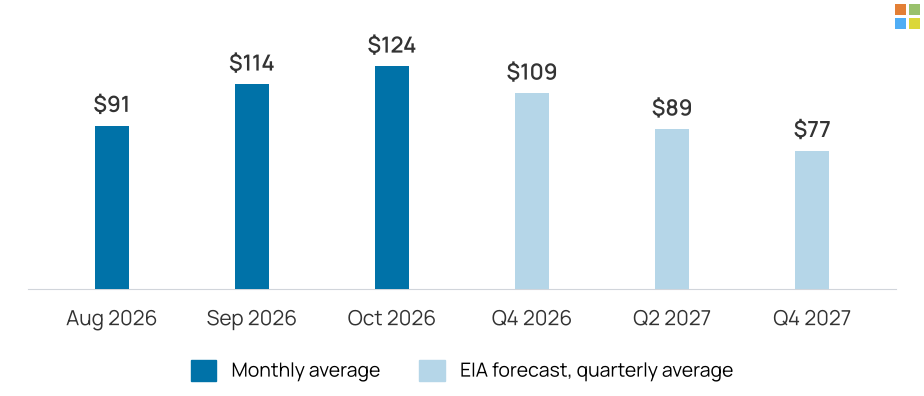
Chart 4. Brent crude oil spot price, dollars per barrel.
Source: U.S. Energy Information Administration, Short-Term Energy Outlook, November 10, 2026.
Even at $90, oil is well above the $81 average of the first quarter, and the damage to prices has already been done. Transport, aviation fuel, petrochemicals, logistics and shipping insurance all cost more than they did. The EIA raised its 2027 forecast for retail diesel by 12% in a single month. Energy producers may benefit, but for most businesses and consumers, the increase represents an additional cost that is still working its way through the economy.
Timing is what makes the shock particularly problematic.
If the US economy were entering this episode with strong growth, moderate inflation and readily available financing, higher oil prices would be unpleasant but potentially manageable.
The current environment is different.
Consumers are already under pressure from the cost of living. Companies are funding enormous investment programs. The government continues to borrow on a massive scale. Long-term Treasury yields are above 5%.
The oil shock did not create these vulnerabilities. It threatens to intensify them simultaneously.
The Fed’s dilemma: inflation versus economic damage
On October 28, the Federal Reserve left its federal funds target range unchanged at 3.75% to 4.00%. The decision passed by a 10-to-2 vote, with two policymakers favoring a quarter-point increase.
Since then, the debate has moved on from whether to hike to how much. After the October inflation report, futures markets fully priced a quarter-point increase at the December 8–9 meeting and assigned a 10% to 15% probability to a half-point move. Governor Christopher Waller described a quarter point as his baseline. Dallas Fed President Lorie Logan argued for more hikes at a faster pace. Chair Kevin Warsh has declined to signal the path.
But raising rates under current conditions is far from painless.
If policymakers decide that additional tightening is necessary to contain inflation, they risk intensifying pressure on economic sectors that are already highly sensitive to financing costs.
The problem is that higher rates affect much more than inflation. They influence investment decisions, housing activity, credit availability and consumer demand.
Companies facing refinancing difficulties could see their interest expenses rise further. Businesses with thin margins and limited pricing power could find it increasingly difficult to absorb the additional burden.
Yet the long end of the bond market is not waiting for the Fed.
The 10-year Treasury yield closed at about 5.13% on November 16, up from 4.84% on November 5, when the equity selloff briefly pushed investors into bonds. The two-year yield was near 4.8% and the 30-year yield near 5.5%.
Long-term borrowing costs can remain elevated regardless of what the Fed does with its policy rate. Government borrowing requirements, inflation expectations and the term premium can keep financing conditions restrictive independently of the Fed’s immediate decisions.
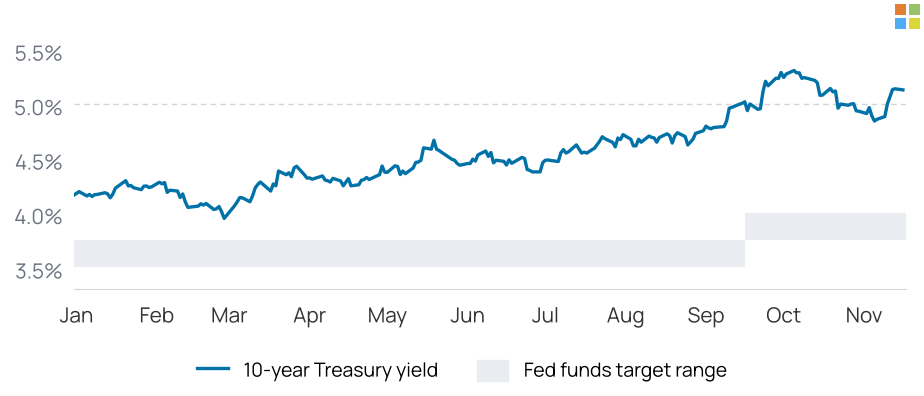
Chart 5. 10-year U.S. Treasury yield, daily close, and the federal funds target range, percent, December 31, 2025 to November 16, 2026.
Source: TradingView (TVC:US10Y); Federal Reserve.
The central bank is therefore facing a difficult trade-off.
Pausing could support the economy, but persistent inflation and a still-expensive oil market could undermine confidence in its commitment to price stability. Raising rates could help contain inflation, but it could also weaken the corporate sector and consumers that are already struggling with expensive financing.
There is no policy option that simultaneously makes money cheap, brings inflation down and preserves the current pace of economic growth.
What breaks first?
The most vulnerable part of this structure may not be the stock market itself.
The first pressure point could be corporate financing.
If bond yields remain elevated, companies with substantial debt burdens will face higher refinancing costs. Investment projects that looked attractive when financing was cheaper may no longer generate adequate returns.
The second pressure point is consumer demand.
Higher energy prices act like an additional tax on households. Money spent on gasoline, heating and transportation cannot be spent on other goods and services. For consumer-facing businesses, this creates the risk of slowing sales just as financing costs remain high.
The third is the AI investment cycle.
If demand for computing power continues to grow and AI monetization meets expectations, today’s extraordinary capital spending could ultimately prove justified.
But if revenue and cash generation fall behind investment, companies may have to reconsider their spending plans. The consequences would extend beyond chipmakers and cloud platforms to power utilities, equipment manufacturers, construction firms and other industries already benefiting from the infrastructure boom. The November 5 selloff, which erased about $2.3 trillion of Nasdaq 100 market value in one afternoon and cut the Philadelphia Semiconductor Index by 12%, showed how quickly that reassessment can spread.
Finally, there is the fiscal risk.
If the cost of government borrowing continues to rise, interest payments will consume an increasing share of federal spending. That will constrain the government’s ability to finance other priorities without further borrowing.
These risks are interconnected.
Slower investment could weaken economic growth. Lower demand could hit corporate revenues. Deteriorating business performance could increase credit risk. Higher credit risk could push borrowing costs up further. And any attempt by the Fed to ease financial conditions could run into inflation constraints.
This is not a forecast of an inevitable crisis. It is a scenario in which a relatively modest external shock could have a disproportionately large impact on financial markets.
What investors should watch
Over the coming quarters, monitoring Fed decisions and the S&P 500 alone will not be enough. Investors should pay attention to several interconnected indicators.
The Treasury market.
Government bond issuance, auction demand, 10-year and 30-year yields, and the term premium will be critical. The November auctions already showed investors asking for a concession. If yields remain elevated even as the policy rate stabilizes, it would suggest that the cost-of-capital problem is extending beyond monetary policy.
The federal deficit and interest expenses.
The scale of government borrowing and the pace at which debt-service costs are increasing will help determine the long-term financing environment in the US.
The cash returns from AI investment.
Cloud revenue growth, data-center utilization, AI-service margins and free cash flow matter more than announcements of new spending commitments. Investors need evidence that infrastructure is generating revenue, not simply expanding installed computing capacity. The next test comes immediately: Nvidia’s results on November 17 and the pricing of Anthropic’s IPO on November 18.
The health of the broader economy.
Employment, real household income, consumer spending, loan delinquencies, corporate bankruptcies and earnings among companies outside the largest technology names will provide a clearer picture of the economy’s ability to withstand higher financing costs. October retail sales, due November 17, and the results of Walmart, Target and Home Depot this week will show whether the consumer is still carrying the economy into the holiday season.
Oil and physical supply flows.
Brent prices alone do not tell the whole story. The recovery of shipments through the Strait of Hormuz, production levels and shipping insurance costs are equally important. A normalization of energy flows would gradually reduce the additional inflationary pressure; a renewed disruption would send the Fed debate straight back to a half-point increase.
Expensive money is no longer just a Fed problem
The US economy has reached a point where the government, technology giants and the rest of corporate America are competing for the same capital.
Washington needs to finance a massive deficit. Technology companies need to build the infrastructure they believe will power the next stage of economic growth, and they are now borrowing to do it. The broader business sector needs to refinance debt, sustain investment and preserve demand.
All of this is happening against a backdrop of persistent inflation, oil that is cheaper than a month ago but still expensive, and a central bank preparing to raise rates rather than cut them.
For now, the AI investment cycle is supporting economic activity and corporate earnings. But that does not make it an unconditional source of stability. The more the economy relies on continued investment, the more exposed it becomes if that spending slows. The first week of November gave a preview of what that exposure looks like.
And this is the central paradox.
The US needs enormous investment to sustain growth. Financing that investment requires capital. But government debt, corporate borrowing and inflation risks are making that capital increasingly expensive. Meanwhile, the rate increases that may be necessary to contain inflation could undermine the very investment cycle and businesses that are supporting growth today.
For equity investors, this means the old strategy of buying growth and assuming that capital will remain readily available is becoming less reliable.
Balance sheets, debt burdens, free cash flow and the ability to finance expansion without constantly returning to capital markets deserve much closer scrutiny.
Expensive money does not necessarily mean an immediate stock-market selloff. But it makes mistakes considerably more costly.
Ultimately, the question is not simply how impressive the future of artificial intelligence will be. It is whether the US economy can afford to pay for that future while servicing its existing debt and keeping the rest of corporate America financially healthy.
Sources and methodological notes
U.S. Treasury, November 2, 2026 — quarterly estimates of federal borrowing; auction results of November 10 and 12, 2026.
Committee for a Responsible Federal Budget, October 16, 2026 — FY2026 federal deficit, national debt and interest expenses.
Federal Reserve Bank of Kansas City, April 2026 — research on the impact of Treasury supply on yields and private investment.
S&P Global Ratings, August 27, 2026 — capital expenditure and free cash flow projections for major hyperscalers.
Reuters, October 30, 2026 — cash flow and capital expenditures of five major technology companies; Reuters/LSEG, November 2026 — US investment-grade bond issuance.
SEC filings and company statements, October 29 – November 10, 2026 — bond offerings of Microsoft, Oracle, Alphabet and Meta; Anthropic Form S-1/A, November 10, 2026.
Bureau of Economic Analysis, October 29, 2026 — preliminary US GDP estimate for Q3 2026.
Bureau of Labor Statistics, November 6 and November 10, 2026 — October employment report and consumer price index.
University of Michigan, November 6, 2026 — preliminary November consumer sentiment index.
FactSet, November 3 and November 13, 2026 — S&P 500 earnings growth, Magnificent Seven versus the remaining 493 companies.
Federal Reserve, October 28, 2026 — FOMC interest-rate decision; CME FedWatch, November 10–13, 2026 — market-implied probabilities for the December meeting.
TradingView, November 16, 2026 — Treasury yields, Brent and WTI futures, S&P 500 and Nasdaq 100 levels.
EIA, Short-Term Energy Outlook, November 10, 2026 — oil markets, supply disruptions and price forecasts.
All figures reflect information available as of November 17, 2026, before the release of Nvidia’s quarterly results and October retail sales. Technology-company capital expenditures include total capex, not exclusively AI-related investment. Estimates and forecasts are subject to revision. Increased Treasury supply can put upward pressure on yields but is not the sole determinant of their movements. The assessment of the economy’s exposure to AI investment does not imply that all GDP growth is generated by this spending.
The 10-year closed Friday at 4.91%, down from 5.15% on Nov 13, while QQQ lost 10.5% in a week (Yahoo Finance). Money got a bit cheaper only because risk got scarier.
Vitaly, does that weaken your expensive-money thesis or confirm it?
Capex at 116% of operating cash flow now carries a Fed footnote, with the October minutes recording staff concern that off-balance-sheet leases and circular financing among AI firms could amplify losses (CNBC). The competition for capital is larger than the bond counts show. Which reprices first, the leases or the bonds?