


This edition is brought to you by Emerging Value. You can read their newsletter here.
Hi, I am the founder of Emerging Value. I have been applying a value investing framework to what I believe are the best investing opportunities for the next ten years: Emerging Markets.
The Emerging markets of yesterday had low growth, unstable economies and sleepy conglomerates.
Today, Emerging Markets have changed. Modern managers have emerged, some with Silicon Valley experience, others from the Asian innovation hubs. They have created innovating companies that want to transform their economies. They often have modern capital returns frameworks.
There is also a valuation disconnect and enormous discounts available, as the theme has been out of favour for nearly 20 years.
The results are the following:
Emerging markets are where you can find the cheapest prices for good growth companies.
Most people are afraid to invest there. I believe in fundamentals before anything, and the fundamentals are strong.
Let’s look at world GDP, and we will see that actually, emerging markets are some of the world’s biggest economies.
China is almost on par with the USA, due to its large population, but the other large emerging markets now represent sises similar to the European developped nations such as France, Italy and the UK, and Canada.
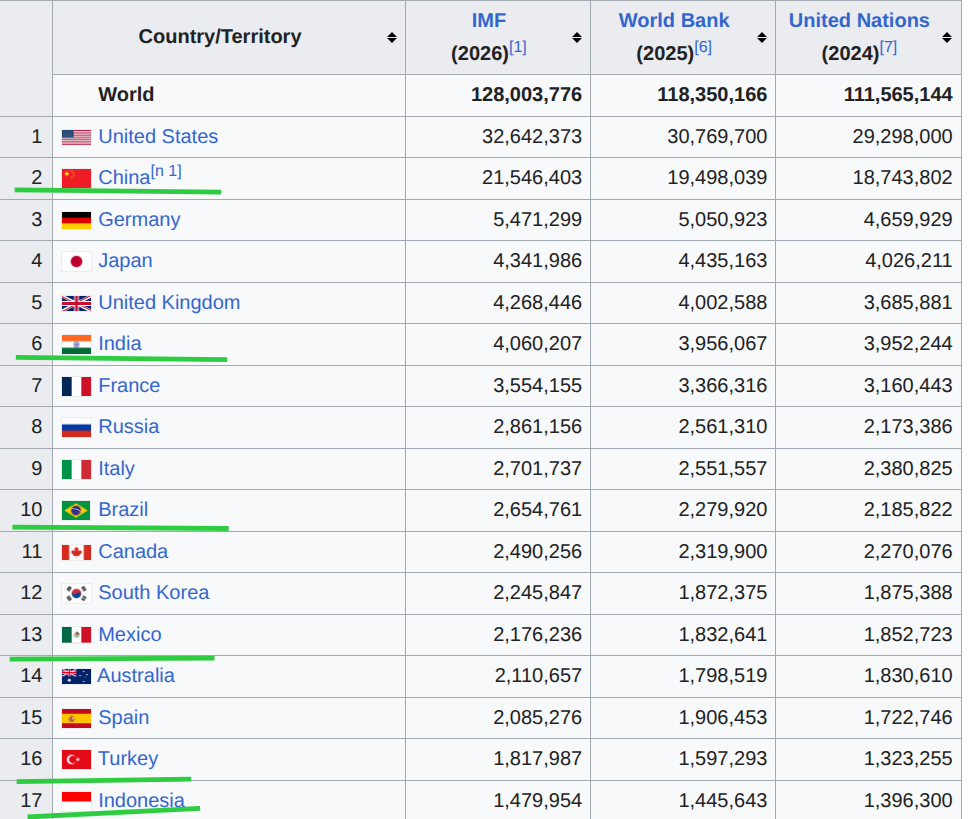
Most of these countries are climbing in the ranking. If you took the ranking 10 years ago, the Emerging market countries would be generally lower, and when you take them in 10 and 20 years, the Emerging market countries will be higher in the list. This is despite real estate crashes, or currency devaluations and political problems. Demographics is destiny.
By all logic China should become the first economy in 20 years or so, and the USA is still a great economy with a good future.
It is possible to invest for the long term in these economies, but you have to pick a fundamentals based approach of the companies versus relying on charts, events and headlines. You need to take the approach of the farmer planting a tree, like Warren Buffett buying American Express and Coca Cola forty years ago.
In these countries, there are leading e-commerce and fintech companies.
Most of these countries and regions have a local Amazon, a few local Block/PayPal/Google Pays. They have strong moats and strong brands.
A lot of these companies are listed in US markets, as ADRs.
To clarify opportunities around Emerging Markets E-commerce companies, you can look at the Price to earnings ratio, but this is more adequate for mature companies and mature markets.
Some companies that are mature and already profitable and can be ranked using this P/E ratio. Around 10 times or less is an excellent ratio because the company earns its price in 10 years.
Others, like companies in aggressive growth mode, are not optimised for profits yet, or the economies are still not mature. You have to picture many countries with wages in the 200$ - 500$ range.
Therefore we cannot just look at P/E ratios for this type of companies, but we can look at other ratios like price to sales.
Therefore I have been analysing these companies by different alternate metrics - numbers as of early november. Remember: we are looking at the very big picture here.
1-Market caps
First we can look at the market cap in USD, pulled in Claude.
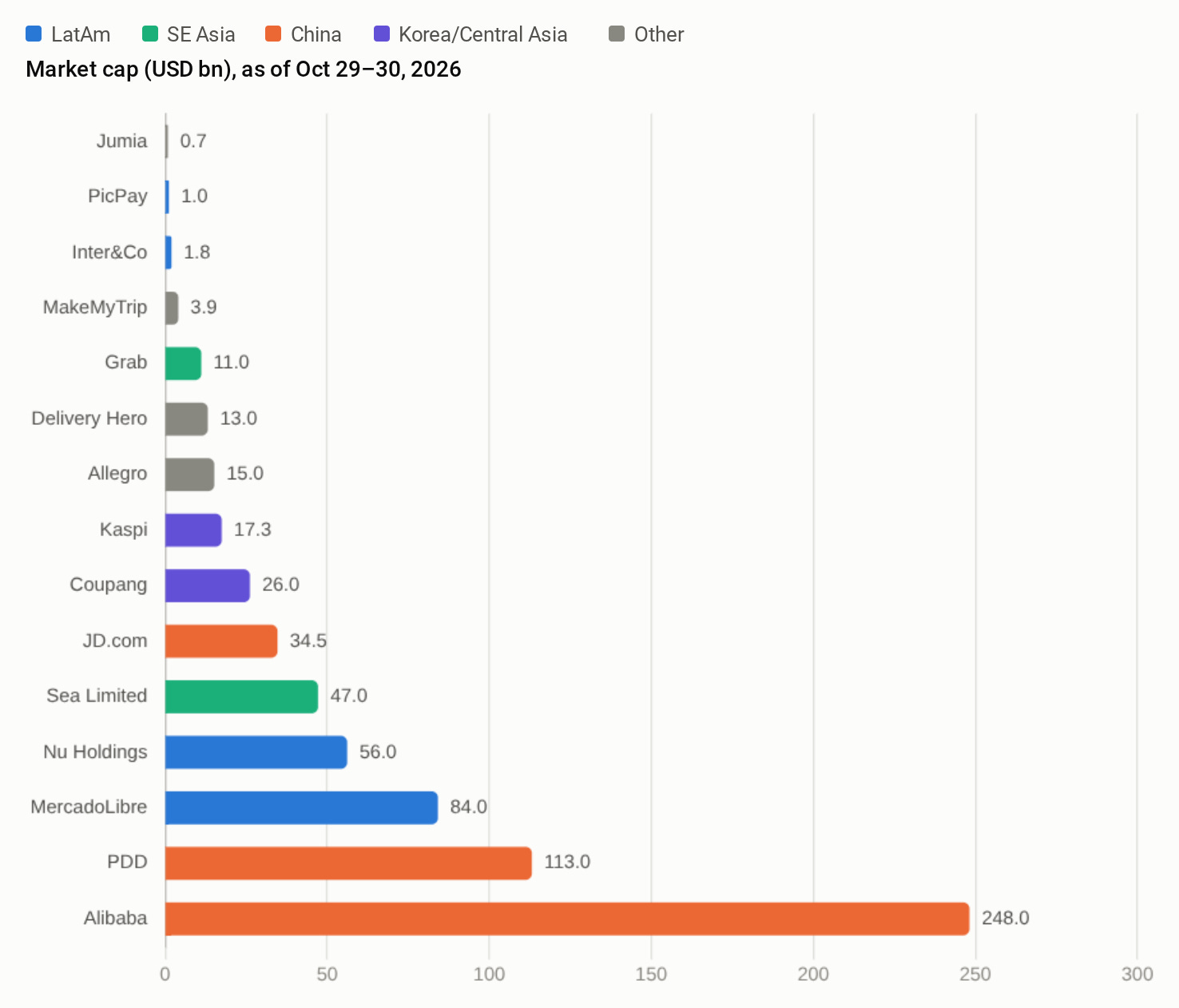
We have Jumia, the African Ecommerce company, MakeMyTrip which is like booking in India, PicPay, Inter&Co and Nu holdings which are Brazilian Fintech, Grab: Uber for South East Asia, Delivery Hero, some sort of Uber eats, Allegro - Amazon for Poland, Kaspi - Some sort of Alibaba in Kazakhstan and Turkyie, Coupang - Amazon for Korea, JD - Amazon for China but with a lower competitive advantage, Sea limited- Ecommerce in South East Asia, Mercado Libre - some sort of Amazon for Latin America, PDD and Alibaba - Ecommerce in China and oveseas.
We can clearly see that Jumia in Africa is the smallest at 0.7 billion USD, while Chinese giants Alibaba and PDD dominate the market cap ranking ($243 billion USD for Alibaba) but they are still very small compared to Amazon ($2590 billion USD).
Two Brazilian Fintech, PicPay and Inter&Co, are among the smallest market capitalisations in the ranking. This could highlight an opportunity.
Another point I notice is that the vast majority of these companies are under the 100 billion USD market capitalisation figure, which is quite stunning giving the size of the opportunity, and many are under 50 billions.
In South East Asia, Sea limited dominates e-commerce and has a market cap of 47 billion USD, with a market of over 600 million customers.
In China, you have 1400 million customers split between 4 or 5 e-commerce companies, which also have an overseas business growing and for some a cloud business.
2-Companies per revenue
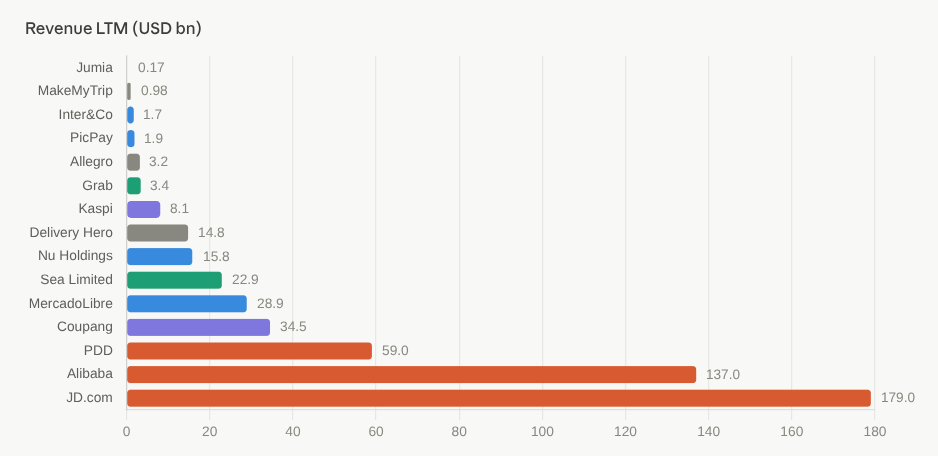
In terms of revenue we can see again the Chinese e-commerce giants being heads and shoulders above the rest.
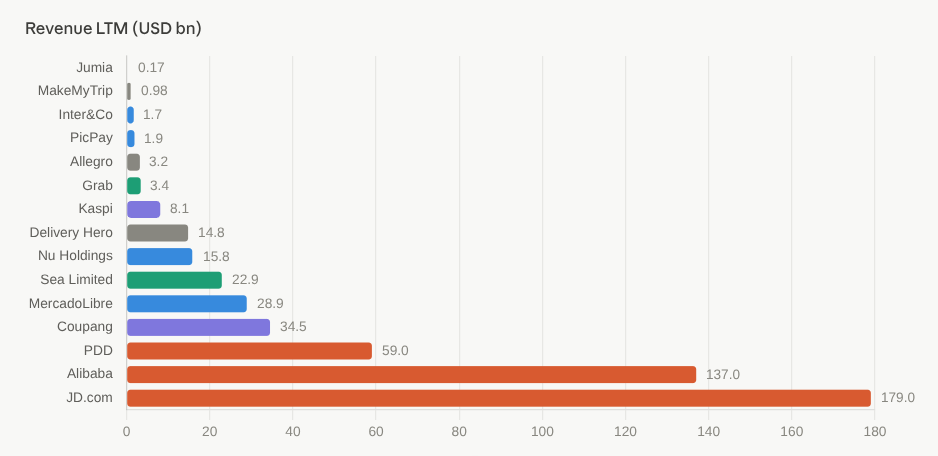
JD.com is first, but revenue is not the best way to compare JD, Alibaba and PDD. JDoperates on a first party business model and mostly sells the merchandise itself, while the others let third party merchants and only take a fee on the sale. GMV would be the best comparative between the three. China dominates the ranking.
On the other hand, Jumia in Africa and MakeMyTrip in India are really really small.
3-Companies per active users (2025):
(Ecommerce branch for Sea limited).
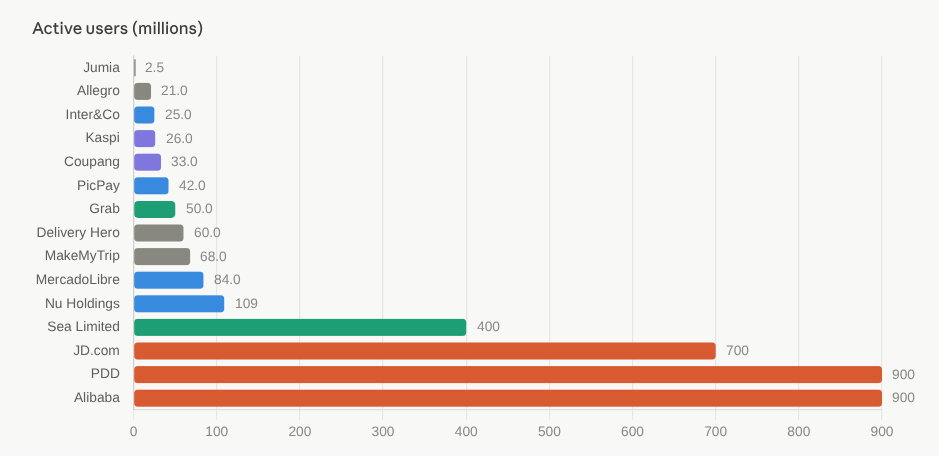
Again, China is number one. This is truly another scale.
Sea limited (E-commerce branch) comes as second behind China in South East Asia.
Latin American countries are behind, and last are Eastern Europe and Africa.
4-Total Adressable market (TAM)
Note that here for PDD and Alibaba, I put the almost the whole world at 6 Billion people, due to them being offensive with Temu, Aliexpress, and for Alibaba local acquisitions in Turkyie and South East Asia.
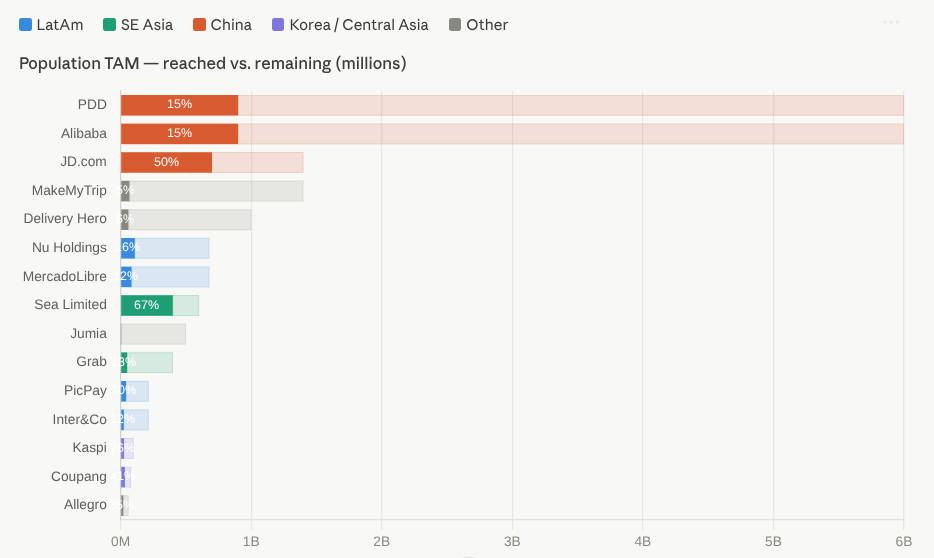
We see the scale of China. What shows up is that JD and Sea limited are much closer to their total addressable markets than the others. It’s difficult to see Coupang as it is small, but it’s well penetrated too.
This leads us to our next chart: the percentage penetrated: this is a rough estimate again.
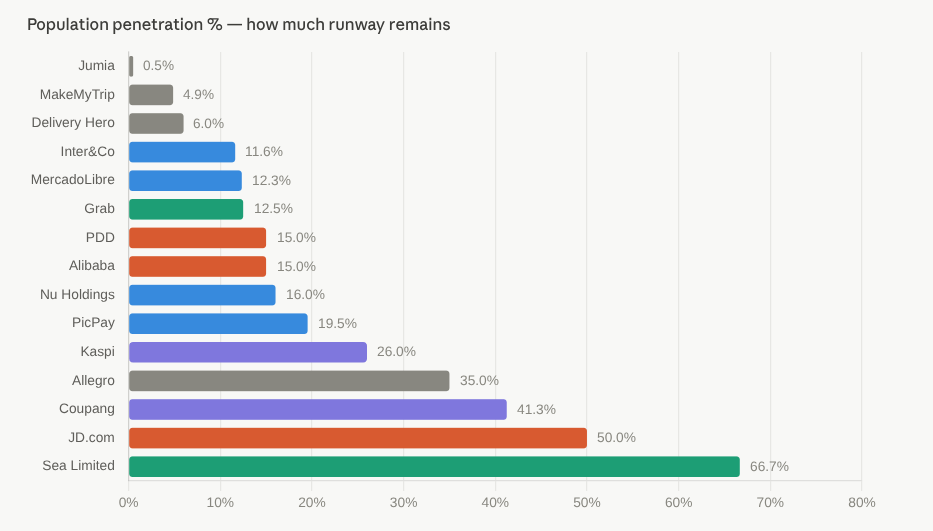
Sea limited is at a high percent, but I did not include Brazil here in the definition of TAM. Nevertheless it is very well penetrated in terms of TAM, even thought it does not disclose separately the E-commerce and Videogames business.
Mercado Libre is very under penetrated, which kind of surprised me as it has a large user base and market capitalisation, but Latin America has over 700 million people. This is a sign that there is more growth to come.
Makemytrip (India) is also under penetrated, and the winner is Jumia, which has penetrated a tiny tiny part of the African population. Being so small, they seem to have the largest growth potentials, but they also are so small that the business models are not proven their ability to capture the growth flywheel yet.
Pure fintech like Nu, Picspay and Inter&Co apper low, but they may never reach 80% of the population penetrated as people don’t use fintech as much as they use dominant e-commerce websites.
5-Price to Sales
Price to sales is a good indicator of value. It looks at what we pay for the companies Sales.
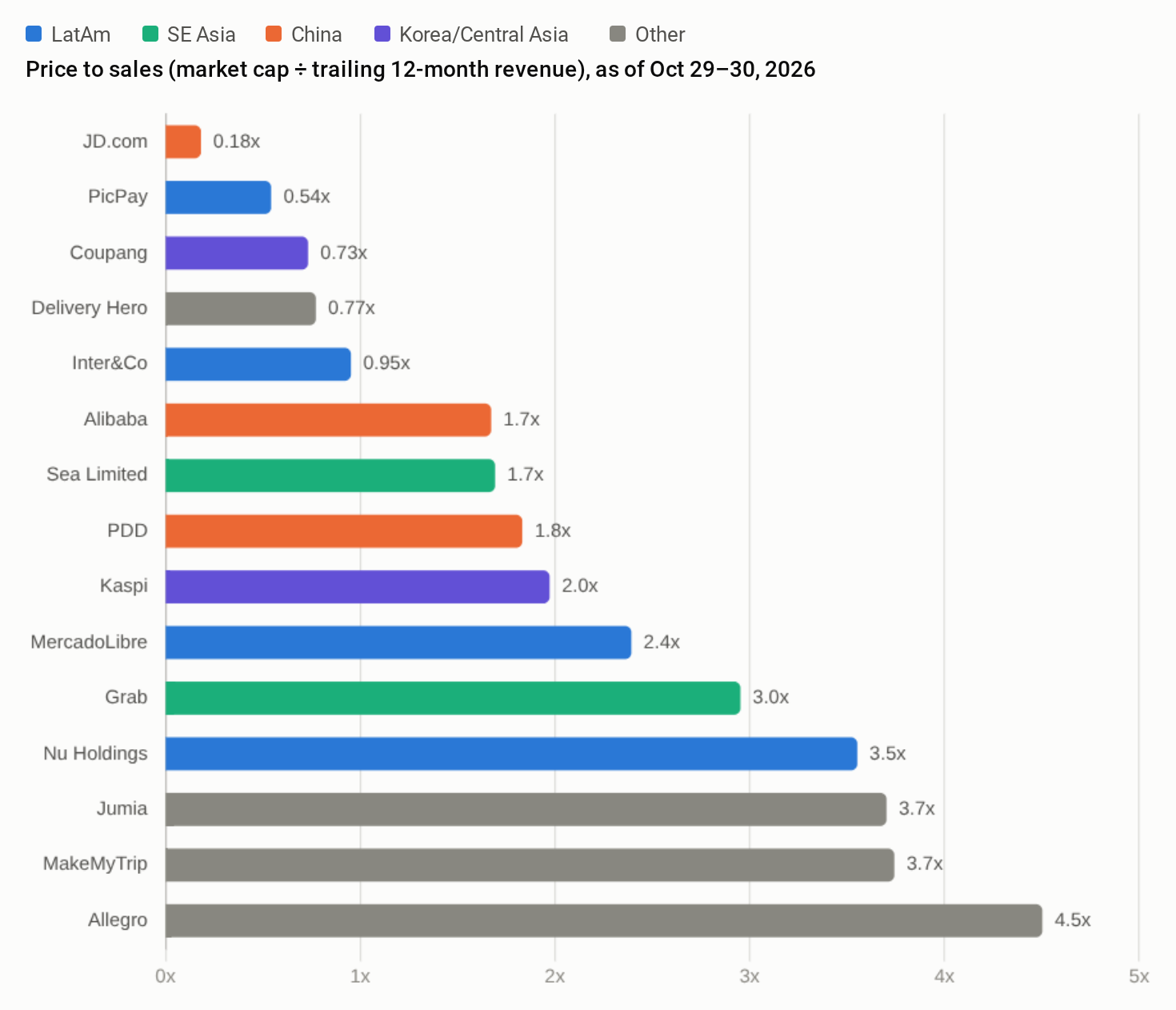
JD is the cheapest because its not really a marketplace business but a direct operating merchant. But it’s very cheap on this regard too.
Alibaba and SEA, as marketplaces are cheap. Brazilian Fintech Inter and Picpay are cheap.
6-Revenue per user
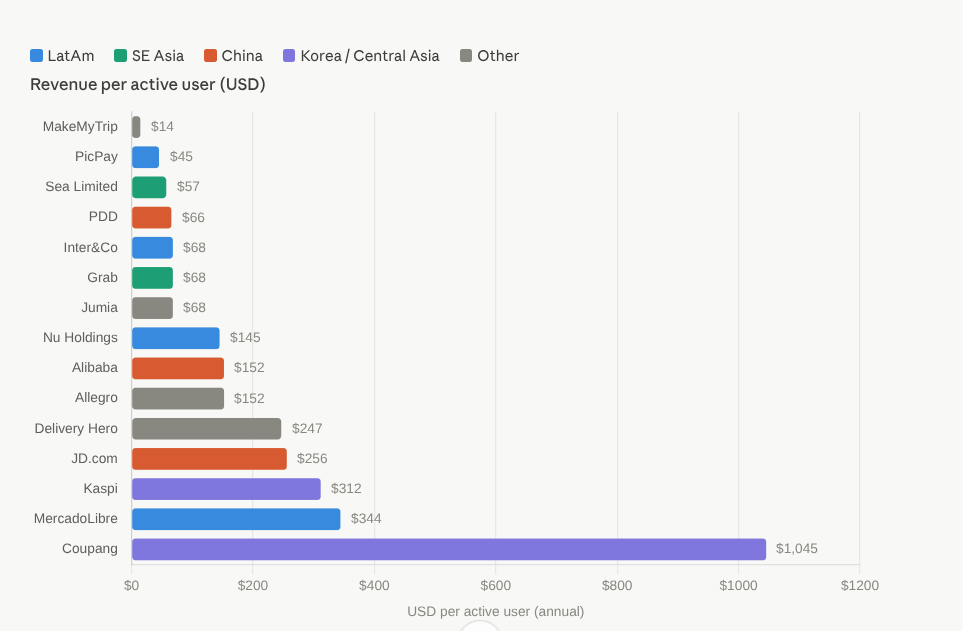
Coupang has a lot of revenue per user due to its dominance in South Korea and first party commerce sales too.
Mercado Libre and Kaspi are doing very well here.
Nu is impressive for a fintech.
We have then a group of companies, Jumia, Grab, Inter, PDD, with different business model and low revenue per user.
7-Market cap per active user
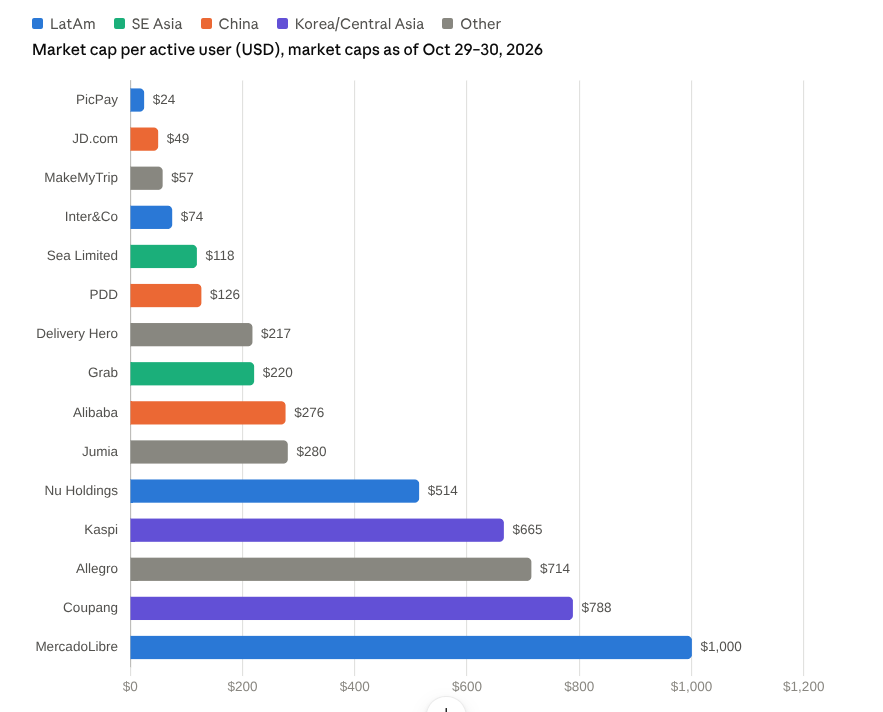
Combining this, we can find the stocks where you pay a lot per active user. Mercado Libre, the investor pays around $1000 per active user. The active user is of course well monetized by Mercado Libre.
We saw earlier that Mercado Libre has a runway to grow active users because Latin America has 600 million people and it only has 89 million monthly active buyers.
Picpay and JD.com are the companies where you pay the least for active users.
Conclusion
All this serves as an introduction to research these companies deeper.
You can find good value in low P/E ratio and low P/S ratio stocks.
Then you can find good growth potential in companies where the total addressable market is much bigger than the current active user base: The largest Example is Jumiain Africa. Therefore, if you think that Jumia will grow profitably into its TAM, you can find that it would be a multibagger from there.
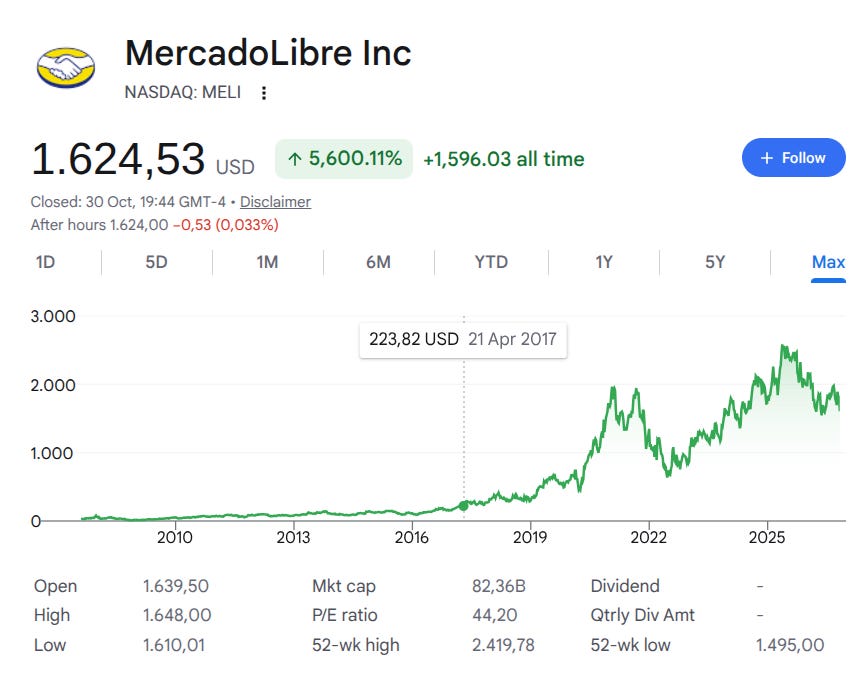
For example Mercado Libre in the 2010s when it was still very small, was a multibagger because it was super small compared to its total addressable market.
You can look at companies where the revenue per user is very low, and this is an opportunity to sell more products and services to the users.
Lastly you can find value where you pay very little for the active users as an investor.
All this framework is an introduction, a mindset to have when reviewing these companies, on top of the classic value investing mindset of low price to earnings, to book and to sales.
On my Substack at Emerging Value, I analyse these companies one by one to find the best investment cases around the EM world, going where the crowd is afraid to go. I aim to provide the most complete coverage of Emerging Market stocks.
I mostly focus on EM stocks listed on the main exchanges such as the NYSE, the NASDAQ, London, and Hong Kong, and I balance my very large Emerging Markets exposure with some developed markets Hidden champions.
If you are interested, please have a look at my publication and subscribe. Thanks Macro Notes for the opportunity.