

Right now, I’m taking a closer look at AI infrastructure in China.
It’s probably the subject I’ve been asked to cover the most over the past month.
So I started researching it using our usual approach at Macro Notes: a global, top-down macro investing approach.
And during that research, one company in particular caught my attention: Zhongji Innolight.
If you’ve never heard of it, Zhongji Innolight is a Chinese company specializing in optical transceivers, among other products. These components are used to transmit data at extremely high speeds within networks and computing infrastructure.
The company published its latest results on October 29, and they’re quite extraordinary.
Between January–September 2025 and the same period in 2026, revenue increased from approximately RMB 25 billion to RMB 69.55 billion.
That’s an increase of 178% in just one year.
Already pretty impressive.
But what’s even more remarkable is the increase in net profit attributable to shareholders, which went from approximately RMB 7.13 billion to RMB 22.24 billion.
We’re talking about growth of almost 212% over the same period.
If you regularly analyze companies, you know how common it is to see revenue increase significantly without profits following at the same pace.
That’s why I find the profit figure particularly interesting. Here, both revenue and profitability are growing exceptionally fast.
Of course, these results alone don’t tell us whether Zhongji Innolight is an attractive investment today. Its valuation may already reflect several years of exceptional growth.
But they raise a question worth investigating.
Is this an isolated success, or are similar conditions developing elsewhere in China’s AI infrastructure supply chain?
Throughout 2025, one of my main research themes was AI infrastructure, with a particular focus on fiber optics.
I published several editions on the subject, but I also carried out much more extensive research and built industry datasets for institutional clients.
However, both in my institutional research and in Macro Notes, I was mainly focused on Western markets, particularly the United States.
And I completely overlooked the Chinese market.
What we observed in the fiber-optics industry was that when a technology starts developing at scale, certain suppliers can experience a disproportionate acceleration in revenue.
It often takes time to increase the manufacturing capacity of sophisticated components. Meanwhile, demand can grow much faster than supply.
We studied this in The $73 Billion Fiber Optics Thesis, and we’ve continued tracking its development through our index on Macro Notes Terminal, recently renamed AI Optical Chain.
The investment thesis was relatively simple.
As AI computing clusters become larger, connecting all those processors becomes increasingly difficult.
A data center can have thousands of extremely powerful GPUs, but if they cannot communicate fast enough, much of that computing power is wasted.
At a certain point, electrical connections become less practical for some high-bandwidth links, and optical interconnects become increasingly important.
This creates demand for optical fibers, transceivers, lasers, networking equipment, and other components.
And the industry has been growing exceptionally fast.
According to LightCounting, shipments of 800G PAM4 chipsets nearly tripled in 2025, with sales more than doubling. The research firm also expected shipments of complete 800G optical transceivers to more than double in 2026.
These are different components and measures, but both show how quickly demand for advanced optical networking has been developing.
Our AI Optical Chain index follows this thesis through companies involved in different parts of the supply chain, including Corning, Ciena, Coherent, and Lumentum.
As of our October 21 update, the index had generated a cumulative return of approximately 420%.
That’s an impressive historical performance, but the return isn’t really the point.
What matters is being able to follow how the investment thesis develops: when the fundamentals improve, when valuations become less attractive, and when new developments justify changing a position.
That’s why we built Macro Notes Terminal.
Instead of reading about an opportunity once and then trying to follow everything yourself, you can access the index, examine its documented holdings and transactions, and follow the updates as the underlying thesis evolves.
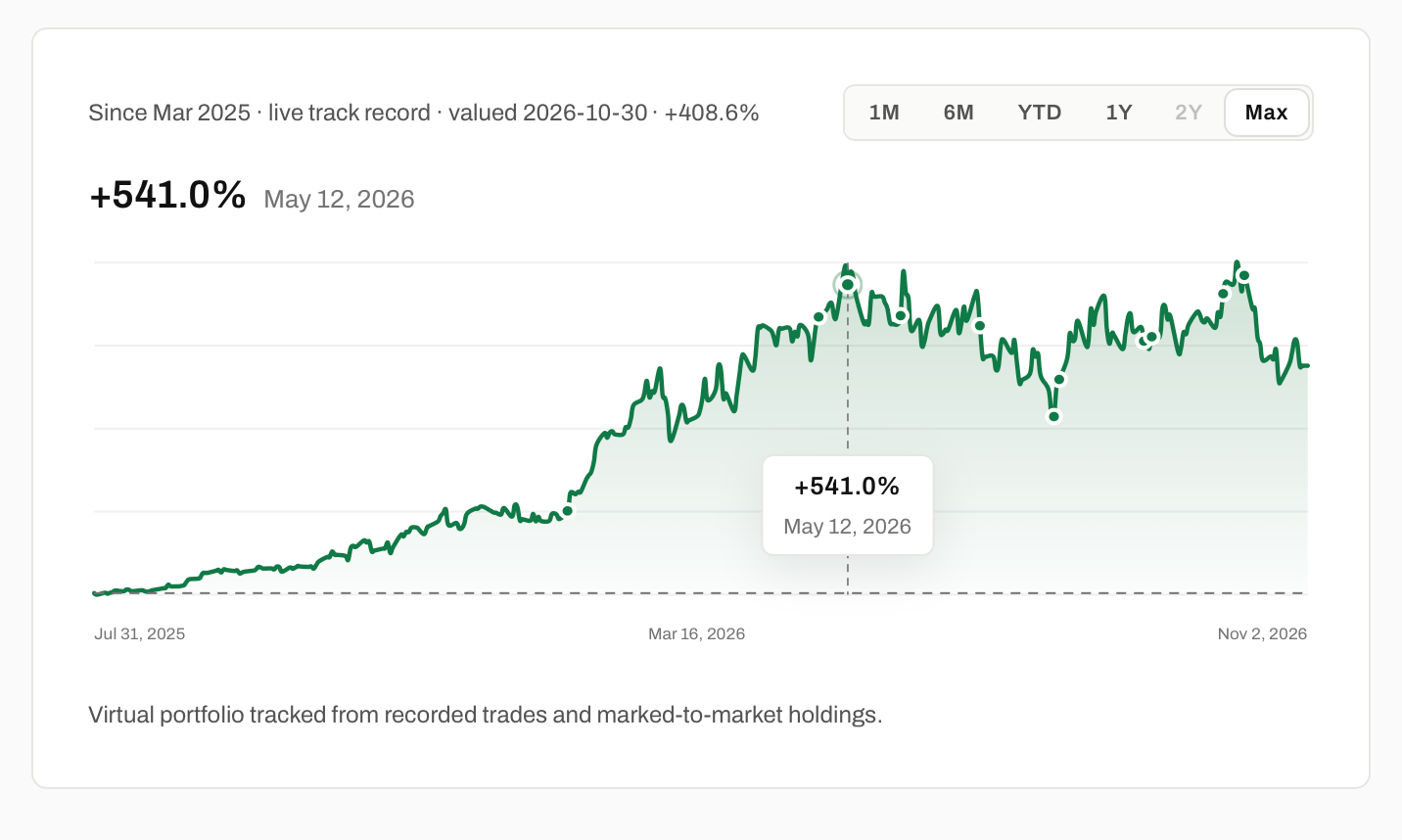
Caption: AI Optical Chain — Macro Notes Terminal. Historical performance, portfolio holdings, and thesis updates. Past performance does not guarantee future results.
What the American AI Infrastructure Boom Taught Us
I think the fiber-optics thesis is a good example of the opportunities that can emerge when an industry grows faster than its suppliers anticipated.
But it wasn’t the only one.
Take Micron Technology.
At the end of 2024, Micron shares were trading at approximately $84.
By December 31, 2025, the stock had reached $285.
That’s a gain of roughly 240% in twelve months.
And Micron wasn’t alone.
SanDisk, Western Digital, and Seagate also experienced extraordinary stock-price appreciation as investors began recognizing how important memory and storage would become to the AI infrastructure buildout.
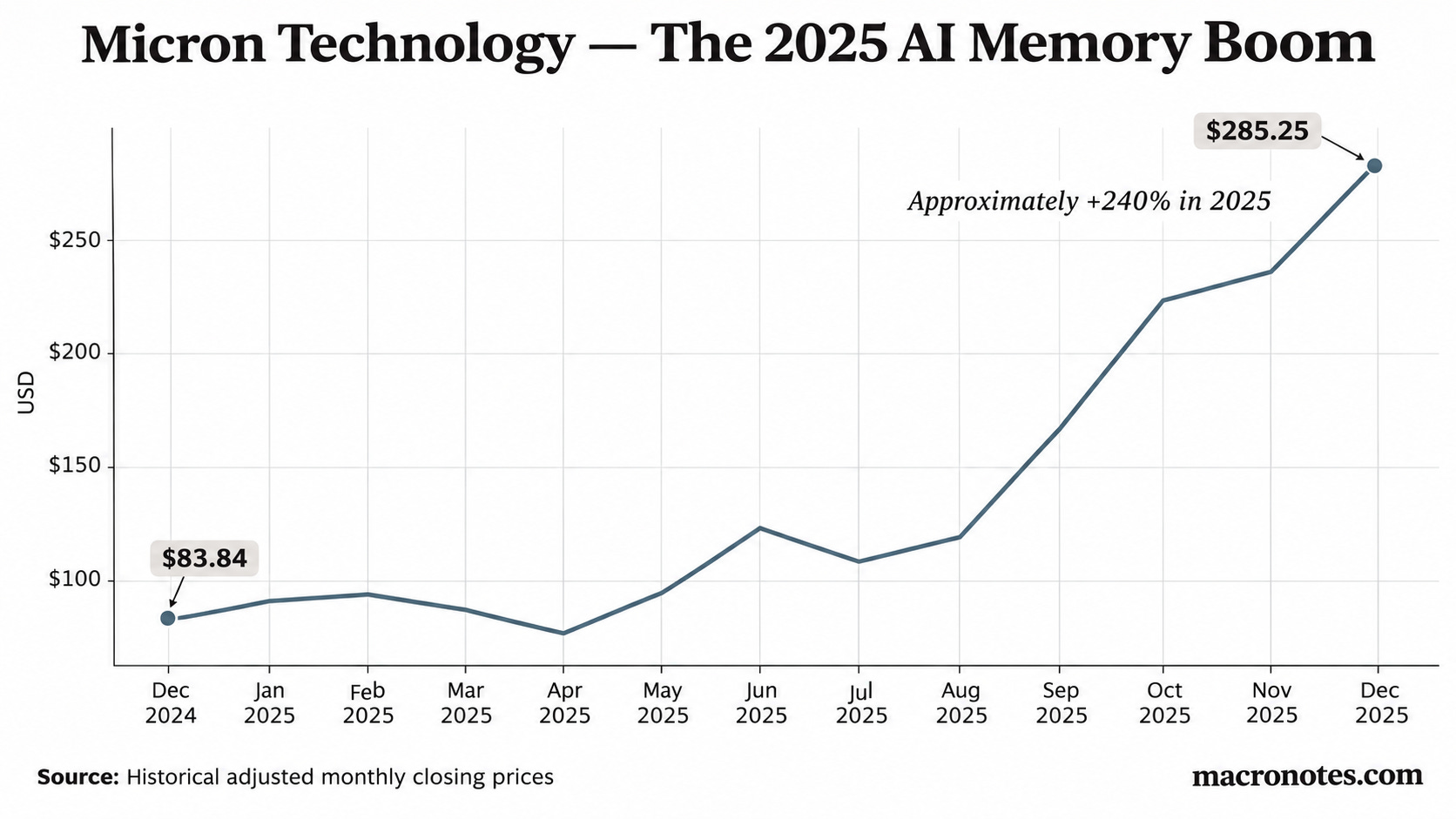
Micron Technology’s adjusted share-price performance during 2025. Source: Historical monthly closing prices.
What makes these examples interesting for investors is that you didn’t need to predict which AI model would eventually become the most successful.
Whether OpenAI, Google, Anthropic, or another company develops the leading models, they all require computing infrastructure.
And that infrastructure requires memory, connectivity, storage, electricity, and cooling.
Of course, different technologies have different requirements, and suppliers don’t all benefit equally.
But understanding what an entire industry needs as it grows can help you discover investment opportunities beyond the companies receiving most of the attention.
Take high-bandwidth memory.
Modern AI accelerators require enormous amounts of memory bandwidth to process information efficiently. As hyperscalers build larger computing clusters, their requirements for specialized memory increase.
But semiconductor manufacturers can’t simply double production whenever demand accelerates.
Expanding manufacturing capacity requires substantial capital, specialized equipment, and time. Producing more advanced chips introduces additional technical challenges.
When demand grows faster than available supply, prices can rise, manufacturers can shift toward higher-margin products, and profits can increase much faster than revenue.
That’s how an industry that once looked relatively mature can suddenly become one of the most interesting parts of a major technological investment cycle.
The same reasoning applies to optical networking, where the need to connect increasingly powerful computing clusters is supporting demand for advanced components.
For investors, this offers a useful way to approach emerging technologies.
Instead of investing in a company simply because it belongs to a fast-growing industry, you can examine which products that industry increasingly depends on, how difficult they are to manufacture, and whether their suppliers have enough pricing power to benefit.
Of course, there’s another side to this opportunity.
Once everyone recognizes the same trend, valuations can move much faster than the underlying businesses.
And we’re getting another reminder of that now.
Why I Don’t Confuse a Correction With the End of a Thesis
October was a difficult month for American technology stocks.
The S&P 500 technology sector declined 6.8%, its largest monthly fall since March 2025, as investors became increasingly concerned about the enormous amounts of capital being invested in artificial intelligence.
And naturally, the bubble debate is back.
I understand why.
Some AI infrastructure stocks have appreciated several hundred percent. Hyperscalers are committing extraordinary amounts of capital, and investors have been willing to pay increasingly high valuations for companies exposed to the same opportunity.
But personally, I think we’re often too quick to call something a bubble whenever stock prices begin falling.
There’s an important difference between a company becoming too expensive and its underlying business becoming fundamentally weaker.
Imagine a company growing revenue by 60% annually because demand for its products is increasing rapidly.
Investors recognize the opportunity, its valuation rises, and eventually the market begins pricing in several more years of exceptional growth.
Then the company reports another strong quarter, but slightly below those expectations.
Its stock could fall 30% even though demand remains strong and the business continues growing.
In that situation, the problem may simply have been the valuation.
And I actually welcome corrections like that.
When everyone wants a piece of the same opportunity, prices can get ahead of fundamentals. Corrections sometimes bring valuations back to more reasonable levels.
For someone looking to invest in a business over several years, that distinction can be very important.
A falling share price doesn’t automatically make a stock cheap, of course. But if the underlying business continues improving while its valuation becomes more reasonable, the balance between potential returns and risk may become more attractive.
Sometimes, however, the problem goes much deeper.
During the dot-com bubble, investors were pricing businesses on extraordinary expectations for future revenues and profits. Many companies had no sustainable business model.
When financing became harder to obtain, a large number disappeared.
Amazon also lost more than 90% of its market value during the collapse, even though the long-term opportunity behind e-commerce was real.
The subprime crisis was different. The financial system had built enormous exposure to risky mortgages, often relying on assumptions about house prices and borrowers’ ability to repay that ultimately proved unsustainable.
A bubble can develop around a genuine opportunity. The technology may be valuable while the businesses, financing structures, or valuations built around it are not.
That’s why I prefer looking at fundamentals rather than trying to label an entire industry.
If you’re evaluating an AI infrastructure company today, the questions worth asking are fairly straightforward.
Is demand for its products still growing? Is that demand translating into higher revenue and profits? How much capital is needed to maintain that growth? And how much of the future opportunity are you already paying for in the share price?
Those questions become particularly important after an industry has experienced a major rally.
I expect we’ll see more corrections in AI infrastructure over the coming years. Some businesses will continue growing, others may face overcapacity or margin pressure, and some may never justify their current valuations.
But I don’t think the opportunity disappears simply because the market becomes more selective.
And that brings me back to China.
While investors are questioning the sustainability of American AI infrastructure spending, China is developing an investment cycle of its own.
The interesting question is whether its underlying demand, financing, and supply constraints could create opportunities that investors have not yet fully recognized.
How Fast Is AI Demand Really Growing in China?
Before getting into the infrastructure itself, we need to understand how much demand exists for the computing capacity China is building.
It’s relatively easy to announce new data centers, investment programs, or ambitious technology initiatives.
But an investment thesis becomes much more convincing when the demand behind those projects is visible in actual usage and financial results.
One figure published by China’s National Data Administration caught my attention.
At the beginning of 2024, China was consuming approximately 100 billion AI tokens per day.
By the end of 2025, that figure had reportedly reached 100 trillion.
And by March 2026, it had exceeded 140 trillion tokens per day.
That’s an increase of more than 1,000 times in just over two years.
Even between December 2025 and March 2026, reported daily consumption increased by more than 40%.
Now, we should be careful with this figure.
These are official Chinese statistics, and the methodology isn’t fully transparent. Token consumption doesn’t represent a fixed amount of revenue, and an increase in usage doesn’t necessarily translate into a proportional increase in infrastructure spending.
Still, the scale of the growth makes it worth looking at what Chinese technology companies are reporting in their financial statements.
And the results are encouraging.
In August 2026, Alibaba reported that its AI Cloud and Compute Services business had generated approximately $7.1 billion in quarterly revenue, up 45% year over year.
Its cloud segment’s adjusted operating profit increased even faster, rising 133% to approximately $830 million.
That’s an encouraging combination.
We’re seeing substantial revenue growth alongside an improvement in adjusted operating profitability.
Of course, that doesn’t tell us how much capital Alibaba needs to invest to sustain that growth. Operating profit and return on invested capital are two different things.
But it provides evidence that at least part of the increase in computing demand is already generating meaningful commercial activity.
Baidu provides another useful example.
In the second quarter of 2026, its AI Cloud Infrastructure revenue increased 50% to RMB 7.3 billion.
Within that business, GPU Cloud revenue increased 283% year over year, compared with growth of 184% in the previous quarter.
That’s particularly interesting because GPU Cloud is directly exposed to customers paying for AI computing resources.
We now have several indicators pointing in the same direction.
Reported AI usage is expanding rapidly, cloud providers are generating substantial revenue growth, and demand for GPU-based cloud services appears particularly strong.
There are limitations to each of these figures, but together they give us a much better foundation for studying China’s AI infrastructure market.
And they help answer an important question for anyone considering investing in the sector.
Is China building infrastructure for demand that might eventually appear, or is there already enough commercial activity to justify expanding computing capacity?
The evidence increasingly points to real and growing demand.
That doesn’t mean every investment will be profitable, but it gives us a reason to examine the companies supplying the infrastructure more closely.
There’s also an important difference between how AI is developing in China and the model we’re familiar with in the United States.
China’s Open AI Model
One of the most interesting developments in Chinese AI has been the rapid expansion of open-weight models.
DeepSeek and Alibaba’s Qwen are two of the most recognizable examples.
Unlike a system that can only be accessed through a proprietary API, open-weight models can often be downloaded, adapted, and deployed on computing infrastructure chosen by the developer.
This can make adoption considerably easier for businesses.
A manufacturer might use a model for quality control. A financial institution might run specialized AI applications within its own infrastructure. A software company could develop products without relying exclusively on one proprietary model provider.
And as the cost of using capable AI models decreases, more applications become economically viable.
We’re already seeing how quickly this ecosystem is developing.
In its spring 2026 report, Hugging Face estimated that Chinese-developed models accounted for approximately 41% of model downloads on its platform over the preceding year.
That’s a remarkable share, although downloads on Hugging Face don’t represent total global AI usage or market share.
Alibaba also reported in August that its Qwen models had accumulated more than 3 billion downloads globally, with developers creating over 300,000 derivative models.
Again, these aren’t paying customers. But they demonstrate how widely the technology is spreading among developers.
The consequences for infrastructure spending could be significant.
If capable models become cheaper to run, more companies may start deploying AI in situations where the economics previously didn’t make sense.
That could increase the number of applications running in the cloud, on private servers, or within industrial computing systems.
But there’s an important complication.
More efficient models also require less computing power for individual tasks. Some applications will be able to run on smaller systems or directly on devices.
So growing AI adoption doesn’t automatically mean that every type of infrastructure will experience the same increase in demand.
Training large models and running millions of smaller inference workloads can require very different hardware configurations.
And this distinction matters when selecting companies.
A supplier of advanced networking equipment used in large training clusters may benefit from a different investment cycle than a business selling equipment for distributed inference systems.
If you simply assume that more AI usage means more demand for every component, you risk overlooking these differences.
The more useful question is which types of infrastructure will become increasingly important as AI moves from model development into broader commercial adoption.
And Chinese companies are already committing substantial amounts of capital to support that transition.
China’s $139 Billion AI Infrastructure Expansion
In September, Rhodium Group published a detailed report examining the financing of China’s AI industry.
The researchers studied 13 major Chinese companies involved in cloud computing, telecommunications, AI development, and data centers.
They estimated that AI infrastructure capital expenditures across those companies could reach RMB 932 billion, approximately $139 billion, in 2026.
That’s an increase of 103% compared with the previous year.
For 2027, Rhodium projects that spending could exceed RMB 1.2 trillion, or approximately $193 billion.
These are estimates, not completed investments, and they cover the companies examined in the report rather than every business in China.
But the scale of the increase is significant.
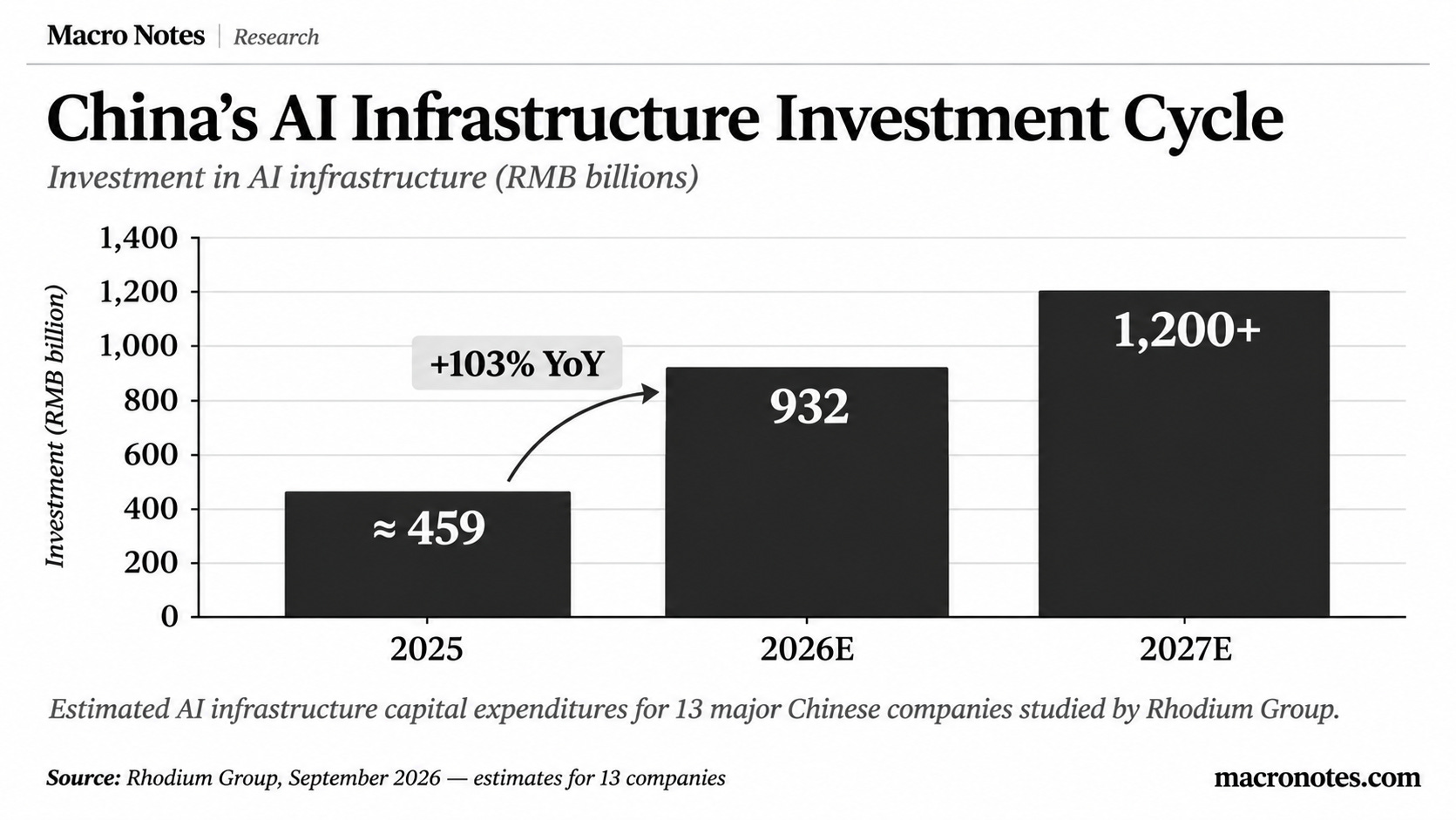
Estimated AI infrastructure capital expenditures for 13 major Chinese companies studied by Rhodium Group. The 2025 figure is derived from the reported growth rate; 2026 and 2027 are estimates.
To put this into perspective, Rhodium estimates that China’s AI infrastructure investment remains around 15% to 20% of the American buildout.
That doesn’t mean China will eventually spend as much as the United States. The markets have different cost structures, computing requirements, and financing models.
But it gives us an idea of the scale of the expansion underway.
And for investors, the opportunity goes far beyond the companies constructing data centers.
All that spending moves through a much larger industrial supply chain.
Companies need accelerators, servers, memory, networking equipment, cooling systems, and electricity infrastructure.
Some suppliers will sell directly to cloud providers. Others will provide components to server manufacturers or networking companies.
And the amount of value captured by each supplier can vary considerably.
A business operating in a highly competitive market may experience significant revenue growth without improving its margins.
Another supplying a technologically difficult component with limited competition could potentially capture a much larger share of the economic value created.
That’s why the total amount of infrastructure spending isn’t enough to identify an attractive investment.
We also need to understand where the money goes, who supplies the equipment, and which companies have the strongest ability to convert additional demand into profits.
There’s another question that deserves attention.
Who is going to pay for all this infrastructure?
Rhodium found that Alibaba, Tencent, and Baidu recorded combined negative free cash flow of approximately RMB 16 billion during the first half of 2026.
These are large businesses with different financial resources, so the figure doesn’t mean they’re unable to continue investing.
Still, it shows that the expansion is consuming substantial capital.
Chinese AI infrastructure is being financed through a combination of corporate investment, equity financing, bank lending, and government-supported investment.
Public financing is particularly important in strategic technologies, including advanced semiconductors and domestic computing capabilities.
For an investor, understanding the financing structure matters almost as much as understanding demand.
A supplier receiving orders from a financially strong customer with years of committed investment may have very different prospects from a company depending on projects that require continuous subsidies or external financing.
And if capital becomes harder to obtain, some projects could be delayed or cancelled even while the overall market continues growing.
This is one of the risks we need to consider when evaluating Chinese infrastructure companies.
A growing industry can still generate disappointing shareholder returns if too much money is invested in capacity that customers don’t need or cannot afford to use.
In fact, we’re already seeing signs of that problem in China.
China’s AI Infrastructure Paradox
Here’s one of the findings that surprised me during the research.
Despite the enormous increase in AI usage and the expansion in infrastructure investment, some Chinese computing centers are already struggling with very low utilization rates.
In July 2026, the U.S.-China Economic and Security Review Commission reported that certain AI computing centers in China had utilization rates below 30%.
That means some facilities were using less than a third of their available computing capacity.
It’s an interesting contradiction.
How can demand for AI computing be growing so quickly while parts of the existing infrastructure remain largely unused?
After looking more closely at how China developed its data-center industry, the answer starts to make sense.
China has spent years encouraging the construction of computing infrastructure through programs such as Eastern Data, Western Compute.
The objective was partly to develop computing capacity in regions with available land and energy resources.
But some of the facilities that were built don’t necessarily match the requirements of modern AI applications.
A data center equipped with older processors may struggle to run advanced AI workloads efficiently.
A facility with insufficient networking capacity may not be suitable for large-scale training.
And a remote data center may be less useful for applications requiring very low latency.
So China can have excess computing capacity in some areas while still facing shortages of the infrastructure required for more advanced workloads.
For investors, this distinction changes the way we should evaluate the market.
You could invest in a Chinese data-center operator expecting to benefit from rising AI demand, only to discover that its facilities are competing in a market where there is already excess capacity.
Meanwhile, a company supplying the advanced components needed to make computing clusters more efficient could be experiencing an entirely different demand cycle.
Both companies might be classified as AI infrastructure businesses.
But their financial prospects could be very different.
And that’s why understanding the industry at the component level matters.
It’s becoming relevant to government policy as well.
According to the same USCC report, Chinese authorities have introduced additional restrictions and approval requirements for certain new data-center projects, partly to reduce inefficient construction.
That suggests the next phase of infrastructure investment may be more selective than the previous one.
Simply building more data centers won’t necessarily solve the industry’s problems.
Improving the performance, efficiency, and suitability of computing infrastructure may become just as important.
And some of China’s technological limitations make the situation even more interesting.
Take high-bandwidth memory, or HBM.
On October 28, Reuters reported that Chinese memory manufacturer CXMT was preparing to begin limited production of HBM3E, an advanced type of memory used in AI accelerators.
According to people familiar with the plans, the company’s manufacturing yields were only around 20% to 30%, compared with approximately 70% at South Korea’s SK Hynix.
Manufacturing yield is the proportion of chips produced that meet the required specifications.
At a 20% yield, only one in five chips is usable.
That creates a substantial cost disadvantage and limits the amount of memory the manufacturer can supply.
These yield estimates haven’t been officially confirmed by the companies involved, but they illustrate the technological difficulties China faces in developing its domestic AI supply chain.
And this is where the paradox becomes particularly important.
Some computing facilities are underutilized, while manufacturers are struggling to produce enough of certain advanced components.
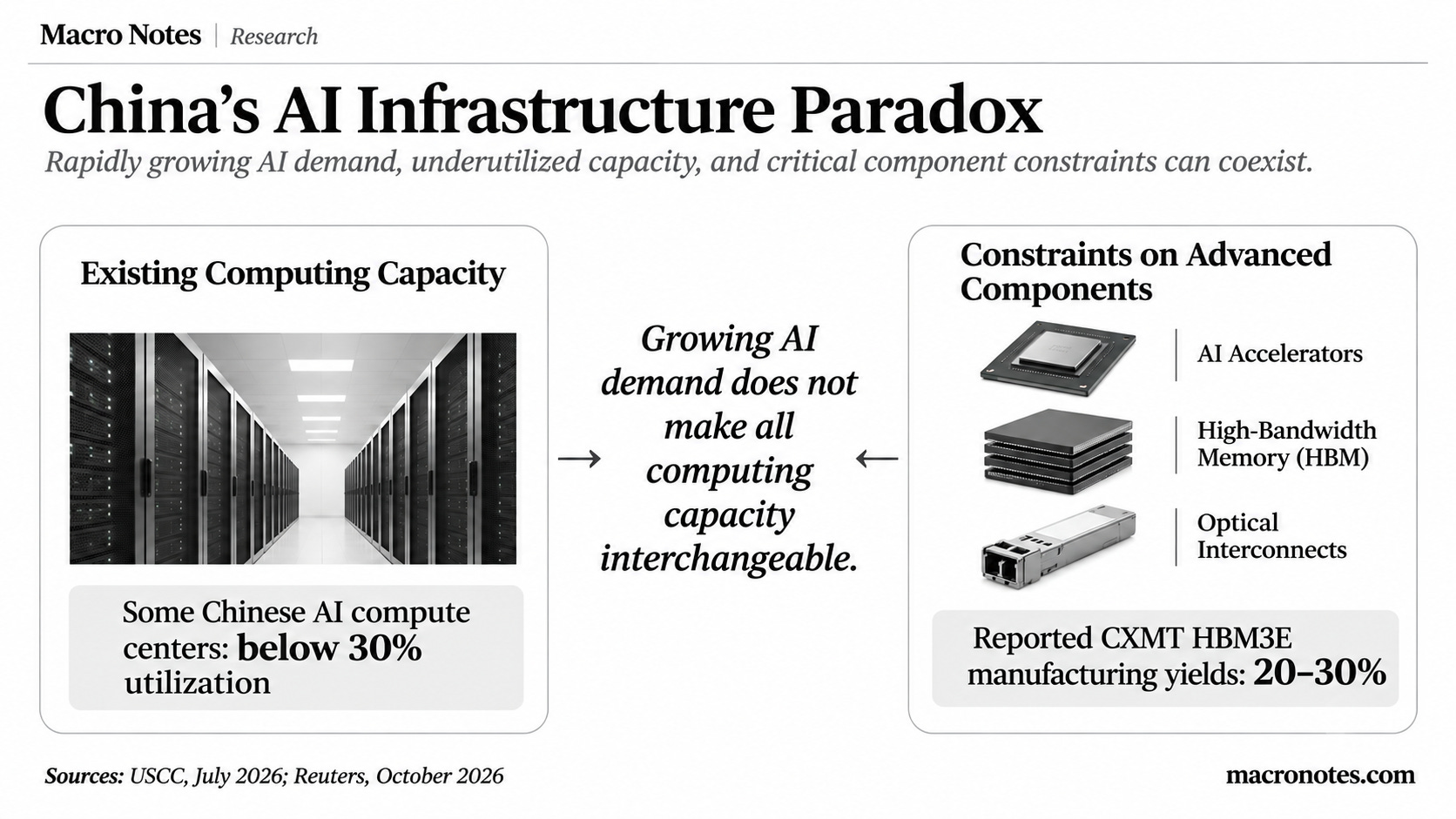
Some Chinese AI computing facilities remain underutilized while advanced hardware manufacturing faces significant constraints. Sources: USCC, July 2026; Reuters, October 2026.
Understanding this difference can help you avoid treating the entire infrastructure industry as one investment opportunity.
There may be excess capacity in one segment and a genuine shortage in another.
The most promising businesses won’t necessarily be those announcing the largest projects or spending the most capital.
They may be suppliers capable of addressing constraints that customers are willing to pay a premium to solve.
That could involve optical interconnects, memory, domestic AI accelerators, networking systems, liquid cooling, or power equipment.
But each of these industries has different economics.
Some shortages could last for years. Others might disappear quickly as manufacturers increase capacity or technologies change.
And even when demand is strong, the financial returns will depend on the company’s production costs, competitive position, and valuation.
This is the kind of analysis that can help distinguish a compelling investment thesis from a business that simply happens to operate in a popular industry.
Which brings me back to Zhongji Innolight.
Two Different Investment Opportunities Behind China’s AI Boom
Remember Zhongji Innolight, the company I mentioned at the beginning?
Its latest results are extraordinary, but I found something else in its financial statements that I think is particularly important for understanding this market.
During the first half of 2026, its optical transceiver revenue increased from RMB 14.43 billion to RMB 41.36 billion.
That’s growth of almost 187%.
Its overall gross margin also improved from 38.7% to 45.8%.
According to the company, part of that improvement came from an increasing contribution of advanced high-speed optical transceivers, which carry higher margins than lower-speed products.
So we’re seeing rapid revenue growth and a more profitable product mix.
But when you look at the company’s geographical revenue breakdown, something else becomes apparent.
94.8% of Zhongji Innolight’s revenue during the first half of 2026 came from outside mainland China.
Revenue from overseas markets increased approximately 210%, while domestic revenue increased only 7.7%.
That’s quite a difference.
One of China’s major AI infrastructure suppliers is generating most of its revenue from international markets.
The company reports these figures by delivery region, so they don’t tell us the exact identity or location of every end customer.
But the geographical exposure is clear.
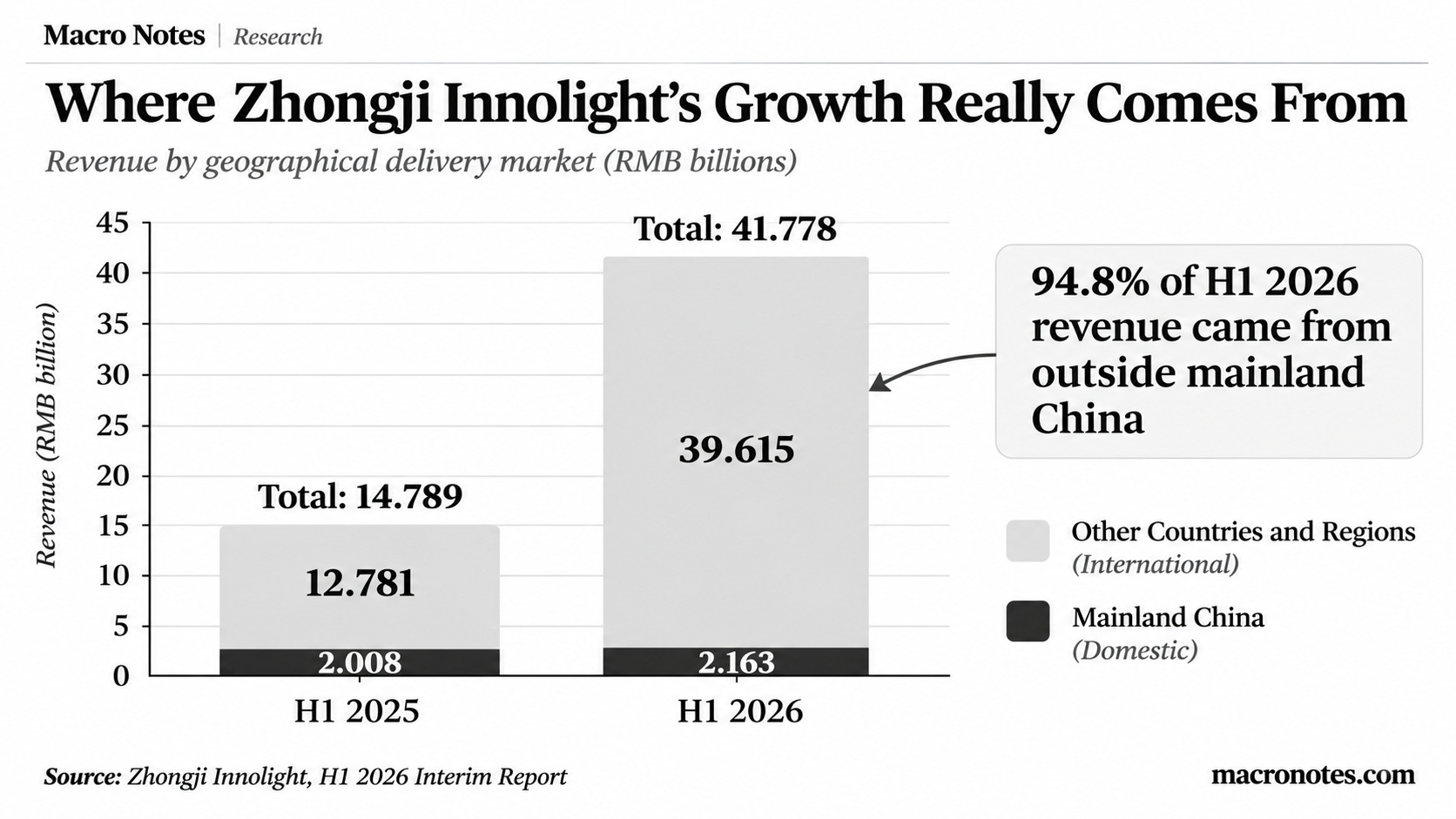
Zhongji Innolight’s revenue by geographical delivery market, H1 2025 versus H1 2026. Source: Zhongji Innolight, H1 2026 Interim Report.
I think this is one of the most useful distinctions for investors looking at China’s AI infrastructure market.
There are actually two different opportunities here.
The first is the development of China’s domestic AI infrastructure.
This includes companies supplying the computing systems, accelerators, memory, networking equipment, and other infrastructure that Chinese businesses will need as AI adoption expands.
Their growth depends on local demand, industrial policy, financing conditions, and China’s ability to develop competitive domestic technologies.
The second is the role of Chinese manufacturers in the global AI infrastructure supply chain.
Companies like Zhongji Innolight can benefit substantially from American and international hyperscaler spending, even if growth in China’s domestic market is more modest.
And those two investment theses don’t necessarily move together.
Imagine you’re looking to invest in the expansion of Chinese AI infrastructure.
You identify a Chinese company with extraordinary revenue growth and strong exposure to AI networking.
But after examining its customer base and geographic revenues, you discover that most of its business depends on international infrastructure investment.
You may still have found an excellent company.
But you’re not necessarily getting the exposure you originally wanted.
If American hyperscalers reduce capital expenditures, some Chinese exporters could face pressure even if China’s domestic AI spending continues increasing.
Conversely, a slowdown in Chinese domestic investment wouldn’t necessarily prevent internationally competitive suppliers from growing if demand remains strong elsewhere.
This is why the company’s country of incorporation tells us relatively little about where its underlying economic exposure actually comes from.
The customers, supply chains, competitive position, and financial statements tell us much more.
And they’re particularly important when the market is valuing companies on expectations of exceptional future growth.
A company growing revenue by 100% or 200% can be an extraordinary business and still be an unattractive investment if its share price already assumes several more years of similar growth.
The question is whether the future returns justify the price you’re paying today.
And that’s what I want to help you evaluate in this market.
We’ve now seen several reasons to take China’s AI infrastructure expansion seriously.
AI usage is growing, cloud providers are generating substantial revenue growth, and capital investment is accelerating.
But we’ve also seen underutilized infrastructure, technological bottlenecks, financing constraints, and significant differences between domestic and international suppliers.
For investors, these differences are important.
They can help explain why two companies operating in the same industry might experience completely different financial outcomes.
And they can help narrow down where the most promising opportunities may actually be.
The next step is to examine the companies, their financial performance, and their valuations.
Because knowing that China is investing heavily in AI infrastructure is useful.
Knowing which businesses can capture that spending, and whether their shares are still attractively priced, is much more valuable when making an investment decision.
That’s where today’s Premium research begins.
In Macro Notes Premium: Finding the Investment Opportunities Behind China’s AI Infrastructure Expansion
If you’re looking for investment opportunities in China’s AI infrastructure market, I think the most important question now is which companies can turn this enormous expansion into sustainable profits—and which ones are still trading at valuations that make sense for investors.
We’ve already seen that demand is growing rapidly. But the market is far from uniform.
Some businesses may benefit from years of investment in advanced computing. Others could struggle with excess capacity, increasing competition, or financing constraints.
And some of the companies benefiting most from AI infrastructure spending in China may actually depend more heavily on international demand.
Understanding these differences can give you a much better foundation for evaluating the opportunities available in the market.
That’s what I want you to take away from today’s Premium research.
Here’s what you’ll be able to examine in the full edition:
Where the demand is actually going. Understand how China’s AI adoption, open-weight models, training and inference are changing infrastructure requirements, so you can distinguish the segments with genuine growth potential from those where additional investment may be less attractive.
Which infrastructure bottlenecks matter most. Examine optical interconnects, advanced memory, domestic AI accelerators, liquid cooling, and power infrastructure to understand where supply constraints could support stronger demand, pricing power, and profitability.
The publicly traded companies exposed to these opportunities. Go beyond the AI narrative with company-level financial analysis, including revenue growth, margins, competitive advantages, customer exposure, balance sheets, and valuations. The goal is to help you build a more informed shortlist rather than simply follow the most popular stocks.
What the current valuations are telling us. Understand what companies would need to achieve financially to justify their market prices, where expectations may already be too optimistic, and which businesses deserve closer attention.
The scenarios and indicators worth monitoring. Explore what could happen if AI adoption continues accelerating, domestic semiconductor production improves, or infrastructure spending slows. You’ll also see the financial and operating signals that could strengthen or weaken these investment theses.
I also want to distinguish companies benefiting primarily from global hyperscaler spending from those more directly exposed to the Chinese domestic market.
I believe this is particularly important because the two opportunities have different growth drivers, financing conditions, and risks.
And the research doesn’t stop when you finish reading.
One of the reasons we built Macro Notes Terminal is that an investment thesis can change considerably over time.
A company might report exceptional growth today, but six months later its valuation, margins, competitive position, or customer demand could look very different.
As a Macro Notes Premium subscriber, you also get access to Macro Notes Terminal, where you can explore our investment thesis indexes, examine documented positions and transactions, and follow new developments as our research evolves.
You also receive our Premium research archive and future editions, covering new investment theses across technology, energy, industrial supply chains, geopolitics, and other structural changes in the global economy.
The idea is to give you more than a collection of interesting investment stories.
We want to help you discover opportunities, understand the businesses behind them, evaluate their risks and valuations, and keep following the evidence as the market develops.
And that’s exactly the approach we’re applying to China’s AI infrastructure.
The American AI boom showed how much value can be created when an industry grows faster than its suppliers can respond.
Now the question is where similar conditions are developing in China, which companies are positioned to benefit, and how much of that potential is already reflected in their valuations.
Let’s get into the companies, their financials, and the investment theses behind China’s AI infrastructure expansion.