


I’ve recently become obsessed with a private company you may have already heard of: Boom Supersonic.
And not because I suddenly became interested in aviation, but because a company whose mission is to bring commercial supersonic flights back has actually developed a very innovative solution to one of the biggest problems facing artificial intelligence infrastructure.
And that’s what I want to talk about today.
Something Elon Musk often says, and which is probably behind his ability to build such successful companies, is that the only laws that are truly real and impossible to change are the laws of physics.
Regulations and laws are very human things. They can be changed, adjusted, or removed.
Physics is the real rule of the game.
And SpaceX is probably the best example of this philosophy: trying to accomplish everything that physics allows. If something is not physically impossible, SpaceX will try to do it.
Boom Supersonic is pursuing a somewhat similar idea. The problem with supersonic travel is regulation and cost. Physics itself is not the problem. Boom’s bet was essentially to say:
If we can build a supersonic aircraft without the traditional sonic boom — which has been one of the main arguments behind restrictions on supersonic flight — then supersonic flights could eventually be allowed again.
And if we can do it at a much lower cost, then it can also become economically viable.
At that point, you can build a profitable business around it.
Since the 1960s, there has been almost no improvement in the speed of international air travel, even though international travelers place a very high value on time.
By offering a premium product to customers who would normally fly business class, you potentially have a market.
The idea is to target exactly this customer.
A normal economy flight remains long.
A premium flight could eventually become supersonic.
If someone is already willing to pay several thousand dollars to fly from London to New York, Boom wants to offer a product where the value proposition is no longer simply a seat that turns into a bed, but potentially three hours saved.
New York to London could, for example, fall from around seven hours to roughly three and a half.
And that allows Boom to target a very different market from a Boeing 787 or Airbus A350.
A 787 has to spread the economics of the flight across more than 200 passengers.
Boom essentially wants to operate a:
64–80 seat “shared business jet.”
The small number of seats is both an advantage and a problem.
The advantage is that filling 70 premium seats is easier than filling 250 premium seats.
The problem is that all of the aircraft’s costs are spread across only around 70 passengers.
And physically, flying almost twice as fast is expensive.
Of course, for this model to work, the cost per seat becomes extremely important.
You need to offer a price customers are willing to pay.
Otherwise, they will simply continue flying regular business class, spend a few more hours on the plane, and save a few thousand dollars.
At supersonic speeds, you notably face wave drag, the drag created by shock waves.
You need more thrust.
The engines cannot use the enormous bypass ratios found in modern turbofans optimized for Mach 0.85.
Temperatures are higher, structures face more stress, and the aerodynamics become much more demanding.
That is precisely one of the reasons Concorde consumed so much fuel and was never really economically viable.
But we are now more than 50 years later, and a lot of technological progress has been made since then.
And one of the challenges for a new aircraft manufacturer trying to compete with Boeing or Airbus and control its costs is to build its own engine.
So to understand why Boom’s Symphony engine was interesting, I first had to understand what a medium-bypass turbofan actually is.
The bypass ratio measures how much air passes around the engine core compared with how much air passes through the core.
A Boeing 787 or Airbus A350 engine has a high bypass ratio.
That is excellent for fuel efficiency at around Mach 0.85, because it is more efficient to accelerate a large amount of air moderately than a small amount of air very strongly.
But at Mach 1.7, having an enormous fan becomes problematic: diameter, drag, airflow speed, aerodynamic constraints.
Symphony therefore needs a lower or medium bypass ratio compared with a modern long-haul aircraft engine.
It sits somewhere between: a very “hot” turbojet optimized for speed and a large ultra-efficient turbofan optimized for Mach 0.85.
It is a compromise between: supersonic speed and acceptable fuel consumption.
But probably the most important difference between Symphony and Concorde’s engines is the afterburner.
An afterburner, or reheat, consists of injecting fuel after the turbine, directly into the exhaust gases while they are still extremely hot.
Very simply: compressor → normal combustion → turbine → additional fuel injection → enormous hot exhaust jet
This produces a very large increase in thrust.
It is spectacular and is widely used on fighter jets.
But it is also extremely inefficient in terms of fuel consumption.
You get much more thrust, but you burn a huge amount of extra fuel to get it.
Concorde used afterburning — known as reheat — particularly during takeoff and while passing through the transonic region around Mach 1.
That was one of the reasons Concorde consumed so much fuel.
Boom wants Symphony to be able to do: takeoff → acceleration → pass Mach 1 → Mach 1.7 without afterburning.
So instead of getting additional power by essentially “burning a huge amount of fuel behind the engine,” Boom wants the engine itself to be efficient enough to provide the required thrust.
Economically, this is extremely important.
To simplify:
Concorde: engine + afterburner → enormous thrust → enormous fuel consumption.
Overture / Symphony: optimized turbofan → enough thrust without afterburning → better efficiency.
That does not mean Overture — Boom Supersonic’s aircraft — will be as efficient as a 787.
It probably won’t be on a per-seat basis.
But Boom is trying to reduce the difference enough to make supersonic travel commercially viable, which was much more difficult with Concorde’s architecture.
And of course, there are many other technological elements that make the model potentially viable.
The goal is to bring the price of a supersonic flight closer to that of a long-haul business-class flight, while also bringing the cost per seat closer to something economically sustainable.
Every small technological improvement Boom makes can have a huge impact on cost and on the potential of the model.
And that is also why airlines have already placed a significant number of pre-orders.
For them, if the model becomes viable, the question then becomes whether they want to be among the first airlines to launch a supersonic route under their brand rather than wait for a competitor to do it first.
But this is not actually the main subject of this edition.
As I said at the very beginning, what I really want to talk about is AI infrastructure.
Boom created its own engine.
And building an engine adapted to supersonic flight is one of its main competitive advantages in aviation.
Because, as we understood earlier, building a supersonic aircraft is not simply about making an aircraft more aerodynamic.
You also need to build an engine specifically adapted to those speeds.
A turbine engine can be simplified like this:
AIR → COMPRESSION → COMBUSTION → TURBINE
The compressor pulls air into the engine and greatly increases its pressure.
Fuel is then injected into this compressed air.
It burns inside the combustion chamber.
This creates extremely hot, high-pressure gas.
That gas then expands through a turbine.
The turbine spins.
And that rotation creates mechanical energy.
In Symphony, the high-pressure core is mainly made up of: High-Pressure Compressor → Combustor → High-Pressure Turbine
Boom itself describes the engine core around these three fundamental components.
The interesting part is that combustion is not directly what pushes the aircraft forward.
It first creates energy in the gas.
The engine then decides how that energy will be used.
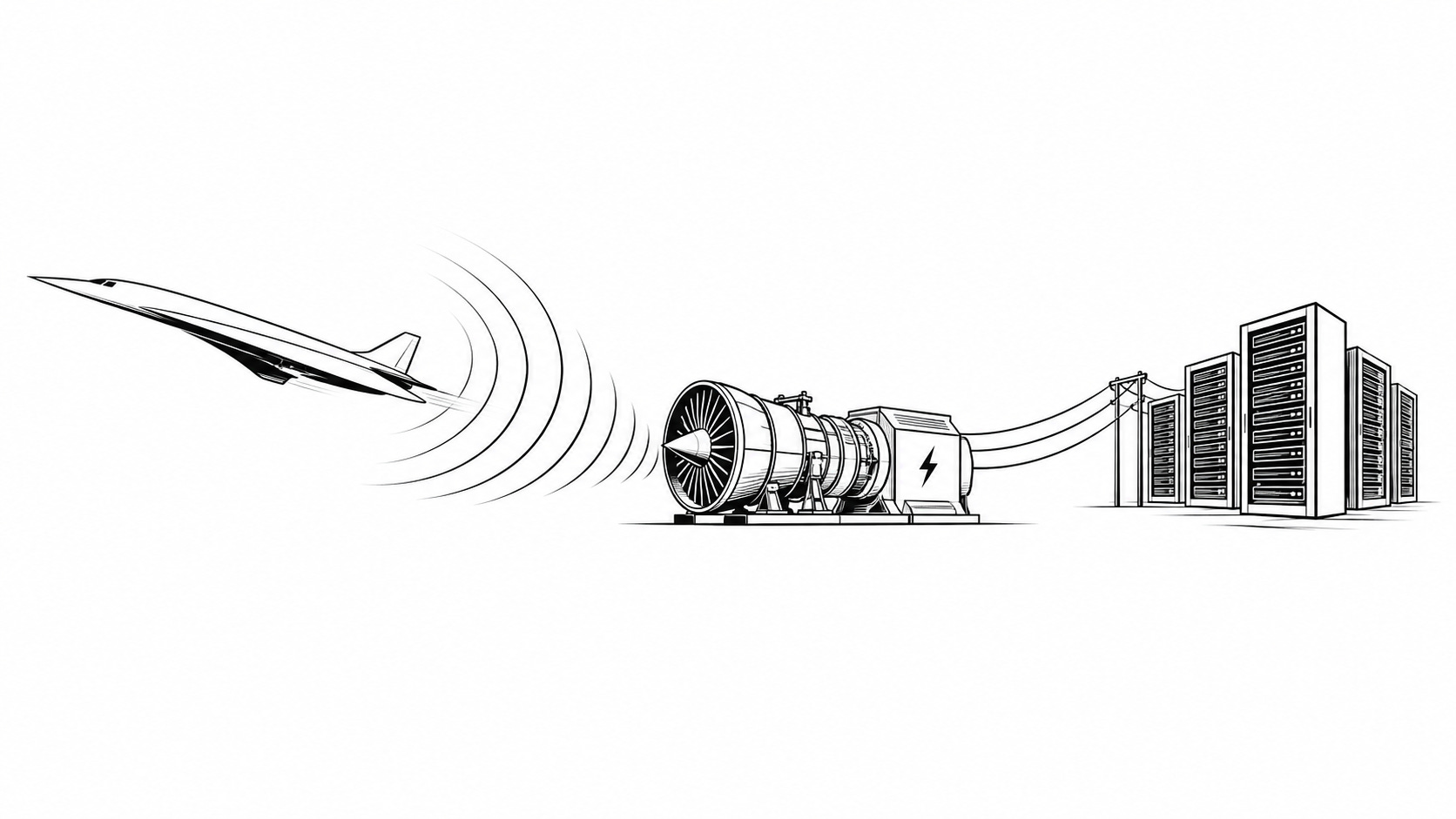
Now imagine taking essentially that same engine core, but instead of using it to move an aircraft forward, you want to use it to produce electricity.
You keep: Air → Compressor → Combustion → Turbine
But instead of using the remaining energy to move the aircraft, you add another turbine designed to recover this mechanical energy.
That turbine is connected to a shaft.
The shaft turns a generator.
And the generator produces electricity.
Boom has created a similar solution called Superpower.
Of course, Superpower is not simply an aircraft engine.
I went through this explanation so that you can understand just how closely related the underlying technologies are.
And this is why it actually makes sense for a company like Boom Supersonic to develop something like this.
They have not suddenly changed industries.
The core of their business is still building the next generation of commercial supersonic aircraft.
But Symphony — the aircraft engine — and Superpower — the system designed to generate electricity — share around 80% of their hardware.
They also share the same high-pressure compressor and high-pressure turbine.
The low spool is slightly modified.
Where Symphony uses its large titanium fan to produce thrust, Superpower adds two additional compression stages and then a three-stage free power turbine, connected to an independent electrical generator.
The fuel injectors are also different:
Jet A / SAF for the aircraft,
natural gas for Superpower.
And of course, the reason Boom is now offering a solution to generate electricity is AI data centers.
As you already know if you have been reading Macro Notes, demand for data centers has exploded with the emergence of AI.
But at this point, you might ask why anyone would bring aircraft technology into this market when turbines capable of doing something similar have already existed for years.
GE Vernova, Siemens Energy, Mitsubishi, Baker Hughes and others obviously did not wait for Boom.
But aircraft engines have several interesting characteristics.
They have to produce enormous amounts of power in very little space and with very little weight.
That creates very high power density.
They also need to withstand extremely high temperatures.
They need to be able to change their power output quickly.
And aerospace technology has been pushed extremely far in areas such as materials, compressor aerodynamics, blade cooling and control systems.
That is actually why an entire category of ground-based turbines already exists:
aeroderivative gas turbines.
GE Vernova is probably the best example.
Its LM2500 comes from aircraft-engine technology and produces around 35 MW in its LM2500XPRESS version.
Crusoe has already ordered 29 units, representing close to 1 GW of power capacity for its data centers.
Each package arrives around 95% factory assembled and can start in roughly five minutes.
So: Boom is not inventing the concept of using aircraft-engine technology to generate electricity.
This is already an existing industry.
What Boom is trying to do is build a new generation of aeroderivative turbine around an engine architecture it was already developing for Overture.
And to simplify, Superpower is not really trying to create the cheapest electricity possible.
There are other solutions that are much more interesting if your only objective is to minimize the cost of electricity.
Instead, Boom is trying to solve another problem that has become critical for AI:
getting a very large amount of MW, very quickly, directly where the data center needs them.
I think this is the most important part of this edition.
A traditional data center may consume a few dozen MW.
The new generation of AI campuses can require hundreds of MW, and in some cases more than 1 GW.
And most importantly, this demand is concentrated in one location.
That is very different from 1 GW of electricity demand spread across millions of households.
Here, you can have a single campus saying:
“I need another 500 MW here, in this exact location, ideally within the next two years.”
The IEA estimates that global data-center electricity consumption could rise from around 485 TWh in 2025 to roughly 950 TWh by 2030, while electricity consumption from data centers specifically related to AI could roughly triple.
In the United States, data centers could represent close to half of total electricity-demand growth through 2030.
So the problem is not simply:
“The world needs to produce more electricity.”
It is more specifically:
“We need to deliver enormous amounts of electricity to a few very specific locations, very quickly.”
And that is much harder.
Of course, this electricity can be more expensive.
But that is simply part of the supply-and-demand equation.
If you have already spent billions of dollars building an AI campus, installing GPUs, networking equipment and cooling systems, getting access to power quickly can be far more important than getting the absolute cheapest possible electricity.
There are also several other interesting points.
The natural gas used by these systems is already widely available in many of the regions where data centers are being built.
And gas can provide continuous power, which is obviously important for data centers designed to operate 24 hours a day.
Superpower is also relatively compact.
And aircraft-engine technology is naturally designed to operate in very high-temperature environments, which can also be useful for power generation.
Boom claims that Superpower can maintain its full 42 MW output at temperatures above 110°F, or roughly 43°C, without using water.
In short, what I found extremely interesting while researching Boom is that it gives us a way to understand two different subjects at the same time.
On one side, the return of supersonic travel and the challenges involved in making high-speed commercial aviation economically viable.
But on the other side, it shows how a startup building aircraft engines can end up developing a product that directly addresses one of the biggest emerging problems in AI infrastructure.
And for Boom itself, this potentially makes the business model much more viable.
Overture has not launched yet.
Building a commercial aircraft takes time.
Regulation has also started evolving as Boom works on solutions around the sonic-boom problem.
But aviation obviously remains a highly regulated industry — and fortunately so.
For a company like Boom, having a potentially very profitable secondary market for a large part of the technology it is already developing is therefore very good news.
The Premium Edition: The Next AI Infrastructure Trade
Today’s edition is free and open to everyone.
But while researching Boom, we also started building a new index on Altis.finance around the larger investment thesis behind this story.
Because the interesting part is not simply Boom.
Boom is private.
The bigger opportunity is the infrastructure being built around the same problem:
AI companies are able to deploy compute faster than the electric grid can deliver the power required to run it.
And that opens a completely new layer of the AI infrastructure trade.
In the Premium edition coming in the next few days, I’ll go much deeper into this thesis and share the full index we built around it.
We’ll look at the public companies positioned across the entire private-power stack — from gas turbines and distributed generation to electrical equipment, power distribution, cooling and the infrastructure required to bring those megawatts all the way to the GPU.
I’ll also share:
the full Altis.finance index built around the thesis;
the trade history and performance behind it;
the companies already in the portfolio and why each position is there;
the new trades and positions we are currently considering;
which parts of the value chain I think have the strongest exposure to time-to-power;
and the major risks that could invalidate the thesis.
The broader idea is simple:
For the first phase of the AI boom, everyone focused on the chips.
Then came networking, memory, optics and cooling.
Now the bottleneck is moving again.
And this time, it may be moving all the way into power generation itself.
Macro Notes Premium and Founding members will receive the full research and portfolio update in the next few days.
Go Deeper With Macro Notes
Macro Notes is built around a simple idea:
identify structural changes early, understand where the bottlenecks are moving, and find the companies positioned to benefit before those themes become obvious.
The free newsletter will always remain an important part of what we do.
But most of the work happens after the initial idea.
That is what Macro Notes Premium and Founding are built for.
Macro Notes Premium — $500/year
Premium is where we turn the themes discussed in the newsletter into actual investment research.
Premium members get access to:
Full Premium research
Deeper investment theses, company analysis, industry mapping, and follow-up research on the themes we introduce in the free newsletter.
Our Altis.finance indexes
Instead of publishing a thesis once and forgetting about it, we track many of our ideas through live indexes on Altis.finance.
You can see the companies behind each thesis, the trades we record, how the thesis evolves over time, and the performance of the index.
Portfolio updates and new positions
When we add a new company, reduce a position, identify a new part of the value chain, or materially change our view on a thesis, Premium members get the update.
Access to Altis.finance Premium
Macro Notes Premium includes access to the research tools and indexes we publish on Altis.finance.
The goal is to move beyond simply reading research.
You can actually follow how an investment thesis develops over time.
Macro Notes Founding — $1,200/year
Founding includes everything in Macro Notes Premium.
But it is designed for readers who want to go much further and use the same research infrastructure we are building internally.
The biggest difference is Altis.finance Agents and Radar.
Founding members receive:
10,000 Altis Agent & Radar credits every year
These credits can be used to research companies, industries, emerging investment themes and, increasingly, to turn an idea directly into a structured investment thesis.
And this is becoming one of the most important parts of Altis.
Introducing the New Altis.finance Radar
We originally built Radar to help answer a difficult question:
What investment themes are beginning to emerge around a specific trend, company, technology or event?
But we are taking the product much further.
The new version of Radar doesn’t simply return a list of companies.
It can research the underlying theme and begin building complete draft indexes around the opportunities it identifies.
Imagine asking:
What are the second-order beneficiaries of the electricity bottleneck created by AI data centers?
Radar first researches the problem.
It looks for the different investment theses hidden underneath it.
For example, it might identify: on-site gas generation, electrical equipment, grid bottlenecks, data-center cooling, natural-gas infrastructure or other adjacent opportunities.
But instead of stopping there, Radar can turn those themes into draft indexes.
For each thesis, it can generate:
A name and clear investment thesis
An explanation of exactly what structural change the index is trying to capture.
Suggested companies
The public companies with the strongest exposure to that specific thesis.
Suggested trades
Potential entries and changes based on the development of the thesis.
Historical event-based trades
Radar can research when important events around the thesis actually occurred and reconstruct how an index could have evolved through those events, while checking historical dates and prices.
A generated performance chart
So you can immediately visualize how the thesis would have behaved historically.
And Radar can present different ways of approaching the same opportunity.
For example:
Early
Companies positioned before the thesis is broadly reflected in fundamentals.
Balanced
A combination of established beneficiaries and earlier-stage exposure.
Late
Companies where the theme is already more visible in revenue, orders or earnings.
The result is not simply an AI answer.
It becomes a draft investment framework that you can research, edit and eventually turn into your own Altis index.
From a Question to an Investment Thesis
This is the direction we want Altis to move toward.
Today, doing serious thematic research normally means jumping between:
Google, earnings calls, company filings, news, spreadsheets, charts, and portfolio software.
Radar is being built to compress that process.
You start with a question:
“Who benefits if AI data centers increasingly generate their own electricity?”
Radar researches the theme. ↓
Identifies the bottlenecks. ↓
Maps the value chain. ↓
Finds the companies exposed to each part. ↓
Researches the important historical events. ↓
Builds potential indexes. ↓
Suggests trades. ↓
And gives you a structured starting point for deeper research.
The objective is not for AI to make the investment decision for you.
It is to dramatically reduce the amount of time required to go from:
“This trend looks interesting.”
to:
“I understand the thesis, the value chain, the public companies exposed to it, and how I could track it.”
That is where I think Radar becomes genuinely valuable.
Premium or Founding?
If you mainly want to read our research, follow our investment theses and access the indexes we build, Macro Notes Premium is the right plan.
Macro Notes Premium — $500/year
If you want everything in Premium but also want to use Altis as your own research platform, explore investment ideas with Agents, and use the new Radar to discover and build theses yourself, Founding is designed for that.
Macro Notes Founding — $1,200/year
Founding includes 10,000 Agent & Radar credits every year, alongside full access to Macro Notes Premium and Altis.finance.
We are increasingly building Macro Notes and Altis as two parts of the same product:
Macro Notes helps you discover the themes we are researching.
Altis helps you follow them, test them, and increasingly discover new ones yourself.