

For most of the AI boom, the bottleneck was easy to identify.
GPUs.
Companies wanted far more computing power than Nvidia and the semiconductor supply chain could provide. Prices rose, hyperscalers rushed to secure capacity, and investors focused almost entirely on the accelerator layer.
But over the past year, another bottleneck has quietly become much more important.
Memory.
And the reason is structural.
GPUs perform the calculations, but an AI system needs several additional layers around them to continuously feed, process and retain data.
A simplified AI infrastructure stack looks like this:
AI accelerator
      ↓
HBM
Feeds enormous amounts of data directly into the GPU
      ↓
Server DRAM
Holds active workloads, model states and temporary data
      ↓
Enterprise SSDs
Provide fast access to datasets, embeddings and inference context
      ↓
Mass-capacity HDDs
Store huge volumes of checkpoints, logs, video and historical data cheaply
Each layer solves a different problem.
HBM is the fastest and most strategically important.
Modern accelerators need extraordinary memory bandwidth because having a powerful GPU is useless if data cannot reach it quickly enough.
And each generation of AI accelerator is using more HBM.
That creates an unusual problem for the memory industry.
HBM is manufactured using many of the same underlying semiconductor resources as conventional DRAM, but it consumes substantially more capacity per unit of usable memory.
So when manufacturers such as Micron, SK Hynix and Samsung allocate more production toward HBM, they are not simply creating additional AI memory.
They are also reducing the effective capacity available for conventional server and consumer DRAM.
That is the first bottleneck.
Then comes storage.
AI models continuously create and consume enormous datasets.
Training requires data.
Inference generates new data.
AI agents retain context.
Video models produce enormous files.
Models create checkpoints that need to be saved.
Not all of this information needs expensive ultra-fast storage.
Frequently accessed datasets are increasingly stored on enterprise SSDs, which creates demand for NAND flash.
But the enormous volume of colder data still needs the lowest possible cost per terabyte.
That is why high-capacity hard drives, a technology many investors expected SSDs to eventually replace, have unexpectedly become another beneficiary of the AI infrastructure boom.
The result is that AI demand is now pulling on almost every major layer of the memory and storage supply chain at the same time:
More AI compute
      ↓
More HBM per accelerator
      ↓
Less effective DRAM capacity
      ↓
Higher server memory demand
      ↓
More active data → Enterprise SSD demand
      ↓
More retained data → HDD demand
And unlike software, none of these industries can instantly add supply.
Memory fabrication plants cost billions of dollars.
They take years to build.
New processes need to be qualified.
Enterprise SSDs must pass demanding customer tests.
Hard-drive manufacturers need years to transition toward new technologies such as HAMR.
So demand can move much faster than capacity.
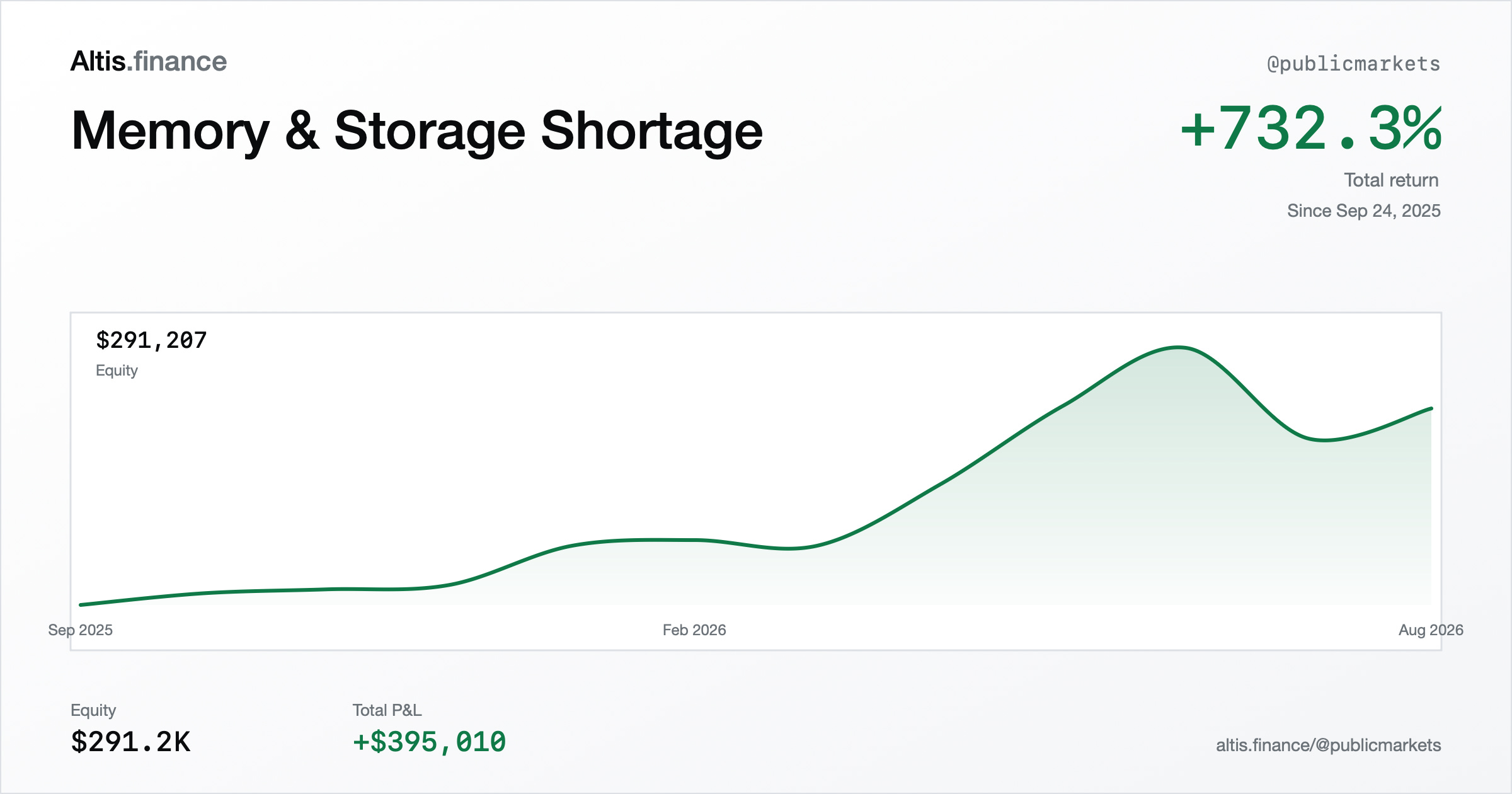
That imbalance was the core observation behind our Memory & Storage Shortage portfolio.
We first started investing around this idea in September 2025 through Public Markets and documenting the positions on Altis Terminal.
At the time, the thesis was relatively simple:
AI infrastructure was creating data and consuming memory faster than the physical supply chain could expand.
Since then, the portfolio has returned +732%.
But something more interesting is happening now.
The shortage is beginning to escape the semiconductor industry.
Nvidia’s latest results showed that AI demand remains extraordinarily strong, with data-center revenue more than doubling from a year earlier.
Yet Nvidia is now also dealing with rising memory and component costs that are expected to pressure margins.
SK Hynix, one of the world’s largest memory manufacturers, now believes the global memory shortage could persist through 2030.
And despite enormous new investments in capacity, memory prices continue to rise.
TrendForce currently expects conventional DRAM contract prices to increase another 13–18% quarter over quarter, while NAND prices are expected to rise 10–15%.
Those increases are much slower than earlier this year.
But prices are still rising from already extraordinary levels.
And that matters because DRAM and NAND are not only used inside AI servers.
They are inside:
PCs.
Smartphones.
Cloud infrastructure.
Networking equipment.
Cars.
Industrial systems.
And increasingly almost every device with meaningful computing power.
This is where the thesis begins to change.
Initially, AI created an investment opportunity for the companies supplying memory.
Now, rising memory prices are becoming an input cost for everyone else.
PC manufacturers either absorb the higher costs and lose margin, or increase prices.
Smartphone manufacturers face the same decision.
Cloud providers need more expensive infrastructure.
Networking equipment becomes more costly.
Even Nvidia — arguably the company with the greatest pricing power in the entire AI supply chain — is beginning to feel the effect.
We may therefore be entering the next chapter of the AI infrastructure boom:
AI is no longer simply increasing the price of computing. It is beginning to increase the price of everything that needs memory.
And that raises a much more difficult question for investors.
The shortage remains real.
But after memory and storage stocks have already appreciated several hundred percent, is the investment opportunity still as attractive as the underlying industry thesis?
This week, we are going back through the portfolio that originally positioned us for this shortage to understand what has changed, which parts of the supply chain remain structurally constrained, where new capacity is beginning to appear, and where we would allocate capital today.
Premium members can follow the thesis in real time
Macro Notes Premium is not limited to the editions we publish here.
Your subscription also includes access to Altis Terminal, where you can follow the Memory & Storage Shortage portfolio in real time — including its positions, trade history, performance and future updates.
Altis Terminal currently includes more than 100 live portfolios covering investment theses published across Macro Notes, Public Markets and our other research newsletters.
Premium members also receive:
Access to the complete Macro Notes archive.
Every future Premium edition.
Access to our live portfolios and their ongoing updates.
More than 100 investment theses organized and tracked inside Altis Terminal.
Macro Notes Premium is currently $300 per year until the end of this week.
We will be updating the subscription price after that.
If you subscribe before the increase, your $300 annual price will remain locked for as long as you stay subscribed.
Subscribe today to unlock the full edition and access the Memory & Storage Shortage portfolio on Altis Terminal.
In the Premium section, we will look at:
Why the memory shortage could remain structural for several more years.
How HBM production is affecting conventional DRAM and NAND supply.
What Nvidia’s latest results tell us about memory costs and AI infrastructure margins.
Why the shortage is now beginning to affect PCs, smartphones and other hardware markets.
A complete update of our Memory & Storage Shortage portfolio, including the positions that drove its +732% return.
The trades we have already reduced after exceptional reratings.
Which companies still appear best positioned to benefit from the shortage.
Where valuations and expectations may now have gone too far.
And most importantly, where we would allocate new capital today.